Evidence-aware field notes for the moments when ordinary stress advice feels too small for the conditions you are actually living and working in.
By Hailey MorganUpdated November 202628 min read
The difference in one minute
Stress is the wider category. It can arise at work, at home, in school, during caregiving, in financial uncertainty, or during an important conversation. It may be short-lived or persistent. Occupational burnout is narrower: WHO uses the term for phenomena in the occupational context and describes it through three dimensions rather than through a simple tiredness checklist. [1]
A stressful project deadline can produce urgency, muscle tension, trouble settling down, and temporary concentration difficulty. If the deadline passes and the person can reconnect with their work and recover, that experience may remain acute stress. A worker who repeatedly feels depleted by work, increasingly distant or cynical about the job, and less effective may be dealing with an occupational pattern that deserves closer attention. The comparison is not a diagnosis.
Dimension
Stress
Chronic stress
Occupational burnout
General definition
A broad psychological and physiological response to demands.
Persistent or recurring exposure to demands with cumulative burden.
Work-related phenomenon tied to chronic workplace stress that has not been successfully managed.
Occupational specificity
May occur at work or outside work.
May arise in many life contexts.
WHO uses the term specifically for the occupational context.
Typical pattern
Often linked to an identifiable demand and may ease when it changes.
May continue when demands or uncertainty remain.
Often involves exhaustion plus mental distance/cynicism and reduced professional efficacy.
Recovery opportunities
A pause, problem-solving, support, or sleep opportunity may help.
Recovery may be incomplete when the stressor remains.
Time away may help, but unchanged work conditions can recreate the difficulty.
Organizational lens
Ask whether workload, control, role clarity, support, and fairness fit the job.
Examine sustained work design and recovery opportunities.
Work redesign and safer conditions matter alongside personal support.
Professional support
Appropriate when distress is persistent, severe, or confusing.
Appropriate when functioning, sleep, mood, or health are affected.
Appropriate when difficulties persist or overlap with other health concerns.
What is stress?
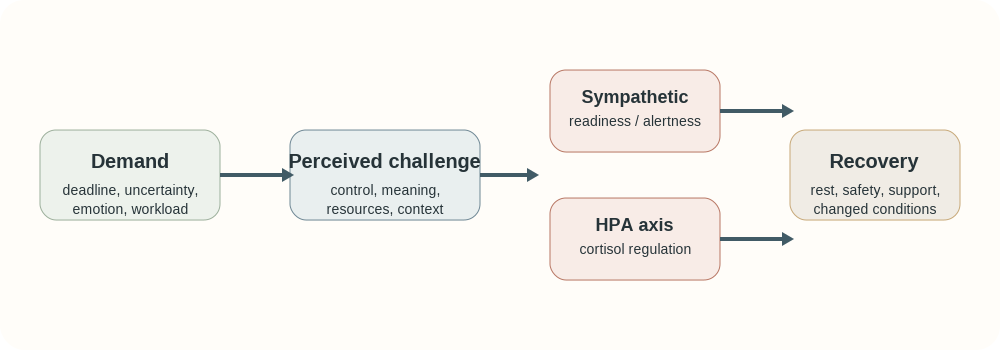
Stress is a response to demands that a person perceives as challenging, uncertain, threatening, important, or difficult to control. The response can include changes in attention, emotion, muscle tension, heart rate, sleep, energy, and behavior. People do not respond identically to the same situation. Health, past experiences, access to support, financial pressure, work control, discrimination, caregiving, and the perceived ability to leave or change the situation all matter.
Stress is not always harmful. A short period of activation can support attention or preparation. But it is also misleading to divide biology into “good stress” and “bad stress” as if all bodies respond the same way. A demand that is manageable with clear expectations and adequate resources can feel very different from a demand that is unpredictable, unsafe, or impossible to complete with the available time.
What is occupational burnout?
The WHO ICD-11 definition is precise: “Burn-out is a syndrome conceptualized as resulting from chronic workplace stress that has not been successfully managed.” It is characterized by feelings of energy depletion or exhaustion; increased mental distance from one’s job, or feelings of negativism or cynicism related to one’s job; and reduced professional efficacy. WHO places burnout in the ICD-11 chapter on factors influencing health status or contact with health services, and states that it is not classified as a medical condition. [1]
This does not make the experience trivial. A phenomenon can be serious, distressing, and functionally disruptive without being classified as a medical condition in ICD-11. A clinician can still assess symptoms that overlap with depression, anxiety, sleep disorders, physical illness, or other health concerns.
Acute stress, chronic stress, and occupational burnout
Acute stress
What it means: Short-term response to an identifiable demand or event.
Example: A deadline, unexpected event, difficult conversation, or exam.
Helpful direction: Name the demand, make a practical adjustment, and allow recovery if possible.
Chronic stress
What it means: Persistent or recurring exposure to demands or uncertainty.
Helpful direction: Look beyond coping skills to resources, boundaries, safety, and professional support.
Occupational burnout
What it means: WHO occupational phenomenon associated with chronic workplace stress not successfully managed.
Example: Work-related exhaustion, increased mental distance or cynicism, and reduced professional efficacy.
Helpful direction: Consider work redesign, support, health assessment, and safer organizational conditions.
The human stress response
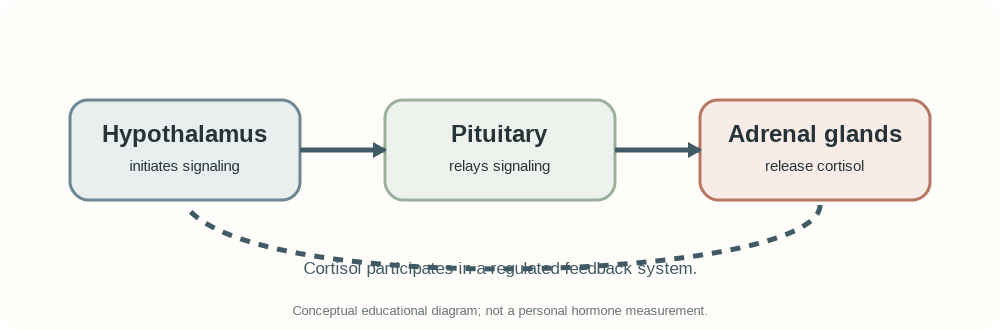
Conceptual illustration, not a personal measurement. People can respond differently to the same demand.The HPA axis is a coordinated regulatory system. It is not a simple on/off switch and does not provide a personal burnout score.
Normal physiology
Cortisol has useful jobs
Cortisol participates in daily rhythms, energy regulation, immune signaling, and responses to demands. It is not a toxin to eliminate.
Measurements depend on timing, sample type, context, medications, sleep, illness, and individual variation.
Myth correction
One test cannot label burnout
Research on cortisol and occupational stress is mixed and context-dependent. A single home result cannot establish burnout, and “adrenal fatigue” is not an established medical diagnosis.
The World Health Organization identifies three key dimensions in its ICD-11 framework:
01
Energy depletion or exhaustion
Persistent work-related exhaustion and reduced perceived energy. Exhaustion alone does not establish burnout.
Workplace context: A demanding schedule, insufficient staffing, long availability expectations, or inadequate recovery can contribute.
Important uncertainty: A reader cannot establish a diagnosis from one dimension or a checklist.
02
Increased mental distance from work
Psychological disengagement, negative feelings, or cynicism related to the job. Healthy boundaries are not automatically burnout.
Workplace context: Role conflict, unfair treatment, values conflict, and repeated disappointment can shape the relationship with work.
Important uncertainty: A reader cannot establish a diagnosis from one dimension or a checklist.
03
Reduced professional efficacy
A reduced sense of effectiveness or accomplishment. Perceived efficacy is not identical to measured job performance.
Workplace context: Insufficient resources, unclear expectations, poor feedback, and compensatory effort can affect confidence and perceived capability.
Important uncertainty: A reader cannot establish a diagnosis from one dimension or a checklist.
Workplace conditions and the Six Areas of Worklife
Research by Christina Maslach and Michael Leiter identifies six areas of organizational environment where mismatches between employee and workplace occur:
Workload
The fit between demands, time, staffing, and recovery opportunity.
Example: A team repeatedly fills vacancies with unpaid overtime.
Improvement: Review priorities, staffing, deadlines, and what can be stopped.
Control
Appropriate autonomy and participation in decisions that affect the work.
Example: A worker is accountable for outcomes but cannot adjust sequence or resources.
Improvement: Increase clarity, voice, flexibility where feasible, and decision latitude.
Reward
Recognition, compensation, feedback, and whether the exchange feels adequate.
Example: Extra responsibility is treated as invisible or assumed.
Improvement: Make contributions visible and review compensation and feedback systems.
Community
Workplace relationships, support, belonging, and conflict.
Example: A person cannot ask for help without ridicule or retaliation.
Improvement: Build trusted relationships, respectful communication, and routes for conflict repair.
Fairness
Consistent processes, respect, and equitable treatment.
Example: Rules are applied differently depending on who asks.
Improvement: Make decisions transparent and address discrimination or harassment through safe channels.
Values
Alignment or conflict between personal values and organizational practices.
Example: A role repeatedly rewards behavior that conflicts with professional ethics.
Improvement: Clarify expectations, invite worker voice, and address structural value conflicts.
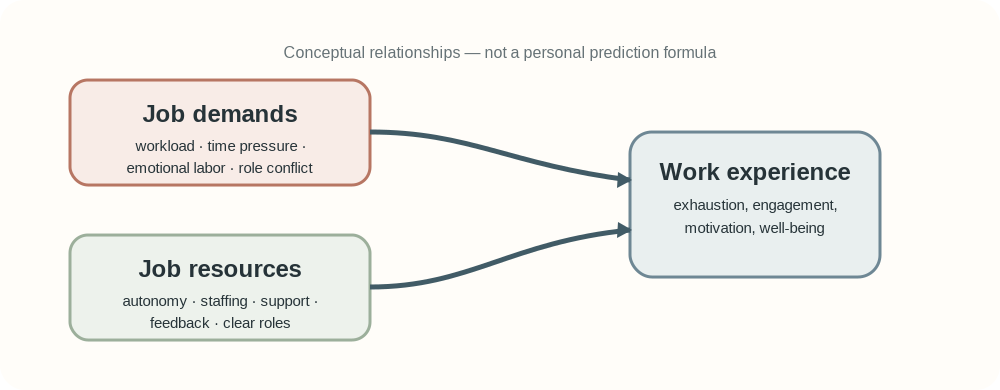
The JD-R model is a conceptual framework, not a formula that predicts burnout for every person.
Burnout, depression, anxiety, and mental exhaustion
Occupational burnout shares symptoms with several clinical conditions, which is why professional evaluation is vital when symptoms persist:
Experience
General meaning
Possible context
Appropriate next step
Occupational burnout
Work-related phenomenon with WHO dimensions.
May center on job conditions but can affect life outside work.
Workplace review plus qualified assessment when persistent or disruptive.
Depression
Recognized mental-health condition with persistent mood, interest, cognitive, physical, and functional symptoms that require clinical assessment.
May affect several areas of life, not only work.
Qualified medical or mental-health evaluation.
Anxiety
Ordinary worry can be a normal response; anxiety disorders require clinical assessment of pattern, distress, and impairment.
May be work-related, broader, or both.
Qualified assessment rather than one symptom or appearance.
Mental exhaustion
Broad everyday phrase for cognitive or psychological fatigue.
Can follow sustained attention, emotional labor, sleep loss, illness, or many other demands.
Consider sleep, health, work, and personal context; seek care for persistent or concerning symptoms.
Individual self-care and organizational responsibility
Problem
Individual adaptation
Team intervention
Organizational intervention
Limitation
Unclear priorities
Write the competing tasks in one place.
Agree on priority order.
Design a workload and deadline process.
Individual clarity cannot solve understaffing.
After-hours availability
Silence nonessential notifications when safe.
Set shared communication expectations.
Define urgent-contact procedures and staffing.
Boundaries may carry employment risk.
Insufficient recovery
Protect an available break or sleep opportunity.
Coordinate coverage.
Protect breaks, leave, and realistic schedules.
A break cannot compensate for chronic overload.
Low support
Identify a trusted person or professional.
Create peer support routes.
Resource managers and workers; address retaliation.
Disclosure should be proportionate and safe.
Harassment or unfairness
Use the safest available documentation/support route.
Interrupt harmful behavior and signpost resources.
Investigate and prevent harm through policy and accountability.
Personal resilience is not a remedy for misconduct.
Interactive tools and practical planning
Interactive / educational only
Stress & Occupational Burnout Awareness Guide
This short guide helps you identify which explanations and support routes may be relevant. It does not calculate risk, diagnose burnout, or store answers.
No answer is sent to a server, saved to storage, or added to analytics.
Interactive / no data stored
Workload, Boundaries & Recovery Planner
Use this to organize a workload conversation and a flexible recovery opportunity. It does not determine a medical condition or give individualized legal advice.
Prefer a private conversation · No employer names, income records, medical records, or answers are collected.
Workplace boundary scripts
Neutral, copyable scripts you can adapt for setting sustainable workload boundaries:
Clarifying competing priorities
I currently have several tasks with overlapping deadlines. Could we review which should take priority and agree on realistic delivery dates?
Requesting workload support
My current workload is difficult to sustain. Could we discuss whether some responsibilities can be reassigned, simplified, or rescheduled?
Establishing availability
I will be available during the agreed working hours. For genuinely urgent matters outside those hours, could we establish a clear communication process?
Requesting a private conversation
I would appreciate a private discussion about my current workload and some difficulties I have been experiencing. I would like to explore practical adjustments that could help.
Clarifying added responsibilities
I can take on this responsibility, but we may need to adjust one of my existing commitments. Which task would you prefer me to prioritize?
Asking household members for support
I have been feeling particularly exhausted after work. Could we review how to share some of the household responsibilities this week?
Workplace rights and practical support in the US
Internal routes
Depending on safety and policy, options may include a manager, human resources, occupational health, an employee assistance program, a union, or a worker representative. Ask about confidentiality before sharing details.
US legal information
The ADA, FMLA, state law, employer size, eligibility, medical documentation, and job circumstances can change what applies. Burnout does not automatically qualify someone for leave or accommodation.
If the workplace is unsafe, retaliation is a concern, or discrimination may be involved, consider a qualified employment professional, worker representative, or official agency resource. This page is not individualized legal advice.
There is no universal “quit” answer. Consider immediate safety, health, support, benefits, savings, dependents, access to care, possible workplace changes, and the risks of staying or leaving.
Practical recovery and flexible routines
1 / 5–10 min
Review essential priorities
Purpose: Reduce immediate cognitive load.
Adaptation: Use paper or a free notes app.
2 / 5–15 min
Clarify one unclear responsibility
Purpose: Reduce ambiguity.
Adaptation: Ask in writing if that feels safer.
3 / 2–5 min
Postpone a nonessential task
Purpose: Create a small margin.
Adaptation: Only where consequences are manageable.
4 / 10–30 min
Reduce task switching
Purpose: Protect attention.
Adaptation: Close nonessential tabs or alerts.
5 / 5–20 min
Ask for practical assistance
Purpose: Share a concrete load.
Adaptation: Choose a person with appropriate access.
6 / 1–5 min
Sit comfortably
Purpose: Reduce physical discomfort.
Adaptation: Adapt for pain, disability, or mobility needs.
7 / 5–15 min
Take an appropriate break
Purpose: Step away from demand.
Adaptation: Follow workplace safety and coverage rules.
8 / 5–10 min
Adjust seating
Purpose: Support physical comfort.
Adaptation: Use existing items; do not treat as medical care.
9 / 2–5 min
Review hydration needs
Purpose: Attend to a basic need.
Adaptation: Individual needs and medical restrictions vary.
10 / 10–30 min planning
Protect sleep opportunity
Purpose: Support recovery capacity.
Adaptation: Sleep opportunity is not a promise of sleep.
11 / 5–15 min
Pause a demanding task
Purpose: Reduce cognitive load.
Adaptation: Return only if and when practical.
12 / 2–5 min
Reduce notifications
Purpose: Create a quieter environment.
Adaptation: Keep important safety alerts accessible.
13 / 10–30 min
Read for pleasure
Purpose: Offer low-demand leisure.
Adaptation: Choose readable formats and lighting.
14 / 10–30 min
Enjoy a familiar activity
Purpose: Create gentle recovery.
Adaptation: No achievement requirement.
15 / 5–60 min
Step away from work information
Purpose: Support detachment.
Adaptation: May not be possible for all roles.
16 / 10–30 min
Speak with a trusted person
Purpose: Add social support.
Adaptation: Do not share more than feels safe.
17 / 15–60 min
Contact a professional
Purpose: Explore qualified support.
Adaptation: Access, cost, and wait times vary.
18 / 10–60 min
Enjoy supportive connection
Purpose: Reduce isolation.
Adaptation: Connection can also be tiring; choose what fits.
19 / 5–60 min
Spend comfortable time alone
Purpose: Reduce social demand.
Adaptation: Not a substitute for support when unsafe.
20 / 5–15 min
Write an optional reflection
Purpose: Organize concerns.
Adaptation: Do not force tracking or scoring.
21 / 2–10 min
Adjust lighting
Purpose: Reduce environmental strain.
Adaptation: Consider visual needs and safe illumination.
22 / 5–20 min
Reduce unnecessary noise
Purpose: Support sensory comfort.
Adaptation: Stay aware of important sounds.
23 / 5–15 min
Create a resting area
Purpose: Make rest easier to access.
Adaptation: Use what is already available.
24 / 5–30 min
Spend time outdoors
Purpose: Change environment if accessible.
Adaptation: Weather, mobility, and safety matter.
25 / 5–20 min
Organize essential materials
Purpose: Reduce friction.
Adaptation: Stop if organizing becomes another demand.
26 / 5–30 min
Listen to enjoyable music
Purpose: Offer meaningful leisure.
Adaptation: Keep volume comfortable.
27 / 10–60 min
Revisit a hobby
Purpose: Reconnect with interest.
Adaptation: It does not need to become productive.
28 / 10–60 min
Enjoy selected entertainment
Purpose: Provide an accessible pause.
Adaptation: Choose content that feels supportive.
29 / 5–15 min
Identify one adjustment
Purpose: Prepare a practical request.
Adaptation: Organizational approval may be needed.
30 / 5–60 min
Rest without productivity
Purpose: Allow recovery without earning it.
Adaptation: A valid option even when tasks remain.
Flexible window
5 minutes
Pause notifications if safe, unclench your body, name one immediate demand, or simply sit.
No routine guarantees a specific amount of stress reduction or burnout recovery.
Flexible window
15 minutes
Step away from work information, drink water if appropriate, listen to music, or have a short supportive conversation.
No routine guarantees a specific amount of stress reduction or burnout recovery.
Flexible window
30 minutes
Combine comfortable rest with a low-demand activity, a practical meal, or one workload note for later.
No routine guarantees a specific amount of stress reduction or burnout recovery.
Flexible window
60 minutes
Choose any combination of rest, leisure, personal care, support, and optional sleep preparation. You may spend the entire hour resting.
No routine guarantees a specific amount of stress reduction or burnout recovery.
Busy office professional
Priority review, a realistic break, one boundary, and an evening transition without productivity demands.
No-cost version: Use a paper note, existing quiet space, free support, or a short pause.
Remote worker
Separate work and personal spaces where possible, clarify communication windows, and use a brief work-to-home ritual.
No-cost version: Use a paper note, existing quiet space, free support, or a short pause.
Emotionally demanding worker
Use available peer or occupational support, protect decompression where possible, and consider professional care.
No-cost version: Use a paper note, existing quiet space, free support, or a short pause.
Freelancer or entrepreneur
Set client expectations, review the workload pipeline, and account for financial constraints before changing commitments.
No-cost version: Use a paper note, existing quiet space, free support, or a short pause.
Shift worker
Protect a realistic sleep opportunity, plan recovery around the schedule, and use available workplace resources.
No-cost version: Use a paper note, existing quiet space, free support, or a short pause.
Working parent or caregiver
Share responsibilities where possible, choose flexible recovery, and lower the expectation that every day must look the same.
No-cost version: Use a paper note, existing quiet space, free support, or a short pause.
Seven-day awareness framework
This is for awareness and planning, not treatment. Do not delay necessary care to complete it.
Optional stage
Week 1 — Awareness
Review demands, resources, recovery opportunity, and the experiences you want to understand.
This does not promise recovery within 30 days.
Optional stage
Week 2 — Practical adjustments
Explore manageable changes to priorities, communication, and unnecessary demands.
This does not promise recovery within 30 days.
Optional stage
Week 3 — Support and organization
Consider workplace resources, practical assistance, and qualified professional guidance.
This does not promise recovery within 30 days.
Optional stage
Week 4 — Sustainable review
Ask which changes are realistic, what remains unresolved, and what support may be appropriate.
This does not promise recovery within 30 days.
Reusable reflection worksheet
Myths versus more accurate facts
Myth 1
Stress and burnout are identical.
More accurate: Stress is broad; WHO burnout is occupational and has three dimensions.
Myth 2
Burnout is simply tiredness.
More accurate: Exhaustion is one dimension; mental distance and efficacy also matter.
Myth 3
Productive employees cannot be burned out.
More accurate: Output can be maintained through compensatory effort or fear of consequences.
Myth 4
Burnout always means depression.
More accurate: They can overlap, but neither establishes the other.
Myth 5
WHO classifies burnout as a disease.
More accurate: WHO classifies it as an occupational phenomenon, not a medical condition.
Myth 6
Every kind of life exhaustion is WHO burnout.
More accurate: WHO uses the term specifically for occupational phenomena.
Myth 7
Stress is always harmful.
More accurate: Stress can be adaptive, although persistent or overwhelming demands may be harmful.
Myth 8
Cortisol is inherently harmful.
More accurate: Cortisol has normal regulatory functions.
Myth 9
Everyone with burnout has high cortisol.
More accurate: Research is variable and measurements are context-dependent.
Myth 10
Adrenal fatigue is an established diagnosis.
More accurate: It is not an established medical diagnosis; adrenal insufficiency is different.
Myth 11
Meditation automatically cures burnout.
More accurate: A calming practice may help some people, but it cannot redesign unsafe work.
Myth 12
A vacation permanently fixes burnout.
More accurate: Time away can help while unchanged conditions can recreate the problem.
Myth 13
Exercise is always correct.
More accurate: Movement is optional and must fit health, access, schedule, and preference.
Myth 14
Burnout is caused only by weak boundaries.
More accurate: Work design, fairness, staffing, and support matter.
Myth 15
Quitting is always best.
More accurate: Safety, health, finances, benefits, and alternatives must be considered.
Myth 16
Expensive wellness products are necessary.
More accurate: No-cost recovery and workplace action may be more relevant.
Myth 17
Everyone recovers on a predictable timeline.
More accurate: Recovery depends on demands, support, health, and changes to conditions.
Myth 18
A wearable score can diagnose burnout.
More accurate: Wearables are not medical evidence of burnout.
Eight hypothetical scenarios
Scenario 1 / hypothetical
A stressful deadline
Main concern: Temporary pressure with a generally intact relationship to work.
Approach: Use acute-stress problem solving, clarify priorities, and allow recovery without labeling the week.
This is an educational example, not a clinical case or verified workplace outcome.
Scenario 2 / hypothetical
Persistent occupational exhaustion
Main concern: Recurring exhaustion with cynicism and reduced perceived efficacy.
Approach: Review WHO dimensions, conditions, support, and qualified care without self-diagnosis.
This is an educational example, not a clinical case or verified workplace outcome.
Scenario 3 / hypothetical
High-performing but exhausted
Main concern: Targets remain met through compensatory effort.
Approach: Visible productivity does not rule out distress or the need for support.
This is an educational example, not a clinical case or verified workplace outcome.
Scenario 4 / hypothetical
Vacation without lasting change
Main concern: Comfort improves away from work, then difficulties return.
Approach: Temporary relief and organizational change are different interventions.
This is an educational example, not a clinical case or verified workplace outcome.
Scenario 5 / hypothetical
Financially constrained
Main concern: Leaving feels necessary but income cannot disappear overnight.
Approach: Plan practical support and career options without pressure or risky decisions.
This is an educational example, not a clinical case or verified workplace outcome.
Scenario 6 / hypothetical
Remote and always available
Main concern: Work communication bleeds into personal time.
Approach: Clarify expected windows and urgent-contact procedures where safe.
This is an educational example, not a clinical case or verified workplace outcome.
Scenario 7 / hypothetical
Exhaustion across life
Main concern: Low mood, loss of interest, or exhaustion extends beyond work.
Approach: Qualified medical or psychological assessment may be appropriate.
This is an educational example, not a clinical case or verified workplace outcome.
Scenario 8 / hypothetical
Harassment or unfair treatment
Main concern: Distress occurs in a workplace with unsafe conduct or insufficient support.
Approach: Use the safest support channel; resilience alone does not solve misconduct.
This is an educational example, not a clinical case or verified workplace outcome.
When to seek professional attention
When qualified support may be appropriate
Consider professional evaluation for persistent or worsening exhaustion, low mood, loss of interest, severe anxiety, major sleep changes, panic-like experiences, unexplained physical symptoms, increased substance reliance, significant impairment, or persistent hopelessness. These signs can have more than one cause.
Possible routes include primary care, a licensed mental-health professional, occupational health, an employee assistance program, or a worker representative. Eligibility, cost, confidentiality, and access vary.
Personal Well-Being & Support Checklist
Supportive comfort & organization aids (Optional)
As an Amazon Associate I earn from qualifying purchases. Optional conveniences to support workload management, circadian alertness, and sensory quiet.
Task Boundaries
Clever Fox Planner PRO - Weekly Life & Work Organizer
Simple undated workload planner
No-cost alternative: Simple notebook, paper checklist, or calendar
What is the difference between stress and burnout?
Stress is a broad response to demands. Occupational burnout is a WHO-defined work-related phenomenon involving exhaustion, increased mental distance or cynicism, and reduced professional efficacy.
What is occupational burnout?
WHO describes it as resulting from chronic workplace stress that has not been successfully managed. WHO classifies it as an occupational phenomenon, not a medical condition.
Is burnout simply extreme stress?
They overlap, but burnout adds an occupational context and a particular three-dimensional framework. The terms should not be treated as interchangeable.
What are the three dimensions?
Energy depletion or exhaustion; increased mental distance from one’s job or work-related negativism/cynicism; and reduced professional efficacy.
Can chronic stress contribute to burnout?
It may contribute when workplace demands continue without successful management, recovery, or adequate resources. There is no universal timeline.
Can I be burned out and still productive?
Yes. Output can be maintained through compensatory effort, perfectionism, responsibility, financial pressure, or fear of job loss.
What does workplace cynicism mean?
It refers to negative feelings or increased mental distance related to one’s job. Protecting personal time is not automatically cynicism.
What is reduced professional efficacy?
A reduced sense of effectiveness or accomplishment. It is not identical to an objective performance rating.
Is burnout the same as depression?
No. They can overlap, and a qualified professional may be needed to assess persistent symptoms across work and life.
Is burnout the same as anxiety?
No. Worry and anxiety responses are broad; anxiety disorders require clinical assessment.
Is mental exhaustion the same as burnout?
No. Mental exhaustion is a broad everyday phrase. Burnout is specifically occupational in the WHO framework and includes more than exhaustion.
Can stress contribute to physical symptoms?
Stress may be associated with muscle tension, headaches, sleep changes, fatigue, gastrointestinal discomfort, and concentration difficulty, but other medical causes are possible.
Does burnout always increase cortisol?
No. Cortisol research is variable and measurements depend on timing, context, and individual factors.
Is adrenal fatigue a recognized medical condition?
No. Adrenal fatigue is not an established diagnosis. Adrenal insufficiency is a recognized medical condition requiring evaluation.
Can a vacation resolve burnout?
Time away may support recovery, but returning to unchanged workload, control, staffing, or relationships can recreate difficulty.
Can meditation cure burnout?
A relaxation practice may be supportive for some people, but it cannot substitute for work redesign, safety, healthcare, or organizational support.
Can self-care prevent occupational burnout?
Personal recovery matters, but prevention also depends on job design, staffing, autonomy, fairness, support, and safe conditions.
What workplace factors may contribute?
High demands, low control, role conflict, inadequate resources, poor support, unfairness, harassment, discrimination, and constant availability expectations can matter.
What is the Job Demands-Resources model?
A framework that considers how job demands relate to effort and exhaustion while job resources support motivation and engagement. It is conceptual, not a personal prediction formula.
How can managers help?
Make priorities explicit, review workload, protect recovery, provide resources, respond to concerns, and address unfairness or harassment.
How can I communicate workload concerns?
Use specific, respectful language: describe competing tasks, ask for priority order, and request a realistic adjustment. Consider safety and workplace power.
What if my workplace does not support boundaries?
Start with the safest available route, which may be documentation, a worker representative, HR, occupational health, or professional advice rather than direct confrontation.
Should I quit because of burnout?
Not automatically. Consider safety, health, finances, benefits, support, alternatives, and whether practical workplace changes are possible.
Can burnout qualify for accommodations?
Burnout alone does not automatically establish eligibility. ADA, FMLA, state law, employer coverage, medical facts, and individual circumstances matter.
How long does recovery take?
There is no universal timeline. Recovery depends on demands, support, health, recovery opportunities, and whether workplace conditions change.
When should persistent stress be evaluated?
Seek qualified assessment for worsening or persistent distress, major functional change, low mood, severe anxiety, sleep disruption, substance reliance, unexplained symptoms, or hopelessness.
When should I seek urgent crisis support?
If you may hurt yourself or someone else, cannot stay safe, or face an immediate medical emergency, call 911. In the US, call or text 988 for crisis support.
Final takeaway
Stress is broad. Occupational burnout is a work-related phenomenon described by WHO through exhaustion, increased mental distance or cynicism related to work, and reduced professional efficacy. It is not simply tiredness, a cortisol score, depression by definition, or a personal character failure.
Meaningful improvement may require personal support, healthcare, manageable work, safer conditions, fair treatment, organizational change, and realistic career planning. Reader safety and workplace responsibility should come before viral wellness claims, expensive products, productivity pressure, or a demand to become more resilient.