
The distinction
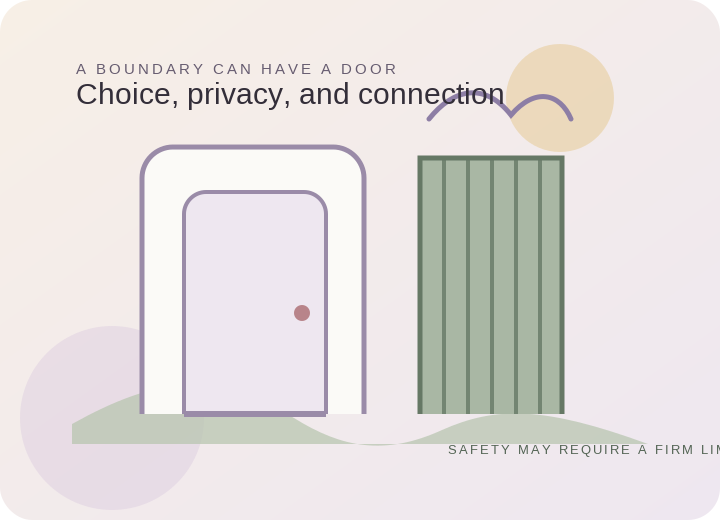
A boundary is a limit. A wall is a pattern.
The real question is not whether you are open or closed. It is whether your level of access fits your values, your relationship goals, and the safety of the situation.
A healthy boundary is about your participation. It answers: What am I comfortable with, what do I choose, and what will I do if my limit is ignored? The American Psychological Association describes a boundary as a psychological demarcation that protects integrity and sets realistic limits on participation.
“Emotional walls” is different. It is a popular, informal phrase for protective patterns such as avoiding desired closeness, withholding important needs, or refusing dependable support even when connection is wanted. It is not a recognized clinical diagnosis.
A private, introverted, independent, culturally reserved, or no-contact person is not automatically behind a wall. Distance may be the wise response to manipulation, coercion, discrimination, or abuse.
“Healthy” does not mean endlessly available. It means your choices have room to be yours.
— a calmer starting point“I’m not comfortable sharing that right now.”
Names a limit. Leaves the other person’s mind and choices their own. Can be firm, flexible, or final depending on context.
Protects choice“I want closeness, but I disappear whenever it feels real.”
Describes a mismatch between a desired relationship and a repeated protective pattern. The cause still needs context.
Notice the mismatchThe psychology
Five lenses are more useful than one label.
Use concepts as tools for reflection—not as verdicts about your personality, your partner, or your past.
Autonomy
Meaningful choice in line with your needs and values. Independence and interdependence can coexist.
Trust
Repeated evidence of reliability, respect, consent, accountability, and responsiveness. Trust is built; it is not owed.
Regulation
Noticing activation and choosing a response that fits. A pause can be regulation; so can asking for support.
Flexibility
Adjusting with context while staying connected to values. Flexibility does not mean giving up safety.
Self-compassion
Asking “What is this protecting?” instead of turning a relationship pattern into a character flaw.
Evidence note
Attachment research is dimensional, contextual, and incomplete.
Research often examines attachment-related anxiety and avoidance as broad dimensions. Reviews describe them as especially visible under certain stressors—not as constant identities. New experiences can change expectations over time. Online quizzes cannot diagnose you or explain a whole relationship.
Read the NIH-hosted review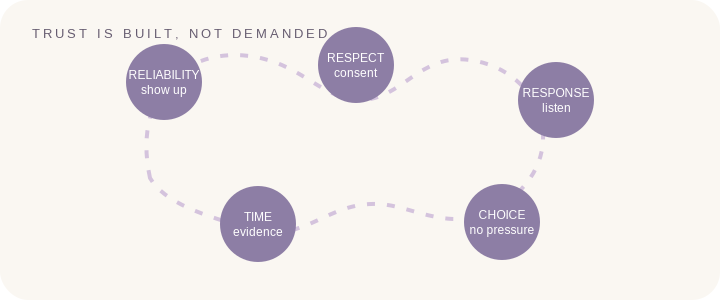
A practical map
Eight kinds of boundaries you can tune.
This is an editorial organizing system—not a standardized clinical taxonomy. Your version can look different from someone else’s.
Emotional
What you share, when you share it, and what kind of support you want.
“I’m not ready to talk about that, but I appreciate you asking.”
Physical
Personal space, touch, comfort, and bodily consent.
“I’m comfortable with a hug, not with more contact.”
Time
Availability, notice, interruptions, and room to recover.
“I can talk for 20 minutes, then I need to rest.”
Financial
Lending, shared costs, spending, and money privacy.
“I’m not comfortable lending money.”
Digital
Devices, messages, passwords, location, tags, and posts.
“Please ask before sharing a photo of me.”
Intellectual
Beliefs, opinions, disagreement, and freedom of thought.
“We can disagree without trying to win.”
Workplace
Scope, workload, availability, and professional privacy.
“Could we review which deadline should take priority?”
Sexual & relationship
Consent, privacy, and mutually negotiated expectations.
“I’m comfortable with this, but not with going further.”
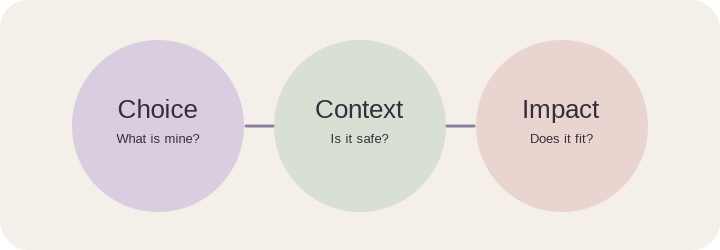
Before you set a limit
Ask what is mine, what is safe, and what fits.
Discomfort does not prove a boundary is wrong. Comfort does not prove it is healthy. Look at the relationship, power differences, practical consequences, and what you genuinely want.
Clearer language
Boundary, request, agreement, rule, or ultimatum?
These words overlap in everyday speech, but they place decision-making in different places.
An ultimatum is not automatically abusive. Context, proportionality, coercion, mutuality, and whether someone can say no without retaliation matter.
In real life
A few scripts to borrow, not perform.
You can be warm, brief, direct, professional, or choose not to communicate. These are examples—not magic words.
“I care about our relationship, and I’d prefer to talk when we can both speak respectfully.”
“I appreciate your concern, but I’d prefer to make this decision myself.”
“I value our friendship, and I’m not available every evening.”
“I can take this on if we adjust one of my existing deadlines.”
“I prefer not to share my device password or live location.”
“I need quiet time, but I appreciate your support.”
Private by design
Relationship Boundaries Reflection Guide
Use this as a low-pressure way to sort through preferences and options. It is not a psychological assessment, attachment test, abuse-risk score, or compatibility calculator.
Step 1 of 7
Which relationship context would you like to explore?
Nothing is saved. You can stop, skip, or reset at any time.
Copy, adapt, or leave it
Assertive Communication & Boundary Script Builder
Choose a context, then edit the language until it sounds like you. The output is a draft about your choices—not a promise that another person will cooperate.
You can maintain privacy without guaranteeing another person’s response.
This wording is optional. You never need to justify consent, safety, or a decision to end contact.
Copying is optional. Copied text may remain in your device clipboard.
Practice, without pressure
Six boundary mistakes—and kinder repairs.
A boundary does not need to be perfect to be useful. It needs to be clear enough for you to act on.
Over-explaining
A long defense can invite debate.
Try one clear sentence, then pause.
Making a boundary about them
“You need to stop being selfish” is a judgment, not a limit.
Name what you will participate in.
Choosing a consequence you cannot keep
An empty threat creates more conflict.
Choose the smallest action you can actually take.
Assuming guilt means wrong
Discomfort may reflect old expectations.
Check safety, values, and impact instead.
Treating privacy as proof of distrust
People can be close and still have private space.
Discuss what information is relevant to shared decisions.
Using a script in an unsafe situation
Directness can increase risk under coercion.
Choose a safer device or specialist support.
Relationship safety
A boundary is not a safety plan.
Threats, intimidation, stalking, sexual coercion, forced disclosure, financial control, isolation, and technology-facilitated monitoring deserve specialist support—not a better script.
The takeaway
The goal is not maximum openness.
It is a life where your privacy, safety, connection, and decisions have somewhere to belong.
Healthy boundaries protect autonomy while allowing chosen connection. Emotional walls is a limited metaphor for protective patterns that may sometimes block desired closeness; it does not explain every private person and it is not a diagnosis.
You can keep firm limits, enjoy solitude, maintain meaningful relationships, or choose no contact. You can also want more closeness and explore it gradually with people who show respect. The direction is yours.
Consent over access. Safety over confrontation. Context over labels. Choice over pressure.
Questions worth revisiting
Frequently asked questions
Are emotional walls a diagnosis?
No. “Emotional walls” is an informal metaphor for protective patterns. It is not a recognized clinical diagnosis, and the same behavior can have many explanations.
Is privacy a healthy boundary?
Often, yes. Privacy can protect autonomy, safety, culture, rest, and personal identity. Shared decisions may still require relevant honesty.
Can strong boundaries coexist with intimacy?
Yes. Intimacy is not unlimited access. It can grow through choice, trust, responsiveness, and respect for a person’s pace.
Is taking space the silent treatment?
Not automatically. Intention, communication, duration, power, safety, and whether contact is wanted all matter. A person may also stop contact to stay safe.
Do attachment styles determine behavior?
No. Attachment-related anxiety and avoidance are research dimensions that can be context-sensitive. Online labels are not fixed diagnoses.
Should I confront someone who ignores my boundary?
Only if it is safe and useful. If retaliation or coercion is possible, prioritize a safer plan and qualified specialist support.
Can I forgive without reconnecting?
Yes. Forgiveness, reconciliation, trust, continued contact, and emotional openness are separate decisions.
Do boundaries guarantee a better relationship?
No. Boundaries clarify your participation. They cannot make another person respond respectfully or make an incompatibility disappear.
Sources & limits
Read the evidence behind the guide.
Educational note: This resource is not therapy, diagnosis, legal advice, employment-law advice, medical care, or an individualized safety plan. Consult a licensed counselor or relationship therapist for personalized support.