
The short answer
Physical tiredness commonly feels like increased effort or reduced capacity in bodily tasks. Mental exhaustion is a broad description of tiredness associated with sustained thinking, attention, or emotional demands. They can overlap, have many possible contributors, and sometimes call for rest, practical changes, or professional assessment.
Keep these distinctions in mind
- Fatigue is subjective; measurable task performance can change differently from how tired a person feels.
- Sleepiness—struggling to stay awake—is not identical to low energy.
- No online comparison can identify a medical cause.
- Substantial delayed worsening after activity is a reason to avoid generic “push through” advice.
Explore the guide at your pace
These optional tools offer general education only. They do not diagnose, measure severity, or store your answers.
A quick comparison
Physical tiredness vs mental exhaustion
| Aspect | Physical fatigue | Mental exhaustion |
|---|---|---|
| Common description | Body feels depleted; usual movement takes more effort. | Thinking, attention, or complex tasks feel more demanding. |
| Possible contexts | Physical work, standing, illness, pain, travel, caregiving, or exercise. | Studying, prolonged computer work, decisions, interruptions, emotional demands. |
| What may feel different | Endurance, muscle comfort, perceived exertion. | Focus, switching tasks, motivation, mental effort. |
| Sleep link | May coexist with poor or insufficient sleep. | Sleep loss can affect attention and perceived effort. |
| General consideration | Reduce demands; allow comfortable recovery and seek help for concerning changes. | Pause demanding tasks; reduce avoidable interruptions and simplify where possible. |
| Important limit | Experience alone does not reveal the cause. | Not a standalone diagnosis; does not establish burnout. |
Body · effort · capacity
What physical tiredness can feel like
People use “physical fatigue” for experiences such as heavier-feeling limbs, reduced endurance, sore or tired muscles after exertion, or a task feeling unusually effortful. Researchers also distinguish what a person reports from performance fatigability—a change in performance during a defined task. Neither tells you, by itself, why you are tired.[1][2]
During demanding movement, force production can be affected by activity intensity and duration, muscle and neuromuscular processes, available substrate, and signals from the nervous system. The balance varies by task and person. “It is just lactic acid” is an oversimplification; lactate is not a complete explanation of fatigue.[11][12]
Physical tiredness does not require a workout. Long standing, a physically demanding shift, caregiving, travel, pain, illness, or ordinary daily responsibilities may all be relevant. New or progressive weakness, severe pain, or neurological symptoms should not be normalized as everyday tiredness.
Attention · effort · workload
What mental exhaustion can feel like
Mental exhaustion is an everyday umbrella phrase rather than a single, universally defined medical diagnosis. Someone may describe trouble maintaining attention, feeling overloaded, finding decisions unusually effortful, or struggling to switch between demanding tasks. They may still be able to complete the work, which does not make their experience unreal.
Focused study, long meetings, constant notifications, complex problem-solving, scheduling care, or emotionally demanding conversations can all feel draining. Cognitive fatigue research studies task demands and performance in specific settings; results do not support a simple claim that ordinary thinking empties a fixed tank of glucose, dopamine, or willpower.
“Decision fatigue” is used to describe decisions feeling harder after repeated or complex choices. Findings depend on context, tasks, and methods. Past ego-depletion claims about a universal fixed daily supply of willpower have faced replication and interpretation concerns; reduce needless choices if useful, but do not treat mental capacity as a measurable daily quota.
The experiences can interact
Why mental work may leave your body feeling tired
A demanding computer day may involve sustained attention, rapid switching, interruptions, uncomfortable posture, limited movement, and stress. You may feel physically worn out even though your muscles were not doing strenuous exercise. That perception is real, but it does not necessarily mean objectively measured muscle strength has declined.
Laboratory exercise studies have found that mental fatigue can influence perceived effort and, in some protocols, endurance performance. This evidence does not mean every mentally demanding day causes physical weakness. Workload, motivation, sleep, mood, task design, and the person’s health all matter.[13][14][15]
Why your body may feel tired while your mind stays active
Physical exertion can coexist with alertness or worries. Caffeine, irregular sleep timing, engaging tasks, emotional concerns, and difficulty transitioning out of work may also affect how alert you feel. A calm transition, lower light or noise if preferred, and a chance to disengage from work may help some people feel more comfortable. These steps cannot replace sleep or resolve persistent sleep problems.
Physical fatigue, mental fatigue, emotional exhaustion, and sleepiness
Physical fatigue
Greater effort or reduced comfort/capacity in bodily tasks.
Mental fatigue
Perceived tiredness linked to sustained cognitive demands.
Emotional exhaustion
Feeling emotionally depleted, often discussed in sustained emotional or work demands. Alone it does not diagnose burnout.
Daytime sleepiness
Difficulty staying awake or an increased tendency to fall asleep. Consider safety and possible assessment.
These experiences are not mutually exclusive. WHO frames burnout as an occupational phenomenon related to chronic workplace stress that has not been successfully managed; it is not a synonym for any tired day.[9]
Fatigue has many possible contributors
Sleep opportunity and quality, irregular schedules, physically demanding activity, pain, illness, sustained cognitive load, emotional stress, caregiving, work hours, limited recovery, and social or practical circumstances may all be relevant. Medical contributors can include anemia, thyroid conditions, infections, medication effects, sleep disorders, chronic illness, and mental health conditions, among others. These examples are not a complete list or a way to diagnose yourself.[1]
Stress may affect sleep, muscle tension, attention, and how demanding a task feels. It does not mean the fatigue is imaginary or that stress is necessarily the only cause. Consumer readiness scores are estimates based on a device’s signals and algorithm—not a medical measure of every dimension of fatigue.
Important exception to generic recovery advice
Post-exertional malaise: more activity is not always the answer
Some people experience symptoms that worsen after physical, cognitive, emotional, or social exertion. The worsening can be delayed and recovery time varies. PEM is associated with ME/CFS and is reported by some people with Long COVID. It differs from ordinary short-term tiredness after activity, but only a clinician can assess an individual’s situation.[4][5][6]
When substantial delayed worsening occurs, advice to push through, exercise harder, or raise activity on a fixed schedule may be inappropriate or harmful. Pacing is sometimes discussed as an individualized way to stay within personal limits; it is not a cure or a substitute for care. Seek professional guidance and do not use this page to choose a rehabilitation plan.
What may help after a demanding day?
If your body feels tired
Consider reducing physical demands, sitting or lying comfortably, using existing cushions, accepting practical help, and allowing appropriate sleep opportunity. Hydration and nourishment can be guided by your usual needs and care advice. Gentle movement is optional only when it already suits your capacity; avoid it if injury, concerning symptoms, or delayed post-exertional worsening is present.
If your mind feels tired
Pause cognitively demanding work, reduce unnecessary alerts, make a work-to-home transition, or choose enjoyable low-demand leisure. Some prefer conversation, selected entertainment, reading, music, or a creative hobby; others prefer quiet or no activity. Meditation and journaling are not required.
Exercise may be enjoyable or supportive for some people, but it is not a universal treatment for mental fatigue. The same is true of caffeine: it may temporarily affect alertness, but does not resolve an underlying cause or replace sleep. Individual sensitivity, timing, pregnancy, medications, and health circumstances matter.[7]
Thirty no-cost ideas, without an energy score
Reduce physical demands
1. Sit comfortably · 2. Lie down if appropriate · 3. Pause a demanding task · 4. Reuse a suitable cushion · 5. Ask for help
Choose what fits; no duration guarantees recovery. Accessibility and safety vary.Reduce cognitive load
1. Pause complex work · 2. Write one essential priority · 3. Reduce task switching · 4. Mute nonessential alerts · 5. Choose a familiar activity
Choose what fits; no duration guarantees recovery. Accessibility and safety vary.Comfort and environment
1. Adjust lighting · 2. Reduce unwanted noise · 3. Choose comfortable seating · 4. Use an accessible outdoor space if helpful · 5. Lower stimulation if preferred
Choose what fits; no duration guarantees recovery. Accessibility and safety vary.Meaningful leisure
1. Read · 2. Listen to familiar music · 3. Watch selected entertainment · 4. Revisit a hobby · 5. Leave some time unstructured
Choose what fits; no duration guarantees recovery. Accessibility and safety vary.Connection and support
1. Talk with a trusted person · 2. Ask for practical assistance · 3. Decline a nonessential commitment if possible · 4. Spend comfortable time alone · 5. Share supportive company
Choose what fits; no duration guarantees recovery. Accessibility and safety vary.Flexible daily adaptations
1. Use a simple meal · 2. Break a task into steps · 3. Postpone a nonessential activity · 4. Review tomorrow’s essentials · 5. Protect sleep opportunity
Choose what fits; no duration guarantees recovery. Accessibility and safety vary.Flexible recovery windows
5 minutes
Pause; sit comfortably; lower one avoidable demand.
15 minutes
Use the whole period for rest or choose one easy, preferred activity.
30 minutes
Try a transition, enjoyable low-demand leisure, or comfortable rest—in any order.
60 minutes
Combine rest, support, comfort, or sleep preparation, or leave the whole window unstructured.
These are planning examples, not biological recovery times. You may do less, more, or nothing.
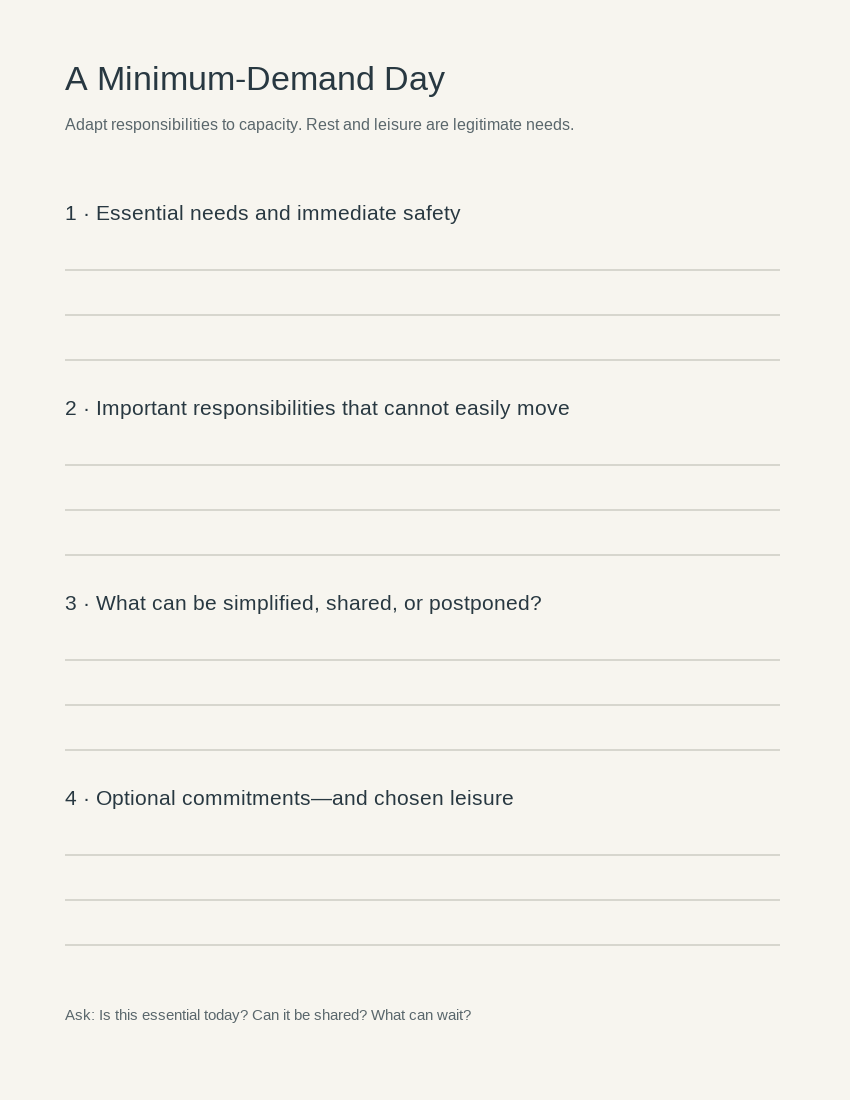
A minimum-demand day: essentials before extras
- Essential needs: personal care, nourishment, prescribed care plans, and immediate safety.
- Important responsibilities: time-sensitive work, caregiving, or appointments that cannot easily move.
- Simplify or share: household tasks, preparation, or nonurgent requests.
- Optional: extra errands, nonessential commitments, additional projects—and chosen leisure.
Rest and leisure are legitimate needs, not rewards for finishing everything. Adapt the plan to capacity without assigning moral value to activity.
Six example routines
After computer work: close work tabs; choose a brief transition; reduce optional decisions; choose leisure or rest.
After physical work: pause physical tasks; use comfortable positioning; ask for help; allow sleep opportunity.
For a student: choose a realistic study priority; take a break when useful; protect sleep opportunity; seek academic support if needed.
For a caregiver: identify one essential need; ask for specific help; simplify one task; use small recovery windows without guilt.
For a low-capacity day: attend to essential needs and safety; defer or share what can move; rest in a way that suits you.
For combined fatigue: reduce both physical and cognitive demands; choose comfortable rest, practical assistance, or a familiar low-demand activity.
Optional reflection frameworks
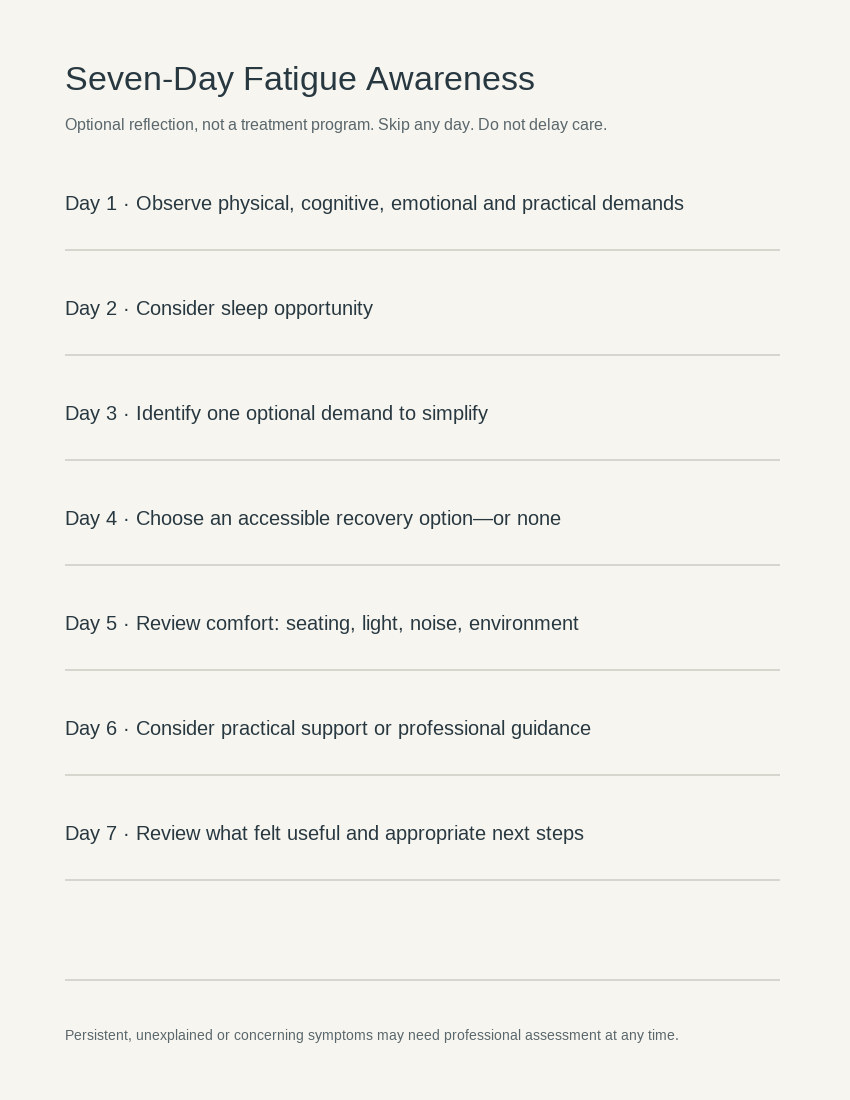
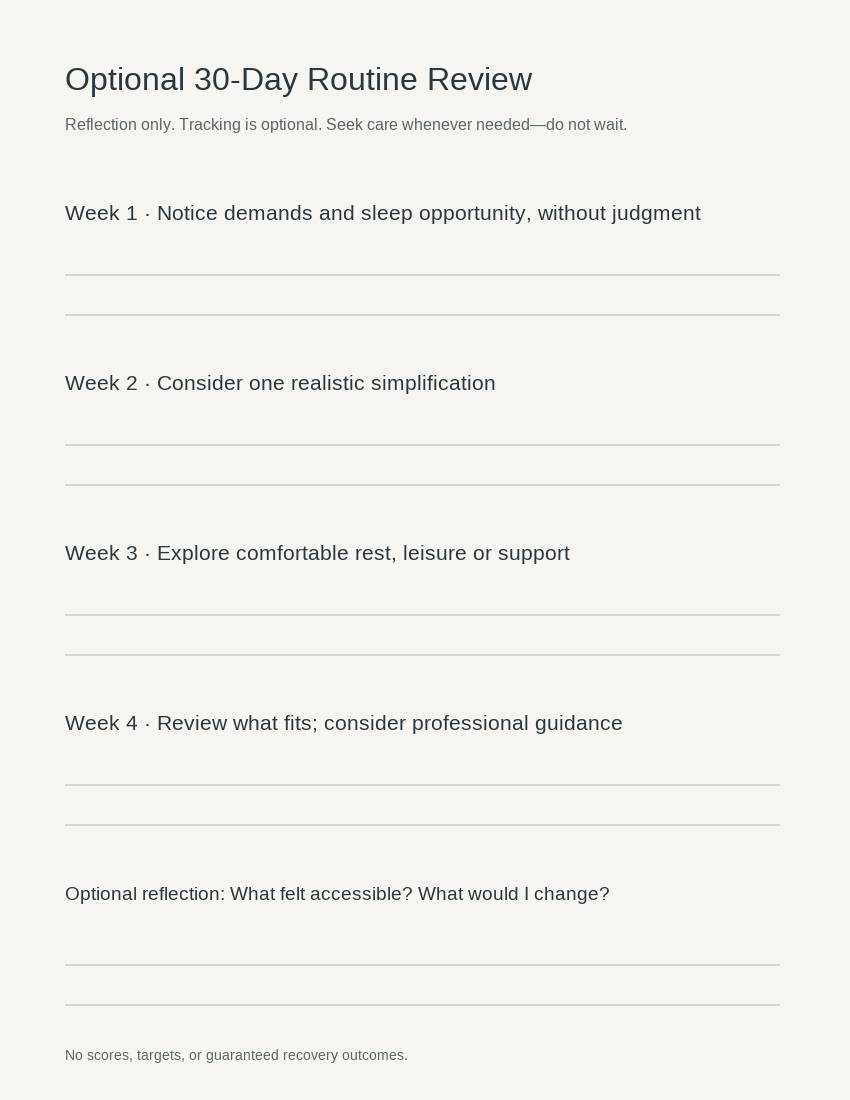
A short awareness exercise can help some people describe demands or prepare questions. It is not a treatment program. Do not delay assessment to finish a seven- or thirty-day plan, and do not track symptoms if that feels burdensome.
How to ask for practical support
At work: “I’m having difficulty sustaining this workload right now. Could we review the highest-priority tasks and discuss a practical adjustment?”
At home: “I’m more tired than usual today. Could you take care of [specific task] while I handle [essential task]?”
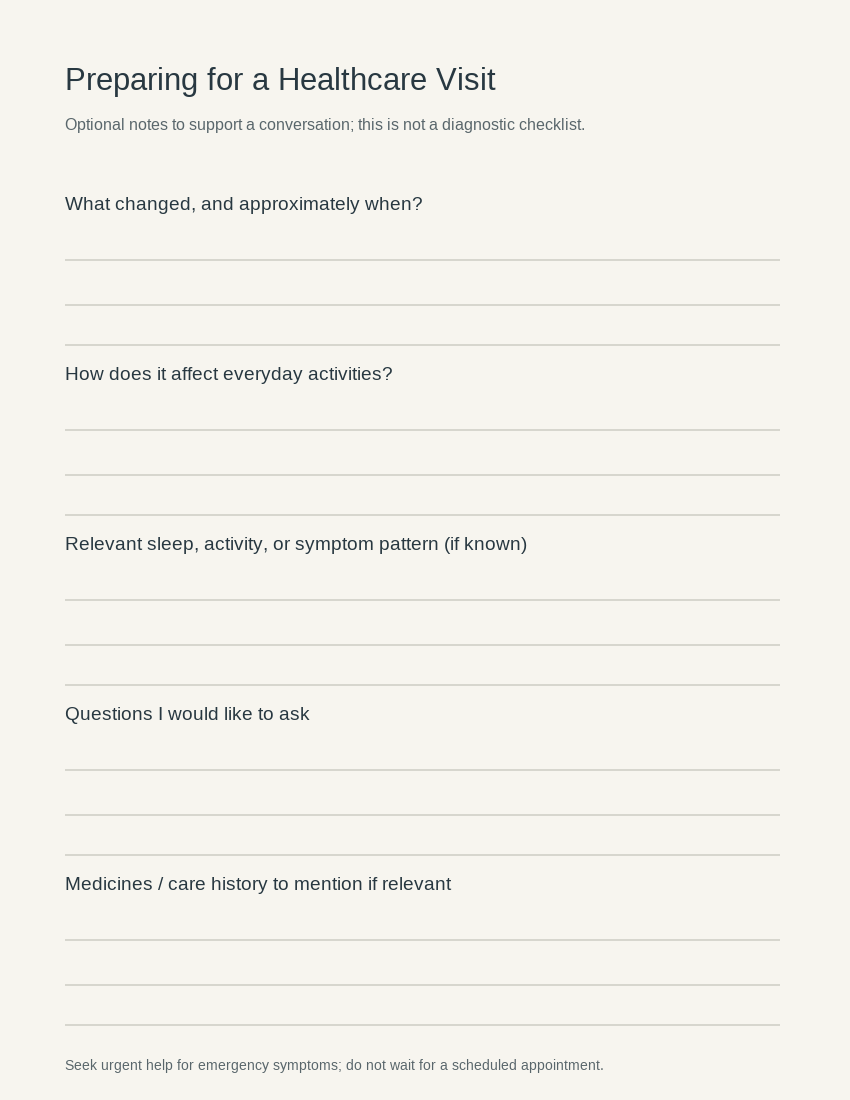
With a clinician: “I’ve noticed [what changed] since [approximate time]. It affects [daily activities]. I also notice [sleep/activity pattern]. What would you recommend we consider?”
When to seek professional or emergency care
Contact a healthcare professional about fatigue that is persistent, unexplained, recurrent, worsening, a substantial change from your usual functioning, or interfering with everyday essentials. Repeated unintended sleep, ongoing sleep problems, new or progressive weakness, substantial post-exertional worsening, persistent concentration difficulty, unexplained weight change, ongoing fever, significant distress, or possible medication effects also merit discussion. Causes vary; symptom duration alone cannot determine them.
Emergency symptoms
For chest pain, severe breathing difficulty, concerning fainting, sudden one-sided weakness, sudden confusion, new speech difficulty, or another acute neurological symptom, seek emergency assistance now. In the U.S., call 911. Do not drive yourself if you may be unsafe to drive.
If you cannot remain adequately alert, do not drive or operate dangerous machinery; arrange safe alternative transportation where needed.
Optional interactive guide · answers stay in this page
Personalized Fatigue Awareness Guide
This is an educational reflection tool—not a symptom checker, diagnosis, or risk score. Safety information is above; choose “prefer not to answer” wherever available.
Optional local planner · no score or stored data
Energy-Adaptive Daily Routine Builder
Plan around the time you actually have. This tool does not measure energy or prescribe activity; leave every suggestion out if it does not suit you.
Four hypothetical situations
Office worker
A long computer day can combine cognitive load, interruptions, sitting, and sleep factors. A break from demanding decisions or a comfortable change of posture may suit; persistent symptoms deserve assessment.
Illustrative example only—not a documented clinical case.Physically tired, mentally alert
After demanding work, concerns, caffeine, or stimulating tasks may leave a person alert. Choose comfortable rest and seek care for persistent sleep difficulties.
Illustrative example only—not a documented clinical case.Student
Concentration difficulty after studying can reflect workload, interruptions, or sleep. Simplify priorities and consider academic support rather than assuming a diagnosis.
Illustrative example only—not a documented clinical case.Caregiver
Physical, cognitive, and emotional demands can combine. Specific practical help and a flexible minimum-demand plan may be more realistic than a strict routine.
Illustrative example only—not a documented clinical case.Relying on caffeine
Temporary alertness is not proof of recovery. Consider timing and sensitivity; persistent tiredness is not best handled by escalating stimulants.
Illustrative example only—not a documented clinical case.Delayed worsening
Substantial worsening after exertion warrants professional guidance. Do not assume that more exercise or daily increases are appropriate.
Illustrative example only—not a documented clinical case.Unintended daytime sleep
Difficulty staying awake despite time in bed needs safety attention and clinical discussion. Do not drive when drowsy.
Illustrative example only—not a documented clinical case.Persistent unexplained fatigue
Routine changes may not address medical or other contributors. Seek appropriate evaluation instead of blaming yourself.
Illustrative example only—not a documented clinical case.Common myths and better context
“Mental fatigue is not real if I sat all day.”
A person’s experience of cognitive tiredness is real; it need not imply measurable muscle weakness.
“The brain runs out of energy after decisions.”
There is no established universal daily quota of decision-making ability.
“Lactic acid explains all muscle fatigue.”
Muscle fatigue reflects multiple task-dependent processes, not one chemical explanation.
“Caffeine restores energy.”
Caffeine may temporarily affect alertness; that is not the same as resolving fatigue.
“Exercise is always the answer.”
Activity can suit some people, while delayed post-exertional worsening calls for care and individualized guidance.
“Eight hours fixes every kind of fatigue.”
Sleep matters, but fatigue can have many contributors; sleep alone may not resolve them.
“Mental exhaustion means burnout.”
The terms are not interchangeable; burnout relates specifically to occupational context in WHO’s framing.
“Wearable recovery scores are medical tests.”
Consumer algorithms are not diagnostic measures of all dimensions of fatigue.
Common experiences associated with physical tiredness
These are observations, not diagnostic criteria. Context and individual differences matter. Consider professional advice for persistent, unexplained, severe, or worsening changes.
1. Increased perceived effort
May occur with physical demands, sleep or health factors, pain, illness, or other circumstances. This experience alone cannot establish a cause; seek professional advice if persistent or concerning.
2. Reduced endurance
May occur with physical demands, sleep or health factors, pain, illness, or other circumstances. This experience alone cannot establish a cause; seek professional advice if persistent or concerning.
3. Heavy-feeling limbs
May occur with physical demands, sleep or health factors, pain, illness, or other circumstances. This experience alone cannot establish a cause; seek professional advice if persistent or concerning.
4. Muscle tiredness after exertion
May occur with physical demands, sleep or health factors, pain, illness, or other circumstances. This experience alone cannot establish a cause; seek professional advice if persistent or concerning.
5. Less willingness to do demanding movement
May occur with physical demands, sleep or health factors, pain, illness, or other circumstances. This experience alone cannot establish a cause; seek professional advice if persistent or concerning.
6. General bodily exhaustion
May occur with physical demands, sleep or health factors, pain, illness, or other circumstances. This experience alone cannot establish a cause; seek professional advice if persistent or concerning.
7. Difficulty maintaining usual activity
May occur with physical demands, sleep or health factors, pain, illness, or other circumstances. This experience alone cannot establish a cause; seek professional advice if persistent or concerning.
8. Desire for physical rest
May occur with physical demands, sleep or health factors, pain, illness, or other circumstances. This experience alone cannot establish a cause; seek professional advice if persistent or concerning.
9. Discomfort after prolonged standing
May occur with physical demands, sleep or health factors, pain, illness, or other circumstances. This experience alone cannot establish a cause; seek professional advice if persistent or concerning.
10. Feeling depleted after physical work
May occur with physical demands, sleep or health factors, pain, illness, or other circumstances. This experience alone cannot establish a cause; seek professional advice if persistent or concerning.
11. Slower task completion
May occur with physical demands, sleep or health factors, pain, illness, or other circumstances. This experience alone cannot establish a cause; seek professional advice if persistent or concerning.
12. Reduced exercise performance
May occur with physical demands, sleep or health factors, pain, illness, or other circumstances. This experience alone cannot establish a cause; seek professional advice if persistent or concerning.
13. More frequent need for activity breaks
May occur with physical demands, sleep or health factors, pain, illness, or other circumstances. This experience alone cannot establish a cause; seek professional advice if persistent or concerning.
14. Difficulty sustaining repetitive movement
May occur with physical demands, sleep or health factors, pain, illness, or other circumstances. This experience alone cannot establish a cause; seek professional advice if persistent or concerning.
15. Reduced comfort after prolonged exertion
May occur with physical demands, sleep or health factors, pain, illness, or other circumstances. This experience alone cannot establish a cause; seek professional advice if persistent or concerning.
Common experiences associated with mental exhaustion
These experiences can reflect many situations and are not diagnoses of ADHD, depression, anxiety, dementia, burnout, or another condition. Adapt demands where useful and seek support for persistent or function-limiting changes.
1. Difficulty maintaining concentration
Possible contributors include workload, interruptions, sleep, emotional demands, or health; this pattern is not diagnostic. Simplify or pause if possible and seek guidance if it persists or limits daily life.
2. Feeling mentally overwhelmed
Possible contributors include workload, interruptions, sleep, emotional demands, or health; this pattern is not diagnostic. Simplify or pause if possible and seek guidance if it persists or limits daily life.
3. Reduced perceived mental energy
Possible contributors include workload, interruptions, sleep, emotional demands, or health; this pattern is not diagnostic. Simplify or pause if possible and seek guidance if it persists or limits daily life.
4. Difficulty initiating demanding tasks
Possible contributors include workload, interruptions, sleep, emotional demands, or health; this pattern is not diagnostic. Simplify or pause if possible and seek guidance if it persists or limits daily life.
5. Increased frustration with complex activities
Possible contributors include workload, interruptions, sleep, emotional demands, or health; this pattern is not diagnostic. Simplify or pause if possible and seek guidance if it persists or limits daily life.
6. Difficulty sustaining attention
Possible contributors include workload, interruptions, sleep, emotional demands, or health; this pattern is not diagnostic. Simplify or pause if possible and seek guidance if it persists or limits daily life.
7. Mental tiredness after long meetings
Possible contributors include workload, interruptions, sleep, emotional demands, or health; this pattern is not diagnostic. Simplify or pause if possible and seek guidance if it persists or limits daily life.
8. Difficulty switching between tasks
Possible contributors include workload, interruptions, sleep, emotional demands, or health; this pattern is not diagnostic. Simplify or pause if possible and seek guidance if it persists or limits daily life.
9. Reduced enthusiasm for demanding responsibilities
Possible contributors include workload, interruptions, sleep, emotional demands, or health; this pattern is not diagnostic. Simplify or pause if possible and seek guidance if it persists or limits daily life.
10. Feeling overloaded by information
Possible contributors include workload, interruptions, sleep, emotional demands, or health; this pattern is not diagnostic. Simplify or pause if possible and seek guidance if it persists or limits daily life.
11. Difficulty processing competing demands
Possible contributors include workload, interruptions, sleep, emotional demands, or health; this pattern is not diagnostic. Simplify or pause if possible and seek guidance if it persists or limits daily life.
12. Reduced tolerance for unnecessary interruptions
Possible contributors include workload, interruptions, sleep, emotional demands, or health; this pattern is not diagnostic. Simplify or pause if possible and seek guidance if it persists or limits daily life.
13. Temporary difficulty remembering information
Possible contributors include workload, interruptions, sleep, emotional demands, or health; this pattern is not diagnostic. Simplify or pause if possible and seek guidance if it persists or limits daily life.
14. Wanting a break from decision-making
Possible contributors include workload, interruptions, sleep, emotional demands, or health; this pattern is not diagnostic. Simplify or pause if possible and seek guidance if it persists or limits daily life.
15. Feeling cognitively depleted after a demanding day
Possible contributors include workload, interruptions, sleep, emotional demands, or health; this pattern is not diagnostic. Simplify or pause if possible and seek guidance if it persists or limits daily life.
Twenty common fatigue-management mistakes
1. Assuming every fatigue has the same cause
A more useful alternative: consider context, adapt demands without blame, use no-cost support where feasible, and seek professional guidance for persistent, unexplained, worsening, or concerning symptoms. Do not push through delayed post-exertional worsening.
2. Treating persistent exhaustion as laziness
A more useful alternative: consider context, adapt demands without blame, use no-cost support where feasible, and seek professional guidance for persistent, unexplained, worsening, or concerning symptoms. Do not push through delayed post-exertional worsening.
3. Ignoring sleep opportunity
A more useful alternative: consider context, adapt demands without blame, use no-cost support where feasible, and seek professional guidance for persistent, unexplained, worsening, or concerning symptoms. Do not push through delayed post-exertional worsening.
4. Assuming sleep resolves every form of fatigue
A more useful alternative: consider context, adapt demands without blame, use no-cost support where feasible, and seek professional guidance for persistent, unexplained, worsening, or concerning symptoms. Do not push through delayed post-exertional worsening.
5. Using caffeine repeatedly to override sleepiness
A more useful alternative: consider context, adapt demands without blame, use no-cost support where feasible, and seek professional guidance for persistent, unexplained, worsening, or concerning symptoms. Do not push through delayed post-exertional worsening.
6. Pushing through unexplained exhaustion
A more useful alternative: consider context, adapt demands without blame, use no-cost support where feasible, and seek professional guidance for persistent, unexplained, worsening, or concerning symptoms. Do not push through delayed post-exertional worsening.
7. Ignoring delayed worsening after exertion
A more useful alternative: consider context, adapt demands without blame, use no-cost support where feasible, and seek professional guidance for persistent, unexplained, worsening, or concerning symptoms. Do not push through delayed post-exertional worsening.
8. Treating exercise as a universal solution
A more useful alternative: consider context, adapt demands without blame, use no-cost support where feasible, and seek professional guidance for persistent, unexplained, worsening, or concerning symptoms. Do not push through delayed post-exertional worsening.
9. Buying unverified energy supplements
A more useful alternative: consider context, adapt demands without blame, use no-cost support where feasible, and seek professional guidance for persistent, unexplained, worsening, or concerning symptoms. Do not push through delayed post-exertional worsening.
10. Expecting instant recovery from relaxation
A more useful alternative: consider context, adapt demands without blame, use no-cost support where feasible, and seek professional guidance for persistent, unexplained, worsening, or concerning symptoms. Do not push through delayed post-exertional worsening.
11. Ignoring emotional or occupational demands
A more useful alternative: consider context, adapt demands without blame, use no-cost support where feasible, and seek professional guidance for persistent, unexplained, worsening, or concerning symptoms. Do not push through delayed post-exertional worsening.
12. Keeping an unrealistic schedule
A more useful alternative: consider context, adapt demands without blame, use no-cost support where feasible, and seek professional guidance for persistent, unexplained, worsening, or concerning symptoms. Do not push through delayed post-exertional worsening.
13. Confusing exhaustion with burnout
A more useful alternative: consider context, adapt demands without blame, use no-cost support where feasible, and seek professional guidance for persistent, unexplained, worsening, or concerning symptoms. Do not push through delayed post-exertional worsening.
14. Assuming physical fatigue always follows exercise
A more useful alternative: consider context, adapt demands without blame, use no-cost support where feasible, and seek professional guidance for persistent, unexplained, worsening, or concerning symptoms. Do not push through delayed post-exertional worsening.
15. Treating a wearable score as a diagnosis
A more useful alternative: consider context, adapt demands without blame, use no-cost support where feasible, and seek professional guidance for persistent, unexplained, worsening, or concerning symptoms. Do not push through delayed post-exertional worsening.
16. Comparing capacity with other people
A more useful alternative: consider context, adapt demands without blame, use no-cost support where feasible, and seek professional guidance for persistent, unexplained, worsening, or concerning symptoms. Do not push through delayed post-exertional worsening.
17. Making rest conditional on productivity
A more useful alternative: consider context, adapt demands without blame, use no-cost support where feasible, and seek professional guidance for persistent, unexplained, worsening, or concerning symptoms. Do not push through delayed post-exertional worsening.
18. Avoiding practical assistance
A more useful alternative: consider context, adapt demands without blame, use no-cost support where feasible, and seek professional guidance for persistent, unexplained, worsening, or concerning symptoms. Do not push through delayed post-exertional worsening.
19. Ignoring persistent functional changes
A more useful alternative: consider context, adapt demands without blame, use no-cost support where feasible, and seek professional guidance for persistent, unexplained, worsening, or concerning symptoms. Do not push through delayed post-exertional worsening.
20. Delaying medical assessment for a wellness challenge
A more useful alternative: consider context, adapt demands without blame, use no-cost support where feasible, and seek professional guidance for persistent, unexplained, worsening, or concerning symptoms. Do not push through delayed post-exertional worsening.
More myths and scientific context
“Fatigue means a lack of discipline.”
Fatigue is an experience with many possible contributors, not a character test.
“Caffeine fully restores energy.”
Temporary alertness does not establish recovery.
“Every person has fixed willpower.”
Research does not establish a universal daily quota.
“Mental fatigue is permanent brain damage.”
Routine cognitive demands do not justify claims of permanent damage.
“A wearable knows every aspect of recovery.”
Consumer scores are limited estimates, not clinical measurements.
“Supplements are necessary.”
No product is universally required; unexplained symptoms need context and potentially care.
“Quiet meditation is the only way to rest.”
Preferences vary; no single waking-rest activity is required.
Frequently asked questions
What is the difference between physical tiredness and mental exhaustion?
Physical fatigue is often experienced as greater effort or reduced capacity during bodily tasks; mental fatigue describes perceived tiredness associated with sustained cognitive or psychological demands. They often overlap and neither identifies a medical cause.
Can mental fatigue make your body feel tired?
It can accompany bodily tiredness. Stress, muscle tension, long periods sitting, sleep disruption, and perceived effort may contribute, but mental fatigue does not always produce measurable muscle weakness.
Can I be physically tired but mentally awake?
Yes. Physical exertion can coexist with alertness, emotional concerns, caffeine use, irregular timing, or difficulty shifting out of an engaging task. Persistent sleep difficulties deserve professional assessment.
Is fatigue the same as sleepiness?
No. Fatigue can mean low energy or increased effort; sleepiness is difficulty maintaining wakefulness or a tendency to fall asleep. Both may occur together.
Is mental exhaustion the same as burnout?
No. Mental exhaustion is a broad everyday description. WHO describes burnout as an occupational phenomenon resulting from chronic workplace stress that has not been successfully managed; exhaustion alone does not establish it.
Can exercise help mental fatigue?
Some people find physical activity supportive for mood or general well-being, but it is not a universal remedy. Symptoms that worsen substantially after exertion need individualized professional guidance, not automatic activity escalation.
What is post-exertional malaise?
PEM describes worsening of symptoms after physical, cognitive, emotional, or social exertion, sometimes with delayed onset and variable duration. It is associated with ME/CFS and can occur in some people with Long COVID; a web article cannot diagnose it.
Can caffeine resolve exhaustion?
Caffeine may temporarily increase alertness for some people; it does not establish recovery or resolve an underlying cause. Sensitivity, timing, pregnancy, medicines, and health circumstances matter.
Why am I still tired after sleeping?
Sleep duration is only one possible factor. Sleep quality, schedule, stress, illness, pain, medication effects, mood, and many other factors can matter; persistent or unexplained fatigue merits assessment.
When should I seek medical advice?
Consider contacting a healthcare professional when fatigue is persistent, unexplained, worsening, substantially different from your usual function, or makes everyday essentials difficult. Seek emergency help for acute warning symptoms listed above.
Should I push through persistent fatigue?
Do not treat unexplained, persistent, or substantially worsening fatigue as a willpower problem. If activity causes delayed symptom worsening, generic push-through or daily-increase advice may be inappropriate.
Can a wearable diagnose fatigue?
Consumer readiness or recovery scores are estimates based on device-specific signals and algorithms; they are not a diagnosis and may not represent every aspect of fatigue or health.
What does physical fatigue feel like?
It may involve increased perceived effort, reduced endurance, heavy-feeling limbs, or muscle tiredness; these experiences do not diagnose a cause.
What does mental fatigue feel like?
People may describe difficulty sustaining attention, cognitive overload, reduced motivation, or increased effort during complex tasks. Experiences vary.
Is emotional exhaustion the same as mental fatigue?
No. Emotional exhaustion describes feeling emotionally depleted; mental fatigue is usually used for cognitive tiredness. They may overlap.
Why do decisions feel exhausting?
Complexity, time pressure, repeated choices, and personal stakes can make decisions feel demanding. Research does not establish a fixed daily supply of decision ability.
Can stress contribute to physical tiredness?
Stress may coexist with muscle tension, sleep disruption, and increased perceived effort, but it does not prove stress is the only contributor.
Is screen time inherently harmful?
No. Focused work, meaningful communication, entertainment, and frequent interruptions differ. Personal context and activity type matter.
What can I do after a mentally demanding day?
You might pause demanding tasks, reduce unnecessary alerts, choose comfortable leisure, or ask for support. These are options, not treatments.
How can I recover after physically demanding work?
Some people choose comfortable rest, reduced physical demands, practical help, and appropriate sleep opportunity. Avoid generic activity advice if symptoms worsen.
What are simple free recovery activities?
Comfortable rest, familiar music, simplifying a task, reducing nonessential notifications, and asking for help are possible no-cost options.
How can I adapt responsibilities on a low-energy day?
Prioritize immediate needs and safety, share or simplify what can move, and consider rest legitimate. This does not replace medical assessment.
Why do I feel tired after sleeping eight hours?
Duration alone does not capture sleep quality, schedule, health, pain, stress, medication effects, or other contributors. Persistent fatigue may warrant care.
What if meditation or journaling does not help?
You do not have to use either. Choose other personally comfortable options, such as supportive conversation, familiar entertainment, or rest.
Can products or supplements restore energy?
Comfort items may serve practical functions but cannot diagnose or treat unexplained fatigue. Evidence, safety, and personal needs vary; no purchase is required.
References and further reading
These sources provide general education, not individualized diagnosis. Research quality and definitions vary by topic; mechanistic laboratory findings do not automatically predict an individual’s experience.
- MedlinePlus: Fatigue
- Kluger et al., Fatigue and fatigability in neurologic illnesses: proposal for a unified taxonomy
- Enoka & Duchateau, Translating fatigue to human performance
- CDC: About ME/CFS
- CDC: Long COVID clinical guidance
- WHO: Post COVID-19 condition
- FDA: Spilling the Beans—How Much Caffeine Is Too Much?
- CDC: How Much Sleep Do I Need?
- WHO: Burn-out an occupational phenomenon
- NIOSH: About Stress at Work
- Enoka & Duchateau: Muscle fatigue—what, why and how it influences muscle function
- Hunter: Performance fatigability—mechanisms and task specificity
- Van Cutsem et al.: Mental fatigue and physical performance (systematic review)
- Holgado et al.: Bias-sensitive meta-analysis of mental fatigue and exercise performance
- Holgado et al.: 2021 correction to the meta-analysis
- CDC: Managing ME/CFS
- NICE: ME/CFS guideline recommendations
- American Academy of Sleep Medicine: Clinical significance of sleepiness
- NIOSH: Preventing crashes when working long hours
- MedlinePlus: Fatigue—Medical Encyclopedia
- CDC: About heart attack symptoms
Educational disclaimer
This article is for general education and does not provide medical advice, diagnosis, or treatment. It has not been medically reviewed. For personal concerns, contact a qualified healthcare professional. Emergency guidance is not a substitute for local emergency services.
Related reading
Related Hailey Morgan articles: Rest vs Sleep: Why They’re Not the Same Thing · Stress vs Burnout · High-Energy vs Low-Energy Days · Screen-Free Evenings vs Scrolling Evenings
Optional comfort accessories
Supportive recovery & comfort aids
As an Amazon Associate I earn from qualifying purchases. Comfort products cannot diagnose or treat unexplained fatigue. Use what you already have if it works for you, or explore these verified optional aids:
Everlasting Comfort Memory Foam Seat Cushion for Office Chair
Comfortable support cushion
Giftable Amber Book Light 1600K Blue Light Blocking LED
Adjustable reading or desk lamp
Brooklinen 100% Mulberry Silk Sleep Mask - Carbon
Comfortable sleep eye mask
Clever Fox Planner Undated - Weekly & Monthly Organizer
Simple undated planner
Hydro Flask Wide Mouth Bottle with Flex Cap
Reusable water bottle
Loop Dream Ear Plugs - Soft Silicone Noise Protection
Comfortable ear protection