It can be unsettling when a product that once felt fine begins to sting—or when your skin reacts to almost everything. The label “sensitized” may sound like a diagnosis, but beauty terminology often compresses several different experiences. A new reaction can reflect irritation, allergic contact dermatitis, an underlying skin condition, environmental stress, or more than one factor. Symptoms alone rarely tell the whole story. [1] [2] [3]
What is sensitive skin?
Dermatology literature commonly describes sensitive skin as unpleasant sensations—such as burning, stinging, tingling, pain or itch—in response to stimuli that usually should not provoke such feelings. Visible changes may be absent, subtle or present. Sensitive skin is a broad descriptive experience rather than one cause or a simple at-home diagnosis. [1] [4]
People differ in sensory reactivity, barrier properties, inflammatory responses and exposures. Research discusses neurosensory pathways and potential barrier contributions, but no single mechanism explains everyone. Sensitive skin is not necessarily permanent, inherited, dry, visibly red or objectively barrier-damaged. [4] [5]
What does “sensitized skin” mean?
In skincare marketing and everyday cosmetic conversation, “sensitized” often means skin has become more reactive after a change—perhaps more exfoliation, a new retinoid, repeated cleansing, multiple new products, a procedure, cold dry weather or an existing inflammatory condition. It is not necessarily a standardized, distinct medical diagnosis.
Do not confuse that informal cosmetic usage with allergic sensitization. In immunology, sensitization describes development of an allergen-specific immune response; subsequent exposure can trigger allergic contact dermatitis. That process is different from temporary stinging or nonspecific irritation. A clinician may use patch testing to investigate allergic contact dermatitis. Do not deliberately reapply a suspected allergen to test it yourself. [2] [3]
Some acquired reactivity may ease when a temporary contributor is removed or managed, but improvement depends on the cause. There is no universal recovery timetable.
Sensitive skin vs sensitized skin: a comparison
| Dimension | Sensitive skin | “Sensitized” skin (cosmetic usage) |
|---|---|---|
| General meaning | A tendency to unpleasant sensations from stimuli often tolerated by others | Informal cosmetic term for increased reactivity after exposures |
| Medical status | Recognized descriptive concept; not one single cause | Not necessarily a standardized distinct diagnosis |
| Possible mechanisms | Sensory nerve responses, barrier differences, inflammation or condition | May involve irritation, barrier stress, allergy, environment or disease |
| Pattern | May be long-standing or vary over time | Often described after a recent change, but timing alone proves nothing |
| Visible signs | May be absent or present | May be absent or present; rash warrants assessment |
| Genetics | Individual susceptibility may contribute; not always inherited | Depends on cause; no simple genetic rule |
| Improvement | Tolerance can change; management depends on contributors | Can improve if a temporary contributor resolves; no promised timeline |
| Care | Gentle, individually tolerated routine; medical advice if persistent | Review new exposures, avoid suspected allergens and seek care if concerning |
These descriptions overlap and are not diagnostic criteria. Medical allergic sensitization is a separate immunologic process that can lead to allergic contact dermatitis.
The terms are not mutually exclusive. A person with a long-standing tendency to stinging can also develop irritant dermatitis or an allergy. A change after a product is useful history, not proof of its mechanism.
Why can previously comfortable skin suddenly feel sensitive?
- New actives or higher frequency: Retinoids, acids and benzoyl peroxide can irritate; increasing frequency or combining products raises exposure. Formulations and individual tolerance differ.
- Over-exfoliation or repeated cleansing: Repeated chemical or physical friction and stripping cleansing can contribute to irritation. More cleansing is not always better.
- Multiple simultaneous product changes: When several products start together, it becomes harder to identify a culprit and total exposure may rise.
- Weather and environment: Cold, wind, low humidity, heat or sun can affect comfort; effects vary by person and context.
- Contact allergy: A person can develop allergy to an ingredient after prior exposure. Itchy rash may occur, but appearance and timing alone cannot confirm allergy.
- Underlying skin condition: Eczema, rosacea and other inflammatory disorders can cause sensitivity-like symptoms.
- Procedures, medication or life changes: Procedures, medicines, age-related changes or hormonal influences may be relevant, but should not be presumed without assessment. Never change prescribed therapy without the prescriber.
A sudden change is not automatically caused by skincare, nor does it automatically mean “barrier damage.” Note timing and seek professional advice if persistent, recurrent or concerning. [1] [2] [3]
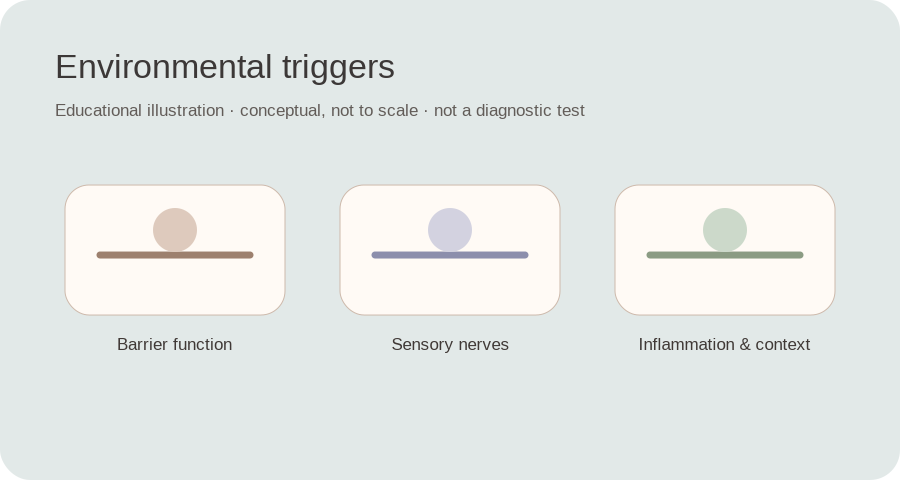
The science: barrier, nerves and inflammation
Barrier function
The stratum corneum helps regulate water movement and limit penetration of some external substances. Barrier involvement is possible, but not required to explain every sensory complaint.
Sensory nerves
Cutaneous sensory pathways can contribute to stinging, burning, itch or tingling. TRPV1 and other receptors are under study; no single receptor explains every person’s symptoms.
Inflammation and context
Irritants, allergy, environment, rosacea, eczema and individual susceptibility may interact. Emerging models should not be used as personal diagnostic tests.
The stratum corneum helps regulate water loss and limits penetration of some external irritants. Sensory nerve pathways contribute to sensations such as itch, burning and stinging; TRPV1 has been studied, but it is one part of a complex system. Inflammatory signals and environmental exposures can interact with individual susceptibility. Mechanisms are active research areas, not a way to diagnose yourself from a symptom. [1] [4] [5]
Ten clues that can help frame a conversation
- Long-standing or recent onset. This history may help identify exposures or pattern, but has uncertainties and cannot diagnose allergy or barrier dysfunction. Keep a brief note if useful; seek care for persistent, worsening, painful, blistering or recurring symptoms.
- Whether familiar products used to be tolerated. This history may help identify exposures or pattern, but has uncertainties and cannot diagnose allergy or barrier dysfunction. Keep a brief note if useful; seek care for persistent, worsening, painful, blistering or recurring symptoms.
- New actives or fragrance. This history may help identify exposures or pattern, but has uncertainties and cannot diagnose allergy or barrier dysfunction. Keep a brief note if useful; seek care for persistent, worsening, painful, blistering or recurring symptoms.
- Changed exfoliation frequency. This history may help identify exposures or pattern, but has uncertainties and cannot diagnose allergy or barrier dysfunction. Keep a brief note if useful; seek care for persistent, worsening, painful, blistering or recurring symptoms.
- Weather or workplace changes. This history may help identify exposures or pattern, but has uncertainties and cannot diagnose allergy or barrier dysfunction. Keep a brief note if useful; seek care for persistent, worsening, painful, blistering or recurring symptoms.
- Persistent burning or stinging. This history may help identify exposures or pattern, but has uncertainties and cannot diagnose allergy or barrier dysfunction. Keep a brief note if useful; seek care for persistent, worsening, painful, blistering or recurring symptoms.
- Itching, rash or swelling. This history may help identify exposures or pattern, but has uncertainties and cannot diagnose allergy or barrier dysfunction. Keep a brief note if useful; seek care for persistent, worsening, painful, blistering or recurring symptoms.
- Dryness or tightness. This history may help identify exposures or pattern, but has uncertainties and cannot diagnose allergy or barrier dysfunction. Keep a brief note if useful; seek care for persistent, worsening, painful, blistering or recurring symptoms.
- One area versus widespread symptoms. This history may help identify exposures or pattern, but has uncertainties and cannot diagnose allergy or barrier dysfunction. Keep a brief note if useful; seek care for persistent, worsening, painful, blistering or recurring symptoms.
- Whether symptoms persist after simplifying. This history may help identify exposures or pattern, but has uncertainties and cannot diagnose allergy or barrier dysfunction. Keep a brief note if useful; seek care for persistent, worsening, painful, blistering or recurring symptoms.
Sensitive vs sensitized vs a compromised skin barrier
| Term | What it generally describes | Limit |
|---|---|---|
| Sensitive skin | Unpleasant sensory response to stimuli | Can occur with or without visible signs |
| “Sensitized” cosmetic skin | Informal description of increased reactivity | Not necessarily a medical diagnosis |
| Barrier dysfunction | Change in protective barrier function | Not interchangeable with sensitivity; not confirmed by a quiz |
These may coexist but are not synonyms. For a deeper barrier-focused guide, see Healthy Skin Barrier vs Damaged Skin Barrier.
Sensitivity vs irritation vs allergic reaction
Irritant contact dermatitis results from direct damage or irritation and can depend on concentration, duration and cumulative exposure. Allergic contact dermatitis is an immune-mediated delayed reaction to a specific allergen in a sensitized person. Sensitive-skin sensations may occur without dermatitis. Burning, itch, rash and redness overlap, so timing or appearance alone cannot reliably distinguish them. Professional assessment—and sometimes patch testing—may be appropriate. [2] [3]
Related: Skin Irritation vs Allergic Reaction: What’s the Difference?.
Can every skin type or tone be sensitive?
Oily and acne-prone: Yes. Sebum does not prevent stinging or irritation. Balance acne care with tolerability and follow prescribed instructions.
Dry: Dryness and sensitivity can overlap, but one does not prove the other. Gentle cleansing and a tolerated moisturizer may help comfort.
Combination and mature: Responses may differ by area and change over time. Avoid assuming one uniform routine fits every zone or age.
Inflammation may look red, deeper, dusky, violet, brown or otherwise different depending on skin tone and individual response; some people mainly feel burning or itch without obvious color change. Inflammation can also leave post-inflammatory hyperpigmentation. Do not use absence of redness to dismiss symptoms. Illustrations here are conceptual—not clinical photographs or diagnostic examples.
Common skincare and environmental triggers
Acids, retinoids, benzoyl peroxide
May irritate depending on strength, frequency, formulation and combinations; follow label/prescriber guidance.
Evidence and individual tolerance vary; a trigger is not universal.
Cleansers, scrubs, repeated layering
Friction, repeated washing and multiple exposures may contribute to irritation in some people.
Evidence and individual tolerance vary; a trigger is not universal.
Fragrance, essential oils, preservatives
Some ingredients can irritate or cause allergy in susceptible people; no universal blacklist.
Evidence and individual tolerance vary; a trigger is not universal.
Cold, wind, low humidity, heat, UV
Environmental conditions may alter comfort; sunscreen and protective habits should suit individual tolerance.
Evidence and individual tolerance vary; a trigger is not universal.
Procedures, medications, health changes
Timing may be relevant but does not establish cause. Ask clinician before changing prescribed treatment.
Evidence and individual tolerance vary; a trigger is not universal.
Ingredients that may support comfort
Ingredient functions are not guarantees. Humectants bind water; emollients soften; occlusives reduce water loss; barrier lipids are components of the stratum corneum. Finished formulation and individual tolerance matter more than a single marketing ingredient. [6] [7]
Ceramides
Barrier lipids used in moisturizers; plausible supportive role. Product composition matters; no guarantee of superiority.
Glycerin
Humectant that binds water; common in moisturizers. Finished formula determines feel and use.
Hyaluronic acid
Water-binding ingredient; can complement emollients, not a standalone cure.
Panthenol / colloidal oatmeal
Used for hydration or soothing; evidence is product- and condition-specific; sensitivities remain possible.
Squalane / petrolatum / dimethicone
Emollient or occlusive functions can soften or reduce water loss; texture and tolerance differ.
Allantoin / niacinamide / centella / licorice
Cosmetic uses and evidence vary; concentration, vehicle and individual sensitivity matter.
Potential ingredients include glycerin, ceramides, hyaluronic acid, panthenol, colloidal oatmeal, squalane, petrolatum, dimethicone, allantoin, niacinamide, centella and licorice-derived ingredients. Evidence varies by ingredient, formulation and condition. Botanical or “natural” ingredients can also cause irritation or allergy. Do not treat an ingredient list as an individualized prescription.
How to read sensitive-skin labels
| Label | What it may communicate—and limits |
|---|---|
| Fragrance-free | Generally indicates no fragrance added as such; check full ingredient list. |
| Unscented | May mean scent is masked; does not guarantee fragrance-free. |
| Hypoallergenic | No US FDA definition or test guarantees a product will not cause allergy. |
| Dermatologist-tested | Indicates a test claim, not universal safety or endorsement; seek details. |
| Non-comedogenic | Claim relates to pore-clogging expectations; does not guarantee no irritation. |
| Natural / organic / clean / sensitive-skin friendly | Terms can be marketing-dependent; natural does not mean allergy-free. Read ingredients and assess tolerance. |
In the US, FDA does not define or standardize “hypoallergenic” as a guarantee; no label can promise a person will not react. “Fragrance-free” and “unscented” may not mean the same thing. Read the full ingredient list and consider your own history. “Dermatologist-tested,” “natural,” “clean,” “organic” and “sensitive-skin friendly” are not universal tolerance certifications. [8]
Quick selection checklist
- Identify the product’s purpose and whether it is actually needed.
- Check full ingredients and prior reactions; avoid suspected allergens.
- Prefer a manageable routine and clear usage instructions.
- Do not assume price, “natural,” or a sensitive-skin claim predicts your tolerance.
Can sensitive skin use active ingredients?
Some people tolerate actives; others do not, or tolerate them only in certain formulations and use patterns. If skin is currently uncomfortable, simplify first rather than stacking more products.
| Ingredient | Purpose and tolerance notes |
|---|---|
| Vitamin C | Antioxidant use; acidic formulations may sting; vehicle matters. |
| Niacinamide | Potential supportive role; concentration and formula influence tolerance. |
| Retinol / retinal / prescription retinoids | May cause irritation; follow label and discuss prescription changes with clinician. |
| Salicylic acid / AHAs / PHAs | Exfoliation uses; irritation depends on formulation, frequency and skin. |
| Azelaic acid | May be used for specific skin concerns; can sting; clinician guidance may help. |
| Benzoyl peroxide | Can dry or irritate; use as directed and avoid layering needlessly. |
Pregnancy/breastfeeding: ask a qualified clinician about retinoids and other actives; do not independently change prescribed treatment.
For pregnancy or breastfeeding, ask a clinician about topical retinoids and other products where relevant. Do not stop or alter prescription treatments on your own.
Five gentle routine templates & Recommended Products
These are gentle routine examples paired with dermatologist-recommended, fragrance-free formulas. Cleanser, moisturizer and sun protection should reflect your needs and tolerance.
Naturally sensitive
AM: gentle rinse/cleanser if needed → tolerated moisturizer → sunscreen. PM: gentle cleanse → moisturizer.
No routine requires buying every product. These templates do not replace prescribed care.
Recently reactive
AM/PM: keep previously tolerated essentials; pause nonessential suspected irritants where appropriate. Seek advice if persistent.
No routine requires buying every product. These templates do not replace prescribed care.
Oily/acne-prone
Gentle cleanse → light moisturizer if comfortable → sunscreen; continue acne therapy only as directed.
No routine requires buying every product. These templates do not replace prescribed care.
Dry and sensitive
Gentle cleanse → tolerated cream/emollient → sunscreen by day; richer moisturizer at night if comfortable.
No routine requires buying every product. These templates do not replace prescribed care.
Interested in actives
Establish basics first; consider one optional active at a time, per label, only when comfortable; seek advice for persistent symptoms.
No routine requires buying every product. These templates do not replace prescribed care.
Curated Sensitive & Sensitized Skin Products (Shop on Amazon)
Fragrance-free, non-foaming hydrating lotion wash formulated with hyaluronic acid and 3 essential ceramides to cleanse without stripping reactive skin.
View on Amazon ↗Rich moisturizing cream with bio-identical ceramides 1, 3, 6-II and MVE delivery technology to reinforce lipid matrix and soothe tight, sensitive skin.
View on Amazon ↗Daily lightweight moisturizer combining prebiotic thermal spring water, ceramide-3, niacinamide, and glycerin for calming barrier comfort.
View on Amazon ↗Hypoallergenic, fragrance-free lightweight gel cream with nourishing prebiotic oat and calming feverfew to instantly relieve sensitive skin.
View on Amazon ↗Lanolin-free, non-comedogenic petrolatum ointment enriched with ceramides and hyaluronic acid to lock in hydration and prevent TEWL.
View on Amazon ↗Oil-free zinc oxide facial sunscreen formulated with niacinamide to shield sensitive, redness-prone skin without stinging or clogging pores.
View on Amazon ↗Affiliate disclosure: Some links may be affiliate links. As an Amazon Associate I earn from qualifying purchases. Affiliate links help support Hailey Morgan at no additional cost to you, with zero compromise on evidence-informed recommendations.
Four-week skin comfort review framework
Week 1 · Simplify
Review products and recent changes. Keep tolerated essentials; ask before stopping prescribed treatments.
Week 2 · Consistency
Use a gentle, stable routine; avoid introducing several optional products.
Week 3 · Review
Notice comfort, itch, sting and possible exposures without excessive checking. Persistent/worsening symptoms merit care.
Week 4 · Next steps
Maintain what is comfortable, seek professional advice, or consider one optional product cautiously. Not a recovery forecast.
A brief optional note can help prepare for a clinician visit. No scores are used; avoid frequent checking.
| Date | Products / new changes | Comfort in own words | Environment | Observed reaction | Questions for clinician |
|---|---|---|---|---|---|
Entries remain in this page only and are not saved or sent.
This is an adaptable routine-review framework, not a guaranteed recovery timeline. Avoid excessive appearance checking.
Introducing a new product more carefully
- Read the full ingredient list and instructions.
- Consider previous reactions and relevant clinician advice.
- Introduce one optional product at a time.
- Follow manufacturer directions; do not exceed use instructions.
- At-home tolerance testing may reveal irritation but cannot rule out allergy.
- Avoid unnecessary combinations of potentially irritating actives.
- Stop a new nonessential product if significant symptoms occur.
- Do not deliberately retry a suspected allergen or product linked to a serious reaction.
- Seek professional advice for persistent or recurrent symptoms.
- Professional patch testing is a clinician-directed allergy investigation; it is not the same as trying a product at home.
At-home product tolerance testing cannot rule out allergy. Professional diagnostic patch testing is designed and interpreted by clinicians; do not home-test or reintroduce a suspected allergen, or retry a product associated with a serious reaction. [2]
Sensitive-skin myths vs facts
Sensitive skin is always genetic.
Fact: No; susceptibility may have multiple influences and can change.
It is always dry.
Fact: No; oily, combination and acne-prone skin can also feel sensitive.
It always looks red.
Fact: No; sensations can occur without obvious visible changes, and redness varies by skin tone.
Every case means barrier damage.
Fact: No; barrier changes are one possible factor, not a universal explanation.
Burning means it works.
Fact: No; burning can indicate irritation.
Natural is safer.
Fact: No; natural substances can irritate or cause allergy.
Fragrance-free means allergy-free.
Fact: No; other ingredients can cause reactions.
No actives can ever be tolerated.
Fact: Not universally true; tolerance depends on person and use.
Expensive is gentler.
Fact: Price does not guarantee suitability.
More soothing products are better.
Fact: More exposures can complicate tolerance.
It can always be reversed quickly.
Fact: There is no universal cause or recovery timeline.
Hypoallergenic means no allergy.
Fact: No such guarantee exists under US FDA labeling guidance.
15 common mistakes and more realistic alternatives
- Using too many products at once. This can increase exposure, obscure a cause or delay care. Safer approach: use tolerated essentials, follow directions, change one optional item at a time, and seek clinical advice for persistent or significant symptoms. Avoid changing prescriptions without the prescriber.
- Over-exfoliating. This can increase exposure, obscure a cause or delay care. Safer approach: use tolerated essentials, follow directions, change one optional item at a time, and seek clinical advice for persistent or significant symptoms. Avoid changing prescriptions without the prescriber.
- Cleansing excessively. This can increase exposure, obscure a cause or delay care. Safer approach: use tolerated essentials, follow directions, change one optional item at a time, and seek clinical advice for persistent or significant symptoms. Avoid changing prescriptions without the prescriber.
- Using aggressive scrubs. This can increase exposure, obscure a cause or delay care. Safer approach: use tolerated essentials, follow directions, change one optional item at a time, and seek clinical advice for persistent or significant symptoms. Avoid changing prescriptions without the prescriber.
- Ignoring persistent burning. This can increase exposure, obscure a cause or delay care. Safer approach: use tolerated essentials, follow directions, change one optional item at a time, and seek clinical advice for persistent or significant symptoms. Avoid changing prescriptions without the prescriber.
- Frequently changing moisturizers. This can increase exposure, obscure a cause or delay care. Safer approach: use tolerated essentials, follow directions, change one optional item at a time, and seek clinical advice for persistent or significant symptoms. Avoid changing prescriptions without the prescriber.
- Calling every reaction purging. This can increase exposure, obscure a cause or delay care. Safer approach: use tolerated essentials, follow directions, change one optional item at a time, and seek clinical advice for persistent or significant symptoms. Avoid changing prescriptions without the prescriber.
- Continuing poorly tolerated fragrance. This can increase exposure, obscure a cause or delay care. Safer approach: use tolerated essentials, follow directions, change one optional item at a time, and seek clinical advice for persistent or significant symptoms. Avoid changing prescriptions without the prescriber.
- Trying unverified DIY remedies. This can increase exposure, obscure a cause or delay care. Safer approach: use tolerated essentials, follow directions, change one optional item at a time, and seek clinical advice for persistent or significant symptoms. Avoid changing prescriptions without the prescriber.
- Assuming expensive is better. This can increase exposure, obscure a cause or delay care. Safer approach: use tolerated essentials, follow directions, change one optional item at a time, and seek clinical advice for persistent or significant symptoms. Avoid changing prescriptions without the prescriber.
- Skipping moisturizer solely due to oiliness. This can increase exposure, obscure a cause or delay care. Safer approach: use tolerated essentials, follow directions, change one optional item at a time, and seek clinical advice for persistent or significant symptoms. Avoid changing prescriptions without the prescriber.
- Neglecting suitable sun protection. This can increase exposure, obscure a cause or delay care. Safer approach: use tolerated essentials, follow directions, change one optional item at a time, and seek clinical advice for persistent or significant symptoms. Avoid changing prescriptions without the prescriber.
- Combining several strong actives. This can increase exposure, obscure a cause or delay care. Safer approach: use tolerated essentials, follow directions, change one optional item at a time, and seek clinical advice for persistent or significant symptoms. Avoid changing prescriptions without the prescriber.
- Assuming every case is barrier damage. This can increase exposure, obscure a cause or delay care. Safer approach: use tolerated essentials, follow directions, change one optional item at a time, and seek clinical advice for persistent or significant symptoms. Avoid changing prescriptions without the prescriber.
- Ignoring recurring symptoms. This can increase exposure, obscure a cause or delay care. Safer approach: use tolerated essentials, follow directions, change one optional item at a time, and seek clinical advice for persistent or significant symptoms. Avoid changing prescriptions without the prescriber.
Eight hypothetical scenarios
Hypothetical scenario 1: Long-term stinging
Many formulations sting. Sensory sensitivity is possible, but allergy, dermatitis and other causes remain possible; consider professional evaluation if persistent. Avoid self-diagnosis and unnecessary product purchases.
Hypothetical scenario 2: Sudden reactivity after acids
Multiple exfoliants may contribute to irritation; stop adding actives and seek care if severe or persistent. Avoid self-diagnosis and unnecessary product purchases.
Hypothetical scenario 3: Oily but tight
Repeated cleansing can contribute to discomfort; oiliness does not rule out sensitivity. Avoid self-diagnosis and unnecessary product purchases.
Hypothetical scenario 4: Winter discomfort
Cold and low humidity may be relevant; use tolerated protection and monitor without assuming a diagnosis. Avoid self-diagnosis and unnecessary product purchases.
Hypothetical scenario 5: Retinol irritation
Retinoids can irritate; follow label and contact prescriber before changing prescription treatment. Avoid self-diagnosis and unnecessary product purchases.
Hypothetical scenario 6: Itchy rash after familiar product
Allergy can arise after prior use, but rash has other causes; stop suspected nonessential product and seek advice; do not re-challenge. Avoid self-diagnosis and unnecessary product purchases.
Hypothetical scenario 7: Burning without redness
Visible redness is not required for discomfort; persistent symptoms merit assessment. Avoid self-diagnosis and unnecessary product purchases.
Hypothetical scenario 8: Repeated reactions despite buying “gentle” products
Labels do not guarantee tolerance. Simplify and seek evaluation instead of serial product switching. Avoid self-diagnosis and unnecessary product purchases.
Skin Sensitivity & Skincare Routine Finder
Educational guide only; not a diagnosis or personalized treatment. Interactive self-assessment · Completely private and confidential.
When to see a dermatologist or allergist
Seek professional evaluation for persistent or worsening sensitivity, repeated unexplained reactions, painful changes, significant swelling, blisters, recurrent rash, severe itch, sleep disruption, suspected eczema/rosacea/contact allergy, eye involvement, possible infection, or difficulty tolerating basic care.
Emergency: breathing difficulty, throat or tongue swelling, fainting, or rapidly progressing systemic allergic symptoms require urgent emergency services. In the US call 911; elsewhere use your local emergency number. This warning is not a product-selection prompt.
Frequently asked questions
Is sensitive skin the same as sensitized skin?
No. Sensitive skin describes a tendency to unpleasant sensations; “sensitized” is commonly informal cosmetic language for increased reactivity. They can overlap.
Is sensitive skin genetic?
Individual predisposition may contribute, but sensitivity is not always inherited or permanent.
Can skin become sensitive suddenly?
Yes, tolerance can change. Irritation, allergy, environment, medication or an underlying condition may contribute.
Can temporarily sensitized skin become less reactive?
Sometimes, if a temporary contributor resolves; outcome and timing depend on cause.
Can oily skin be sensitive?
Yes. Oil production does not prevent sensitivity.
Can skin be sensitive without redness?
Yes. Burning, stinging or itch may occur without visible redness.
Why does moisturizer sting?
Irritation, dermatitis, allergy or another cause may be involved. Persistent or recurrent stinging deserves assessment.
Can over-exfoliation cause sensitivity?
Repeated irritating exposure can contribute to irritant dermatitis or discomfort in some people.
Can retinol increase reactivity?
Retinoids may irritate, particularly with initiation or excessive use. Follow directions; ask prescriber before changing prescribed care.
Is sensitive skin the same as a damaged barrier?
No. They may coexist, but symptoms do not confirm barrier dysfunction.
What ingredients may support comfort?
Humectants, emollients and occlusives may help moisturize; finished formulas and individual tolerance vary.
Are ceramides helpful?
They are barrier lipids used in moisturizers, but not a guarantee or proof of superiority for every person.
Can hyaluronic acid irritate?
Any finished product may be poorly tolerated; formula and skin state matter.
Is niacinamide suitable?
Some tolerate it; others may not. Formulation and concentration matter.
Can sensitive skin use vitamin C?
Some can tolerate certain formulations; acidic products may sting. Introduce cautiously only when skin is comfortable.
Is fragrance-free always safe?
No. Other ingredients can irritate or cause allergy.
Does hypoallergenic mean allergy-free?
No. FDA says there is no federal standard defining the term or guaranteeing no allergic reaction.
How should I introduce a product?
One optional product at a time, follow directions, and never re-expose yourself to suspected allergens.
Can sensitive skin be cured?
It depends on cause; there is no single cure for a broad descriptive experience.
When see a dermatologist?
For persistent, worsening, severe, recurrent or unexplained symptoms, or suspected allergy/eczema/rosacea.
Key takeaway
Sensitive skin describes an experience; “sensitized skin” is often informal cosmetic language for increased reactivity, while allergic sensitization is a distinct immune process. The terms can overlap with irritation, barrier changes or skin disease. Keep care simple and individually tolerated, avoid suspected allergens, and seek medical guidance for persistent or concerning symptoms. You do not need an expensive or complicated routine.
Related reading
Healthy Skin Barrier vs Damaged Skin Barrier · Skin Irritation vs Allergic Reaction · Acne Scars vs Dark Spots. Other related pages: Skin Purging vs Breakouts; Blackheads vs Sebaceous Filaments; Dry Skin vs Dehydrated Skin; Retinol vs Retinal; AHA vs BHA vs PHA; Vitamin C vs Niacinamide; Mineral vs Chemical Sunscreen; Ceramides vs Hyaluronic Acid; Gel vs Cream Moisturizer; Hydrating vs Moisturizing Skincare. Explore our complete library of side-by-side clinical comparisons.
References
- DermNet: Sensitive skin (reviewed September 2026)
- DermNet: Allergic contact dermatitis
- DermNet: Irritant contact dermatitis
- Misery et al. Definition of sensitive skin: an international consensus. Contact Dermatitis. 2009.
- Bharadwaj et al. Sensitive skin: review of mechanisms and management. 2017.
- Nugroho et al. Ceramide moisturizers in atopic dermatitis: systematic review/meta-analysis. 2023.
- Skin barrier physiology review. Journal of Clinical and Aesthetic Dermatology. 2025.
- US FDA: Hypoallergenic Cosmetics
- US FDA: Cosmetics Labeling Guide
- American Academy of Dermatology: Dry skin care
Educational disclaimer
This article is general educational information, not medical advice, diagnosis or treatment. It has not been medically reviewed. Skin symptoms have multiple possible causes; consult a qualified health professional for personal assessment. Emergency symptoms require emergency services.