Protein Treatments vs Moisturizing Treatments: What Does Your Hair Need?
A practical guide to keratin, hydrolyzed proteins, conditioning films, hair mechanics, treatment overlap, and simpler routines.
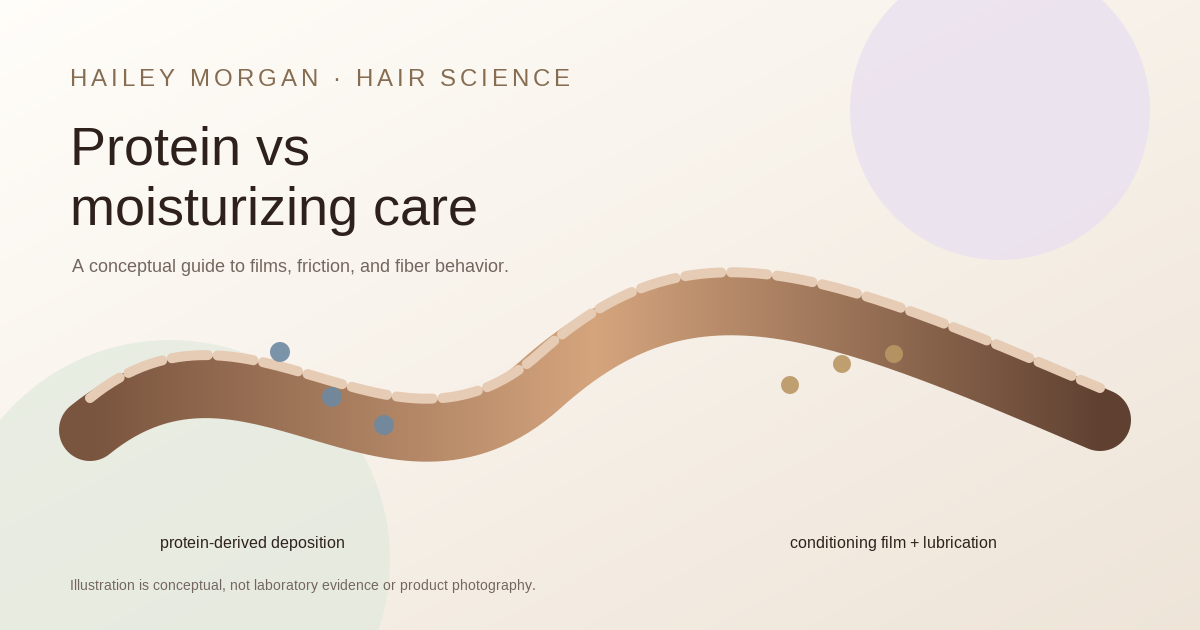
Keratin is the fiber
Natural hair keratin is organized inside a nonliving shaft. A cosmetic protein ingredient is not a replacement part.
Conditioning changes handling
Surface lubrication and lower friction can make detangling easier without deep penetration.
Use what performs
Hair may need protein-containing care, conditioning, both, or neither—depending on the formula and your experience.
Personalized protein vs moisture treatment finder
This guide provides educational haircare considerations based on your observations. It cannot measure protein or water content, diagnose protein overload, or determine the structural condition of your hair.
Question 1 of 12. Optional questions can be skipped.
Hair anatomy and keratin: what treatments can and cannot change
The follicle is living; the visible shaft is primarily keratinized, nonliving material. The cuticle protects the fiber, the cortex contributes much of its mechanical behavior, and the medulla may be absent or discontinuous. Surface lipids and intercellular regions influence wettability and friction. Haircare can improve the way an existing fiber behaves, but it cannot biologically regenerate missing cuticle cells.
Hair shaft anatomy
Conceptual educational illustration, not microscopy.
Keratin is not a single “repair molecule”
Natural hair contains keratin intermediate filaments and associated proteins organized through a complex hierarchy. Cysteine-containing structures contribute to disulfide bonding, while hydrogen and ionic interactions help explain wet/dry behavior.
Cosmetic keratin can mean a hydrolyzed ingredient or derivative. Applying it does not automatically reconstruct the original microscopic architecture of damaged hair.
Hydrolyzed proteins: smaller fragments, not one universal ingredient
Hydrolysis breaks a source protein into a distribution of smaller fragments and peptides. Molecular characteristics, charge, chemical modification, solubility, formulation, contact time, and hair condition all affect what happens next. Some materials mostly remain at the surface. Selected fractions can interact with weathered areas or enter selected regions under specific experimental conditions.
Protein hydrolysis
Source protein → controlled processing → peptide mixture → formulation → fiber interaction.
Amino acids vs peptides vs proteins
Amino acids are building blocks. Peptides are short chains. Proteins are larger organized structures. A product containing arginine, glycine, serine, proline, or a cysteine-derived ingredient does not automatically rebuild functional hair keratin.
A formula’s complete ingredient system matters more than a single hero ingredient.
Hair elasticity, tensile strength, and flexibility are different
Elasticity concerns recovery after deformation. Elongation concerns extension under force. Tensile strength and breaking force concern failure under a defined protocol. Stiffness concerns resistance to deformation. Flexibility is a practical description, and toughness concerns energy absorbed before fracture. A treatment that feels stiffer is not automatically stronger; a softer feel is not automatically higher tensile strength.
Stress–strain concept
The curve is conceptual; it is not a product measurement.
Why the viral stretch test is unreliable
- Force and speed are uncontrolled.
- Strand diameter, length, wetness, humidity, texture, and residue vary.
- Chemical history and existing fractures change behavior.
- A home observation cannot establish a treatment deficiency.
Do not pull hair until it breaks. Laboratory testing uses controlled samples and instruments.
Hair conditioning & protein mechanism simulator
This simulator illustrates possible mechanisms. It does not measure an individual hair fiber, represent a real dose, or predict a product result.
What this illustration means
Protein-derived material may deposit on the surface or interact with selected regions depending on its molecular characteristics and formulation. A deeper-looking interaction is not automatically superior to surface conditioning. Cosmetic improvement does not establish complete biological hair repair.
Selected: Mildly weathered · Protein-containing conditioner · Hydrolyzed keratin · Surface deposition · Medium-diameter strand · Damp · Moderate conceptual amount · Side-by-side comparison
How scientists measure hair treatment performance
Researchers use tensile, elongation, breaking-force, combability, friction, microscopy, water-sorption, protein-loss, stiffness, and deposition methods. Each answers a different question, and laboratory findings depend on the sample, formulation, protocol, humidity, and measurement method. They should not be converted into a personal score.
| Method | What it helps answer | Why it does not become a home diagnosis |
|---|---|---|
| Tensile testing | Measures one defined aspect of fiber behavior or product interaction. | Conditions, sample history, and protocol determine the meaning; one result does not prescribe a routine. |
| Elongation measurement | Measures one defined aspect of fiber behavior or product interaction. | Conditions, sample history, and protocol determine the meaning; one result does not prescribe a routine. |
| Breaking-force measurement | Measures one defined aspect of fiber behavior or product interaction. | Conditions, sample history, and protocol determine the meaning; one result does not prescribe a routine. |
| Combability testing | Measures one defined aspect of fiber behavior or product interaction. | Conditions, sample history, and protocol determine the meaning; one result does not prescribe a routine. |
| Friction measurement | Measures one defined aspect of fiber behavior or product interaction. | Conditions, sample history, and protocol determine the meaning; one result does not prescribe a routine. |
| Microscopy | Measures one defined aspect of fiber behavior or product interaction. | Conditions, sample history, and protocol determine the meaning; one result does not prescribe a routine. |
| Water-sorption analysis | Measures one defined aspect of fiber behavior or product interaction. | Conditions, sample history, and protocol determine the meaning; one result does not prescribe a routine. |
| Protein-loss measurement | Measures one defined aspect of fiber behavior or product interaction. | Conditions, sample history, and protocol determine the meaning; one result does not prescribe a routine. |
| Instrumental stiffness | Measures one defined aspect of fiber behavior or product interaction. | Conditions, sample history, and protocol determine the meaning; one result does not prescribe a routine. |
| Deposition study | Measures one defined aspect of fiber behavior or product interaction. | Conditions, sample history, and protocol determine the meaning; one result does not prescribe a routine. |
Twelve protein-derived ingredients, without the marketing shortcut
Protein-derived ingredients can differ greatly in source, hydrolysis, molecular distribution, charge, and formula compatibility. None is universally superior, and plant-derived, animal-derived, or synthetic origin does not guarantee better safety or performance.
Hydrolyzed keratin
Function: Protein-derived film-forming or conditioning ingredient; behavior depends on hydrolysis and formulation.
Fiber relevance: May deposit on weathered regions; selected molecular fractions have shown penetration or mechanical effects in controlled hair-fiber work.
Limit: A cosmetic ingredient is not the same as natural keratin architecture. Evidence is formulation- and sample-specific.
Hydrolyzed wheat protein
Function: Conditioning, film-forming, and hair-feel modification in some formulations.
Fiber relevance: May improve surface feel, combability, or film-related performance; not proof of permanent repair.
Limit: Hydrolysates vary in peptide distribution and modification. Wheat-derived ingredients may matter for individual sensitivity.
Hydrolyzed rice protein
Function: Protein-derived conditioning or film-forming ingredient used in hair products.
Fiber relevance: Can contribute to cosmetic body, film formation, or manageability in a complete formula.
Limit: “Rice protein” does not predict performance without the formula and use instructions. No guaranteed strengthening result.
Hydrolyzed soy protein
Function: Conditioning and film-forming ingredient.
Fiber relevance: May contribute to surface conditioning and hair feel; any mechanical effect is formulation-specific.
Limit: Ingredient name alone does not establish penetration or strength improvement. Evidence may not generalize across products.
Hydrolyzed silk
Function: Film-forming, conditioning, and sensory modifier.
Fiber relevance: May support smooth feel and manageability through deposition and lubrication-related effects.
Limit: Silk-derived peptides are not a replacement for hair’s natural keratin. Marketing language often exceeds direct evidence.
Hydrolyzed collagen
Function: Film-forming and conditioning ingredient; collagen is not hair keratin.
Fiber relevance: May change surface feel or film characteristics in a formula.
Limit: Does not reconstruct the hair’s original keratin structure. Skin evidence does not automatically transfer to nonliving hair.
Hydrolyzed oat protein
Function: Conditioning and film-forming ingredient.
Fiber relevance: May support slip, body, or a conditioned feel depending on the formula.
Limit: “Gentle” or “natural” does not guarantee a reaction-free experience. No universal porosity rule applies.
Hydrolyzed corn protein
Function: Protein-derived conditioner or film former.
Fiber relevance: May contribute to surface deposition and manageability.
Limit: Results depend on dose, vehicle, contact time, and rinse-out behavior. No evidence supports using the ingredient as a diagnostic marker.
Hydrolyzed pea protein
Function: Conditioning and film-forming ingredient used in some plant-forward formulas.
Fiber relevance: May contribute to cosmetic fullness or feel through deposition; not permanent strand enlargement.
Limit: Plant source does not determine molecular behavior by itself. No universal “protein-free” need follows from hair texture.
Hydrolyzed vegetable protein
Function: Broad INCI-style protein-derived conditioning category.
Fiber relevance: Potential film formation and surface conditioning vary with source and processing.
Limit: The broad name reveals less about the peptide distribution. Do not estimate concentration from label position alone.
Cationically modified protein derivatives
Function: Designed to improve deposition or substantivity on hair surfaces.
Fiber relevance: Charge interactions may help deposition on weathered regions, but the outcome remains formulation-specific.
Limit: “Cationic” does not mean deeply penetrating or permanently repairing. May contribute to a coated feel for some users.
Amino acid and peptide blends
Function: Conditioning, humectant-like, film-forming, or formulation-support roles depending on the blend.
Fiber relevance: Small molecules may interact with water or selected fiber regions; presence does not prove keratin reconstruction.
Limit: Amino acids are building blocks, not assembled hair fibers. Blends are not directly comparable across products.
Fifteen moisturizing and conditioning ingredients
Humectants interact with water. Emollients improve surface feel and lubrication. Conditioning agents can reduce friction, improve combability, and help manageability. One ingredient rarely provides every advertised benefit by itself.
| Ingredient / category | Class | Potential contribution | Limit |
|---|---|---|---|
| Glycerin | Humectant | Interacts with water and can support a conditioned feel; humidity and formula context matter. | Hair feel is not a direct measurement of internal water content. |
| Panthenol | Pro-vitamin / humectant-like conditioner | Can contribute to film, feel, and manageability; not proof of increased internal water content. | Hair feel is not a direct measurement of internal water content. |
| Betaine | Osmolyte / conditioning support | May support water-related formulation behavior and feel. | Hair feel is not a direct measurement of internal water content. |
| Sodium PCA | Humectant / water-binding ingredient | A water-compatible ingredient used in conditioning formulas; effects depend on vehicle. | Hair feel is not a direct measurement of internal water content. |
| Aloe-derived ingredients | Botanical water-phase ingredient | May contribute to formula feel; botanical origin does not establish a hair repair effect. | Hair feel is not a direct measurement of internal water content. |
| Cetyl alcohol | Fatty alcohol / emollient | Supports cream structure, slip, and soft feel; not the same as drying alcohol. | Hair feel is not a direct measurement of internal water content. |
| Cetearyl alcohol | Fatty alcohol blend | Supports emulsions, lubrication, and manageability in conditioners. | Hair feel is not a direct measurement of internal water content. |
| Stearyl alcohol | Fatty alcohol / emollient | Contributes to texture, deposition, and slip in rich formulas. | Hair feel is not a direct measurement of internal water content. |
| Behentrimonium chloride | Cationic conditioning agent | Can reduce friction and improve wet combability through surface interactions. | Hair feel is not a direct measurement of internal water content. |
| Cetrimonium chloride | Cationic conditioning agent | Supports detangling and surface conditioning; use is formula- and dose-dependent. | Hair feel is not a direct measurement of internal water content. |
| Dimethicone | Silicone film former | Can reduce friction, improve gloss, and protect the feel of weathered surfaces. | Hair feel is not a direct measurement of internal water content. |
| Amodimethicone | Amino-functional silicone | May deposit preferentially on damaged regions and improve combability; buildup depends on formula and use. | Hair feel is not a direct measurement of internal water content. |
| Selected polyquaterniums | Conditioning polymers | Can form films that reduce static or friction; properties differ by polymer. | Hair feel is not a direct measurement of internal water content. |
| Squalane | Emollient | Lubricates the surface and changes feel without needing to add water to the fiber. | Hair feel is not a direct measurement of internal water content. |
| Selected cosmetic oils and esters | Emollient / lubricant | Can improve slip and gloss; weight, residue, and compatibility vary widely. | Hair feel is not a direct measurement of internal water content. |
Protein, moisturizing treatment, both, or neither?
Review protein-containing care when
Hair has relevant chemical or mechanical exposure, a complete formula performs well, or a selected treatment has a clear cosmetic purpose. Do not call that protein deficiency.
Prioritize conditioning when
Hair feels rough, tangles, frizzes, or has high surface friction. Those observations suggest a conditioning conversation, not a diagnosis of low internal water.
Use both through one formula
Many conditioners combine hydrolyzed proteins with fatty alcohols, cationic agents, humectants, silicones, oils, and polymers.
Use neither specialized treatment when
A suitable basic conditioner already produces manageable hair. Extra masks and intensive steps may add complexity without adding value.
The truth about protein-moisture balance
Hair does not require a universally validated consumer ratio such as 70/30 or 60/40. Natural structural proteins, water interactions, surface lubrication, product deposition, and mechanical behavior are real topics; a fixed schedule is not a universal law.
All damaged hair needs protein treatments.
Damage has multiple causes; conditioning, heat reduction, gentle handling, and formula-specific products may matter more.
All frizzy hair needs moisturizing treatments.
Frizz can reflect texture, humidity, friction, styling, or damage; one category cannot explain all cases.
Hair requires an exact protein-to-moisture ratio.
No universally validated consumer ratio determines every routine.
A wet stretch test diagnoses deficiency.
Home pulling is uncontrolled and cannot measure fiber mechanics or ingredient need.
Protein overload is a standardized clinical diagnosis.
It is a consumer label for an undesirable feel, not a medical diagnosis.
Moisture overload is a standardized diagnosis.
Softness and weight have many possible explanations.
Every stretchy hair needs protein.
Wet behavior varies naturally and with fiber condition, length, force, and residue.
Every stiff hair needs moisture.
Stiffness may reflect deposition, formula, damage, or styling.
Every soft hair is overconditioned.
Softness can be a desired surface effect.
All proteins penetrate deeply.
Molecular characteristics and formulation determine interaction; many ingredients mainly deposit at the surface.
All amino acids rebuild keratin.
Amino acids are building blocks, not assembled hair fibers.
Surface conditioning has no value.
Slip and friction reduction can improve manageability and reduce mechanical stress.
Protein products permanently reconstruct hair.
Cosmetic effects are temporary or formulation-specific; existing fibers do not biologically regenerate.
Protein treatments create new follicles.
Follicles are living structures; a shaft treatment cannot create them.
Protein permanently increases strand diameter.
A film may change temporary feel or body but not natural follicle output.
Low-porosity hair must avoid every protein.
Porosity labels do not replace evaluation of the complete formula and actual performance.
High-porosity hair always needs frequent protein.
Chemical exposure and product response matter more than a universal schedule.
Fine hair universally requires protein.
Fine diameter affects weight and deposition; it is not proof of protein need.
Curly hair needs weekly protein.
Texture does not dictate a mandatory frequency.
Deep conditioners contain no protein.
Product categories overlap; read the label.
Every mask is more effective than conditioner.
“Mask” is not an independent efficacy measurement.
Keratin smoothing equals protein conditioning.
Smoothing services may involve heat, film-formers, and chemicals.
Every bond builder works the same way.
Technologies and evidence differ by product.
Eggs permanently replace hair keratin.
Food proteins are not equivalent to controlled cosmetic hydrolysates.
Rice water guarantees strengthening.
Household preparations lack standardized composition and controlled performance evidence.
Ordinary washing should be avoided.
Appropriate scalp hygiene is not the same as harmful over-wetting.
Protein and moisturizing products can never be used together.
Many formulas already combine both kinds of ingredients.
Treatments fully restore any damage.
Cosmetic care can improve feel and reduce additional damage; it cannot recreate missing cuticle cells.
A pricey system is required for healthy-looking hair.
A simple suitable routine may be enough.
A viral routine is a diagnosis.
Rules copied from social media are not standardized hair-fiber testing.
Personalized hair treatment schedule builder
This builder does not prescribe a weekly schedule. It prioritizes existing suitable products, preserves unknown directions as unknown, and treats specialized treatments as optional.
Editable routine order
Use the existing shampoo according to its label.
Use a suitable rinse-out conditioner; follow the actual product directions.
Directions unknown — check the label before scheduling.
Directions unknown — check the label before scheduling.
Technology and directions are product-specific; verify before use.
Use only if the product is intended as a leave-in and follow its directions.
Flexible weekly view
Place only steps whose actual product directions are known. A calendar is a planning surface, not a treatment requirement.
Safety, smoothing services, and professional evaluation
Keratin smoothing is a broad commercial term, not a standardized protein conditioner. The FDA warns that many hair-smoothing products can release formaldehyde gas when heated and advises consumers not to apply such products at home. [4] Check labels, ventilation, professional safeguards, and product-specific safety information.
The American Academy of Dermatology emphasizes gentle hair care, reducing damaging styling, and getting appropriate help for hair-loss concerns. [5]
Realistic recovery expectations
Conditioners and masks may immediately improve lubrication, softness, gloss, and manageability. Some formulations can change selected measured material properties under controlled conditions. Reducing unnecessary heat, friction, and chemical exposure can support length retention by reducing additional breakage. Damaged lengths are gradually replaced through new growth and trimming; no product can promise permanent biological regeneration of an existing fiber.
Related Hailey Morgan guides
Frequently asked questions
What is the difference between protein and moisturizing hair treatments?
Protein-containing treatments use protein-derived ingredients that may deposit or form films. Moisturizing and conditioning treatments mainly target lubrication, softness, manageability, and water-related behavior. Products often overlap.
How do I know which treatment my hair needs?
Start with actual hair behavior, previous chemical or heat exposure, complete formulas, product directions, and performance. Do not use a stretch test as a diagnosis.
What does hydrolyzed protein mean?
Hydrolysis breaks larger proteins into a distribution of smaller peptides and fragments. Their behavior depends on source, processing, molecular characteristics, chemical modification, and the full formulation.
Is protein overload a medical diagnosis?
No. Protein overload is a consumer shorthand for an undesirable cosmetic result such as stiffness or roughness. Product buildup, film formation, damage, and insufficient lubrication are alternative explanations.
Can I use protein and moisturizing products together?
Often yes, because many products already contain both protein-derived and conditioning ingredients. Follow each label and avoid unnecessary duplication rather than using a universal order.
Does soft hair mean moisture overload?
No. Softness can reflect lubrication, conditioning deposition, hair texture, product amount, or humidity. It does not establish excessive water or unhealthy hair.
Is a keratin smoothing service the same as a protein treatment?
No. Keratin smoothing is a broad commercial term for procedures that may involve film-formers, chemicals, heat, or other mechanisms. It is not a standardized synonym for a rinse-out protein conditioner.
When should I see a dermatologist?
Seek professional evaluation for significant unexplained breakage, sudden shedding, progressing thinning, bald patches, persistent scalp pain or inflammation, infection concerns, repeated reactions, or severe allergy symptoms.
Research notes
The article’s most specific protein-deposition discussion is limited to the cited controlled hair-fiber study by Malinauskyte and colleagues. The study used selected wool-derived hydrolyzed keratins on sodium-hydroxide-relaxed, very curly hair and prolonged soaking; it should not be generalized to every product or person.
Low- and mid-molecular-weight keratin peptides penetrated more deeply in the tested system; high-molecular-weight material mainly adsorbed at the surface. Mid- and high-molecular-weight peptides changed selected mechanical outcomes.
Limitations: One study, selected peptides, prolonged soaking, relaxed textured hair, and laboratory conditions; not a universal consumer schedule.
Educational synthesis based on peer-reviewed cosmetic fiber studies, FDA consumer updates, and AAD haircare guidance. Always seek professional advice for persistent scalp or hair changes.
References
- Malinauskyte et al., hydrolyzed keratin penetration study.
- Dias et al., Hair Cosmetics: An Overview.
- FDA cosmetic labeling requirements.
- FDA formaldehyde in hair smoothing products.
- American Academy of Dermatology everyday hair care.
- International Journal of Cosmetic Science: Keratin Protein Tensile Studies.
Affiliate disclosure: “As an Amazon Associate I earn from qualifying purchases.” No product purchase is required to apply the gentle haircare framework above; start with what you already own.