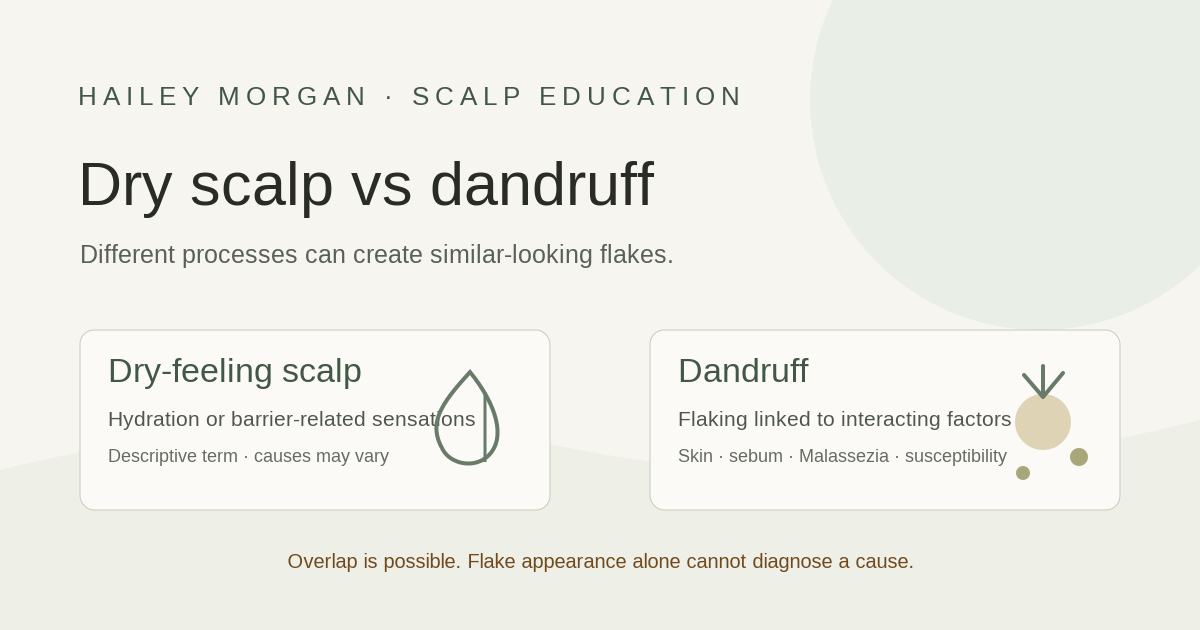
Quick answer
Dry scalp generally describes skin that feels dry or tight, sometimes because of reduced hydration or barrier irritation. Dandruff is a common flaking condition associated with interacting skin, surface lipids, Malassezia, and individual susceptibility. Both can itch and flake, and their appearance overlaps; persistent or concerning symptoms may need professional evaluation.
A few visible flakes are not a diagnosis—and they do not mean you have poor hygiene.
First: when routine advice is not enough
Arrange professional evaluation for persistent or worsening flaking, severe itch, thick adherent scale, bleeding, repeated product reactions, associated hair loss, or symptoms affecting daily life.
Prompt assessment is appropriate for possible infection (especially pus, painful swelling, fever), new bald patches or broken hairs, possible scarring, severe persistent pain/burning, or rapidly worsening symptoms.
Breathing difficulty, throat or tongue swelling, fainting, or rapidly developing severe allergic symptoms require emergency care now. In the United States, call 911 (or your local emergency number). Do not continue product recommendations in that situation.
Ordinary uncomplicated dandruff is not usually an emergency. But patchy hair loss, broken hairs, pus, significant pain, possible scarring, or a rapidly worsening reaction should not be managed by cosmetic experimentation alone. Guidance from the British Association of Dermatologists on scalp ringworm, the NHS on ringworm, and the NHS on anaphylaxis describes warning features; use local emergency services where you live.
Dry scalp vs dandruff: a practical comparison
“Dry scalp” is a descriptive phrase, not one specific diagnosis. Dandruff is a common label for scalp flaking. Inflammation, barrier changes, products, skin conditions, and hair-care practices can overlap, so a table can organize observations but cannot identify your condition.
| Observation | Dry-feeling scalp may involve | Dandruff may involve | What this cannot tell you |
|---|---|---|---|
| Basic description | Dry or tight sensation; reduced skin hydration or irritation may contribute. | Visible scalp flaking associated with skin, surface lipids, Malassezia, and individual susceptibility. | Either phrase alone is a definitive medical diagnosis. |
| Scalp feel | May feel tight, dry, or sensitive. | May itch or feel comfortable; sensations vary. | Itch or tightness uniquely identifies the cause. |
| Flakes | May include fine or loose scale. | Can vary in size and appearance. | Color or size establishes dryness, dandruff, psoriasis, or infection. |
| Oiliness | May have lower visible oil, but oiliness and hydration are not equivalent. | May be associated with scalp lipids, but a visibly oily scalp is not required. | Surface oil proves adequate hydration or confirms dandruff. |
| Barrier / inflammation | Barrier irritation or environmental factors can be relevant. | Barrier and inflammatory responses may contribute. | One pathway explains every person's flakes. |
| Products / environment | Hot water, cleansing, fragrance, weather, or a product reaction may matter. | Product tolerance and seasonal variation can also matter. | A product change or winter timing proves causation. |
| Care considerations | Comfortable cleansing and a suitable moisturizer may help some dry-feeling skin. | Appropriately labeled anti-dandruff products are common care options. | Everyone needs a moisturizer, oil, or medicated shampoo. |
| When to seek care | Persistent, painful, worsening, or unusual changes. | Persistent/recurrent symptoms, severe itch, thick scale, reaction, infection signs, or hair loss. | An article or a self-check can rule out another condition. |
Can an oily scalp still feel dry?
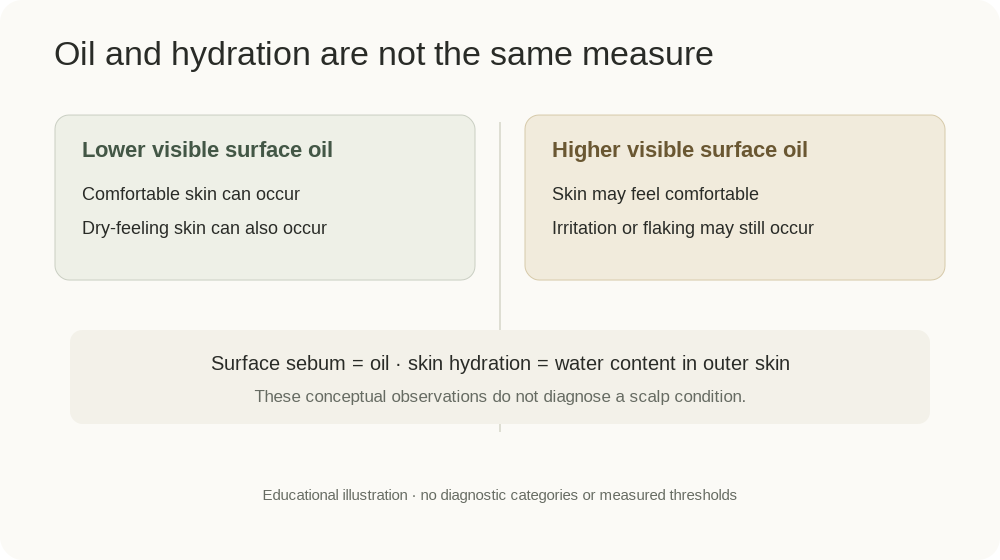
Yes. Sebum is surface oil produced by sebaceous glands. Skin hydration describes water in the outer skin layer. Oiliness does not measure water content or prove that the barrier is comfortable.
Scalp biology: the barrier, water, oil, and normal shedding
The skin barrier
The epidermis is the outer skin layer. Its outermost part, the stratum corneum, helps limit water loss and protect against external exposures. It contains mature skin cells called corneocytes, natural moisturizing factors that help retain water, and organized lipids—including ceramides, cholesterol, and fatty acids—between cells. These general skin-barrier principles help explain why irritation and hydration can matter, but they do not diagnose a particular scalp.
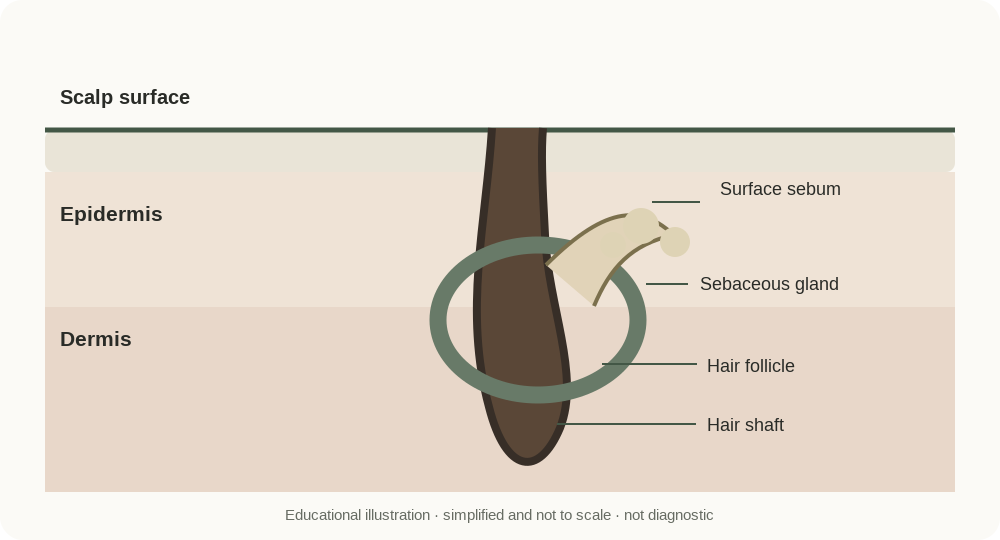
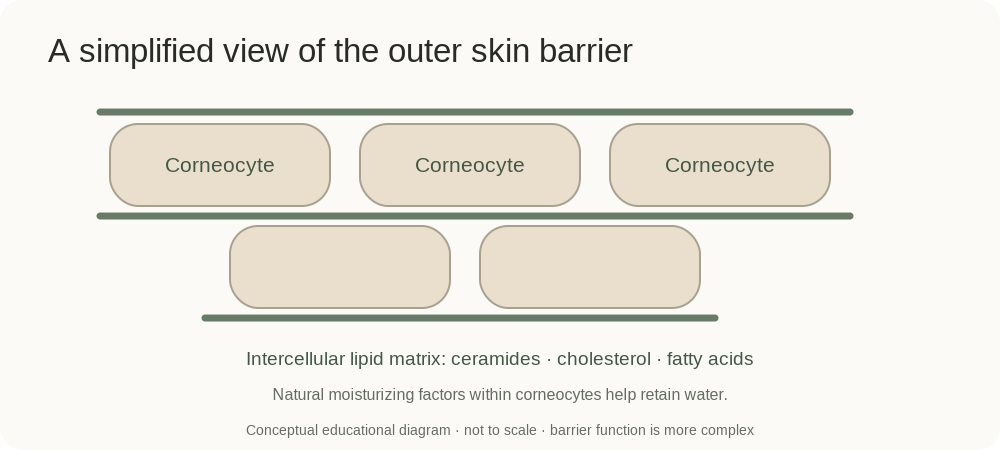
Transepidermal water loss describes water moving through the skin and evaporating from its surface. Barrier changes can affect water balance, but no at-home observation provides a clinical measurement. A small cross-sectional scalp study reported differences in hydration, surface lipid, and water loss in people with seborrheic dermatitis; it did not establish whether those differences caused the condition or provide diagnostic thresholds. Read the cross-sectional scalp study
Sebum is not skin hydration
Sebaceous glands associated with hair follicles release sebum onto the skin and hair. Sebum can affect surface feel, and scalp lipids may interact with the skin and its microorganisms. The stratum-corneum lipid barrier is not identical to surface sebum. A scalp can look oily while feeling irritated or dry.
Why skin sheds
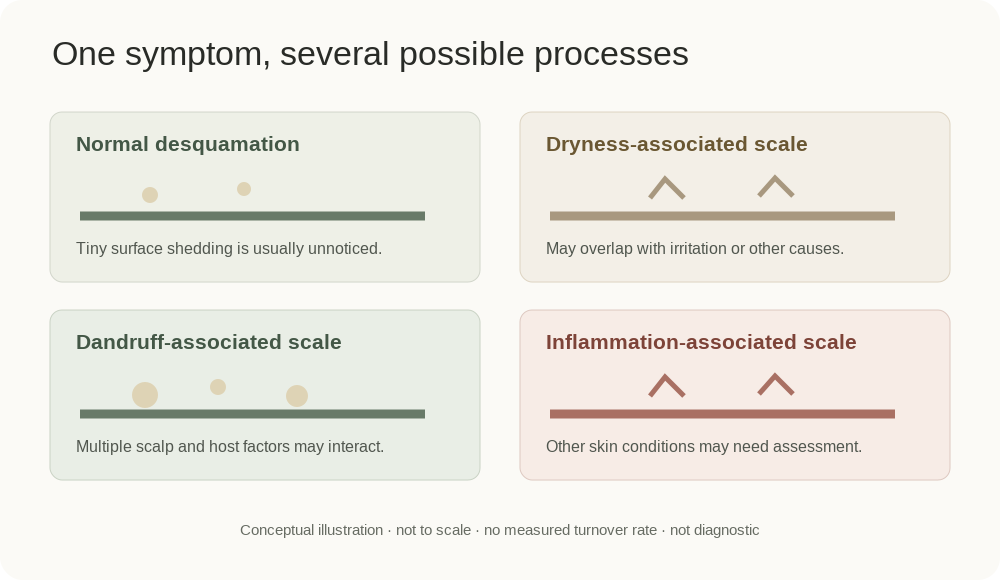
Skin cells are produced in the epidermis, differentiate as they move outward, and are shed from the surface. This ordinary desquamation is usually microscopic and unnoticed. Visible scale can accumulate when shedding, cohesion, skin hydration, irritation, inflammation, residue, or other processes change. “Faster turnover” is an oversimplification if treated as one measured cause for every flaky scalp.
Normal shedding
Regulated release of tiny corneocytes is part of healthy skin renewal.
Dryness-associated scale
May accompany reduced hydration or barrier irritation; it is not a diagnosis from appearance.
Dandruff-associated scale
Visible flakes can relate to interacting scalp, lipid, yeast, and host-response factors.
Inflammation-associated scale
Several conditions can alter skin and scale; persistent or thick changes may need an exam.
What is Malassezia?
Malassezia is a group of yeasts commonly found on human skin, including healthy skin. Its presence alone does not establish dandruff. Research and clinical guidance support an association between Malassezia and dandruff/seborrheic dermatitis, but the condition is better explained as an interaction among skin susceptibility, scalp lipids, barrier properties, and inflammatory responses—not simply “too much fungus.”
Some species, including M. globosa and M. restricta, are discussed in scalp research. Proposed mechanisms involving microbial use of lipids and potentially irritating by-products remain part of a more complex biological picture. A laboratory finding does not prove a treatment will work in every person. Antifungal treatment does not aim to sterilize the scalp, and a “microbiome reset” is not an established routine-care requirement.
Clinical guidance supports practical, label-aligned care; human trials answer questions about the particular intervention studied; observational studies identify associations rather than causes; laboratory mechanisms establish plausibility rather than clinical benefit; preliminary findings need replication; unsupported marketing claims such as permanent cures, scalp detoxification, and complete microbiome resets are not evidence.
For example, Suchonwanit et al. (2019) measured 42 Thai participants with scalp seborrheic dermatitis and 40 controls once. They reported group differences in water loss, hydration, and surface lipid, but a cross-sectional study cannot show that those differences caused disease or define a diagnostic threshold. Li et al. (2022) reported an association between Malassezia hyphae and seborrheic dermatitis in one clinical sample; it does not settle the full causal model.
For accessible clinical guidance, see the American Academy of Dermatology’s dandruff guidance and British Association of Dermatologists’ seborrheic dermatitis leaflet. These explain care options, not the cause of an individual reader’s symptoms.
Dandruff and seborrheic dermatitis
Dandruff is often used for scalp-limited flaking. Seborrheic dermatitis is an inflammatory, relapsing condition that can affect the scalp and other oil-rich areas. The boundary between the terms is not always used identically in clinical and consumer settings; more inflamed, extensive, or persistent symptoms may be described as seborrheic dermatitis.
| Feature | Dandruff description | Seborrheic dermatitis description |
|---|---|---|
| Scale | Visible scalp flaking may occur. | Flaking may be more extensive or occur with inflammation. |
| Other areas | Often discussed as scalp-specific. | May involve eyebrows, sides of nose, ears, beard, or other sebaceous areas. |
| Symptoms | Itching may or may not occur. | Itch and inflammation may occur; appearance varies across skin tones. |
| Course | Can recur. | Often relapsing and may need ongoing clinician- or label-directed care. |
| What helps | Some labeled anti-dandruff shampoos are used. | Treatment depends on site, severity, product, and diagnosis. |
Inflammation may not appear bright red on every skin tone; it can look darker, lighter, violet, or otherwise changed. A photograph alone cannot confirm either condition.
Interactive guide · no diagnosis
Scalp flaking observation guide
Organize what you notice, explore why causes can overlap, and identify when cosmetic routine changes are not enough. Your selections stay in this browser session and are not saved or sent.
Arrange professional evaluation for persistent or worsening flaking, severe itch, thick adherent scale, bleeding, repeated product reactions, associated hair loss, or symptoms affecting daily life.
Prompt assessment is appropriate for possible infection (especially pus, painful swelling, fever), new bald patches or broken hairs, possible scarring, severe persistent pain/burning, or rapidly worsening symptoms.
Breathing difficulty, throat/tongue swelling, fainting, or rapidly developing severe allergic symptoms: call your local emergency number now. Do not continue routine or product suggestions.
What flakes may look like—and why appearance is limited
Small or white flakes
Can accompany dry-feeling skin, dandruff, normal scale accumulation, or another condition.
Larger white scale
Size does not establish a cause or diagnosis.
Yellowish or greasy-looking scale
May appear with scalp surface oil or seborrheic dermatitis; it is not specific.
Thick, adherent scale
Can occur in inflammatory conditions; avoid forceful removal and consider assessment.
Powder-like particles
May be skin scale or cosmetic residue.
Particles attached to hairs
Hair casts, residue, lint, and nits can be confused; visual self-checks are imperfect.
Crusting or discharge
Especially with pain, pus, or feeling unwell, deserves medical attention.
Flakes with hair changes
Broken hairs or new patches require a different level of attention than uncomplicated flaking.
Lighting, hair products, styling, attachment to hair shafts, and skin tone affect appearance. Do not scrape or pick scale just to classify it.
Possible contributors to dry-feeling scalp
The items below are possible contributors, not a checklist of causes and not a diagnostic score. Some have broad skin-barrier plausibility; evidence varies by exposure and scalp-specific research is limited.
Low environmental humidity
Dry air may coincide with discomfort or dryness in susceptible skin.
Evidence context: General skin-barrier plausibility; individual responses vary.
Limit: It does not establish why one person's scalp flakes.
Low-risk thought: Consider comfortable cleansing and avoid adding several new products at once.
Possible contributor · not diagnosticCold weather
Cold outdoor conditions can accompany lower humidity and changes in skin comfort or routine.
Evidence context: General dermatology guidance and seasonal observation.
Limit: Seasonality is not a diagnosis or proof of causation.
Low-risk thought: Review comfort and product tolerance without assuming a seasonal cure.
Possible contributor · not diagnosticIndoor heating
Heated indoor air may coincide with lower humidity and dry-feeling skin.
Evidence context: General skin-barrier plausibility.
Limit: Direct scalp-specific causal evidence is limited.
Low-risk thought: Use comfort-focused environmental adjustments if already available; no purchase is required.
Possible contributor · not diagnosticHot water exposure
Hot or prolonged washing may aggravate dryness or irritation for some people.
Evidence context: General skin-care guidance; not a scalp diagnostic test.
Limit: Tolerance and exposure differ by person and product.
Low-risk thought: Choose comfortably warm water and rinse without forceful scrubbing.
Possible contributor · not diagnosticExcessive or unsuitable cleansing
Cleansing removes soil and some surface lipids; formula and frequency influence tolerance.
Evidence context: General formulation and barrier principles.
Limit: There is no universal wash schedule; avoiding cleansing can also leave buildup.
Low-risk thought: Review comfort, hair, styling, exercise, and product directions.
Possible contributor · not diagnosticProduct-related irritation
Fragrance, surfactants, preservatives, botanicals, and repeated exposure may irritate susceptible skin.
Evidence context: Clinical dermatology guidance on irritant/contact dermatitis.
Limit: Timing alone cannot identify a specific ingredient or cause.
Low-risk thought: Review recent exposures and seek advice for recurring or persistent reactions.
Possible contributor · not diagnosticFragrance sensitivity or allergy
Some people experience irritation or delayed allergic contact dermatitis from fragrance ingredients.
Evidence context: Established contact-dermatitis education; individual diagnosis needs assessment.
Limit: Fragrance-free labeling does not guarantee zero reaction risk.
Low-risk thought: Review the full formula and ask about clinician-directed patch testing if allergy is suspected.
Possible contributor · not diagnosticHair-dye exposure
Hair-color ingredients can irritate or trigger allergic reactions in some people.
Evidence context: Clinical guidance and known contact-allergy risk.
Limit: A reaction's appearance does not identify the ingredient by itself.
Low-risk thought: Avoid applying dye to irritated skin; seek advice for strong or repeated reactions.
Possible contributor · not diagnosticChemical hair treatments
Relaxers, straighteners, bleaching, and other processes can irritate scalp skin; hair-fiber damage is a separate issue.
Evidence context: Clinical safety context and general exposure plausibility.
Limit: A prior treatment does not prove it caused current scale.
Low-risk thought: Avoid chemical treatment on irritated skin and seek assessment for a significant reaction.
Possible contributor · not diagnosticRepeated mechanical irritation
Scratching, tight styling, rough tools, and forceful scale removal may injure skin or hair shafts.
Evidence context: Basic injury mechanism and clinical practice guidance.
Limit: Mechanical irritation may coexist with an underlying condition.
Low-risk thought: Handle gently and do not scrape attached scale.
Possible contributor · not diagnosticAtopic dermatitis or atopic tendency
Atopic skin can be dry, itchy, or more reactive, including on the scalp.
Evidence context: Clinical dermatology guidance; general skin-barrier evidence.
Limit: Not every flaky scalp in a person with atopy is eczema.
Low-risk thought: Use existing clinician guidance and avoid assuming the cause.
Possible contributor · not diagnosticAge-related skin changes
Skin characteristics can change with age and may influence comfort or tolerance.
Evidence context: General dermatology context.
Limit: Age alone does not explain a new or persistent scalp symptom.
Low-risk thought: Discuss new, changing, or persistent symptoms when appropriate.
Possible contributor · not diagnosticExisting barrier impairment
Inflammation, irritation, or another skin condition may affect barrier comfort and water balance.
Evidence context: General barrier biology; scalp-specific measurements are limited.
Limit: An at-home observation cannot measure barrier function.
Low-risk thought: Avoid layering remedies onto painful or inflamed skin.
Possible contributor · not diagnosticSelected medical circumstances or medicines
Some illnesses or medicines can affect skin; relevance depends on a person's history.
Evidence context: Clinical context requiring individualized assessment.
Limit: Do not infer medication causation or stop prescribed medicine independently.
Low-risk thought: Discuss a new skin change with a healthcare professional or pharmacist.
Possible contributor · not diagnosticOther environmental exposure
Sweat, heat, head coverings, travel, activity, water, and product residue can affect comfort or routine.
Evidence context: Plausible contextual factors; direct dandruff causation is not established.
Limit: A shower filter may not soften water, and environmental changes do not diagnose disease.
Low-risk thought: Review buildup and existing habits before buying a device or treatment.
Possible contributor · not diagnosticIndividual skin characteristics and overlap
Barrier sensitivity, hair pattern, product exposure, and more than one scalp process can vary between people.
Evidence context: Clinical observation and general dermatology context.
Limit: No list predicts an individual's diagnosis.
Low-risk thought: Use observations to inform questions, not to self-diagnose.
Possible contributor · not diagnosticFactors associated with dandruff or seborrheic dermatitis
Association, trigger, and established cause are not interchangeable. The exact role of several biological processes remains under study; do not assume stress or oil production alone explains a flare.
Malassezia interactions
Malassezia yeasts are associated with dandruff and seborrheic dermatitis and can also be found on healthy skin.
Evidence context: Clinical guidance, microbiological research, and mechanistic studies.
Limit: Presence alone is not disease; the complete causal pathway remains under study.
Practical relevance: Avoid scalp sterilization and unsupported microbiome-reset claims.
Sebum availability
Sebaceous secretions are one context in which scalp microbial and skin interactions occur.
Evidence context: Established biological context and observational research.
Limit: Visible oil does not diagnose dandruff or directly measure hydration.
Practical relevance: Separate surface sebum from outer-skin water content.
Sebum composition and lipid metabolism
Scalp lipids can interact with Malassezia metabolism and the surrounding skin environment.
Evidence context: Mechanistic and laboratory evidence with clinical associations.
Limit: Laboratory activity does not quantify an individual's disease or establish a universal treatment.
Practical relevance: Do not apply broad oil rules from a single mechanism.
Individual susceptibility
People differ in skin response, barrier properties, and susceptibility to inflammation.
Evidence context: Clinical and mechanistic synthesis.
Limit: No validated at-home susceptibility score is available here.
Practical relevance: A similar-looking scale can have different explanations in different people.
Skin-barrier properties
Barrier characteristics may be associated with dandruff or seborrheic dermatitis.
Evidence context: Cross-sectional scalp measurements and barrier research.
Limit: Association does not show that barrier differences caused the condition.
Practical relevance: Do not interpret oiliness or tightness as a clinical barrier measurement.
Inflammatory responses
Inflammation may contribute to itch, discomfort, and visible changes in some presentations.
Evidence context: Clinical and mechanistic research.
Limit: Inflammation can have many causes and may look different across skin tones.
Practical relevance: Persistent, painful, or extensive inflammation merits assessment.
Altered desquamation
Changes in corneocyte cohesion or visible shedding may contribute to scale accumulation.
Evidence context: Biological framework and clinical observation.
Limit: Simple 'fast turnover' diagrams are conceptual, not universal measured rates.
Practical relevance: Do not forcefully remove attached scale.
Seasonal influences
Some people report variation over time or with seasonal circumstances.
Evidence context: Clinical observation and guidance.
Limit: Seasonal timing does not establish cause or diagnosis.
Practical relevance: Review the broader pattern and product tolerance.
Environmental conditions
Humidity, temperature, sweat, and routine changes may affect comfort or cleansing habits.
Evidence context: Contextual plausibility; direct causal evidence varies.
Limit: Environmental context alone does not confirm dandruff.
Practical relevance: Make only comfortable, low-risk adjustments.
Stress associations
Stress may correlate with symptom flares for some people.
Evidence context: Reported associations and clinical observation.
Limit: Association does not prove stress is the sole cause or that stress management treats every case.
Practical relevance: Do not blame yourself or replace indicated care with stress management alone.
Neurologic or immune-related circumstances
Selected health circumstances have been associated with seborrheic dermatitis in clinical literature.
Evidence context: Clinical associations.
Limit: This is not a personal risk estimate and does not establish causation for an individual.
Practical relevance: Discuss relevant health changes with a clinician without assuming causation.
Recurrence and treatment-response variation
Symptoms may recur, and tolerance or response can differ across people and products.
Evidence context: Clinical guidance and observed relapsing course.
Limit: Recurrence does not mean poor hygiene or treatment failure by itself.
Practical relevance: Follow label or clinician directions; reassess persistent, unusual, or worsening symptoms.
Other causes of scalp scaling
Scalp psoriasis, atopic dermatitis, irritant or allergic contact dermatitis, tinea capitis, product residue, lice/nits, and other inflammatory or scarring disorders can resemble dandruff. These are educational clues only.
| Possibility | Observations that may occur | Why assessment may matter |
|---|---|---|
| Scalp psoriasis | Well-defined, thick plaques with scale may occur; appearance varies. | Persistent plaques, discomfort, or hair loss warrant evaluation. |
| Atopic dermatitis | Itch, dryness, irritation, or scale may occur. | History and examination may help distinguish causes. |
| Irritant contact dermatitis | May follow repeated exposure to irritating products or treatments. | Timing is relevant but does not prove the product caused it. |
| Allergic contact dermatitis | A delayed reaction to an ingredient can occur; fragrances, preservatives, botanicals, or dyes may be relevant. | Professional patch testing may be considered; home testing is not equivalent. |
| Tinea capitis | Scale with broken hairs or patchy hair loss may occur, particularly in children. | May need testing and prescription treatment; do not treat as ordinary dandruff alone. |
| Product residue | Dry shampoo or styling product may leave particles or buildup. | Residue and scale can be difficult to distinguish visually. |
| Lice and nits | Particles attached to hair can resemble scale. | Finding live lice is more useful than relying on a single white particle. |
| Other inflammatory or scarring disorders | Persistent pain, inflammation, scarring, or localized hair loss may occur. | Early professional assessment may be important. |
See DermNet’s scalp psoriasis overview, BAD’s tinea capitis guidance, and CDC head-lice guidance. None replaces an examination.
Dandruff and hair loss: what is known?
Ordinary flakes do not prove permanent follicle damage. Scratching or inflamed skin can coexist with broken hair shafts or temporary shedding, while patchy hair loss has other possible causes. Significant shedding, broken hairs, bald patches, or changes that progress should be assessed rather than treated with a growth-promising shampoo.
Related reading: Hair Shedding vs Hair Breakage: How to Tell the Difference.
How shampoo and labels work
Shampoo surfactants help lift and disperse oil, soil, and styling residue during rinsing. Anionic, amphoteric, and nonionic surfactants differ in properties; a finished product also includes co-surfactants, conditioning ingredients, preservatives, fragrance, and other components. A sulfate-free label does not guarantee a gentle formula, and sulfate presence alone does not prove harm.
Cosmetic cleansing shampoo, clarifying shampoo, scalp moisturizer, rinse-out conditioner, and medicated anti-dandruff shampoo have different intended uses. Conditioners mainly improve hair-fiber feel and manageability; they are not treatments for every scalp condition. A scalp product should be applied only where its label says.
Read the actual package
- Find the active ingredient and intended use, if the product has a Drug Facts panel.
- Read the full directions and warnings, including age limits and stop-use advice.
- Apply to the intended area. A scalp product is not automatically a hair-length conditioner.
- Follow the product-specific contact/rinse instructions. Do not invent a universal contact time.
- Use a suitable conditioner on hair lengths when appropriate.
- Stop and seek advice for worsening irritation; do not mix several medicated products without guidance.
Terms like “detox,” “microbiome friendly,” “natural,” “clinically proven,” “hypoallergenic,” and “dermatologist tested” do not by themselves establish a medical indication or guaranteed result.
Anti-dandruff and moisturizing ingredients
Ingredients work through different mechanisms. Antifungal ingredients target susceptible fungi in appropriate contexts; keratolytics can loosen scale; moisturizers may support hydration or comfort. Not every flaky scalp needs all categories, and formulas can combine several functions.
| Category | Examples | Educational role | Limit |
|---|---|---|---|
| Antifungal / antimicrobial actives | Ketoconazole, selenium sulfide; other actives depend on jurisdiction and label | Used in some anti-dandruff or seborrheic-dermatitis products. | Presence does not identify a diagnosis or ensure response. |
| Keratolytic | Salicylic acid | May loosen accumulated scale. | Scale removal is not equivalent to treating every cause. |
| Scale-modifying formulations | Coal tar and selected other actives | Used in some labeled products. | Indication and warnings depend on product and local law. |
| Humectant / emollient / barrier support | Glycerin, panthenol, urea, ceramides, hyaluronic acid, colloidal oatmeal, dimethicone, squalane | May support water retention, comfort, softness, or reduced friction. | General skin or cosmetic evidence is not proof of scalp-disease treatment. |
| Botanical / essential oil | Coconut, tea tree, rosemary | Cosmetic uses and limited research vary by ingredient/formulation. | “Natural” does not mean safe, effective, or non-allergenic. |
U.S. regulatory summary checked 2026-11-21: the current eCFR dandruff monograph lists specified actives for specified product claims. A DailyMed listing, a cosmetic ingredient allowance, and a medicine authorization are different things. Specific regional examples and gaps are visible in the ingredient tool below. Do not treat “not verified” as approved or banned.
Interactive reference · not a treatment selector
Compare scalp-care ingredients
Search and compare up to three ingredients. Regional information is narrowly scoped to sources reviewed on 2026-11-21; “not verified” means unavailable here, not approval or prohibition.
Do not select an active by flake color or use this tool as a diagnosis. A cosmetic ingredient is not automatically an authorized medicine. Product-specific local labels and clinician instructions take precedence.
Conceptual educational illustration; categories may overlap in a finished formula and none guarantees a clinical outcome.
Ketoconazole
Function: An antifungal active used in some anti-dandruff and seborrheic-dermatitis shampoos.
Mechanism: Reduces susceptible yeast activity. This does not sterilize the scalp or address every possible cause of scaling.
Evidence: Clinical guidance recognizes ketoconazole shampoo as one option for dandruff-associated scalp symptoms; product class and instructions matter.
Limit: The U.S. OTC example in DailyMed is a product-specific label. Do not transfer its directions or concentration to another product or country.
US status checked 2026-11-21: A specific OTC 1% shampoo label is listed in DailyMed (example checked 2026-11-21); do not treat this as a complete market or label census.
Precaution: Check the actual package, warnings, age limits, and stop-use instructions. Seek advice for persistent symptoms or a suspected reaction.
Label: Follow the exact local product label; OTC and prescription formulations are not interchangeable.
Evidence types: Clinical guidance, Human research
Selenium sulfide
Function: An active used in certain labeled anti-dandruff products.
Mechanism: Has antifungal and skin-cell-shedding effects in relevant formulations; mechanism should not be reduced to complete yeast removal.
Evidence: Included among U.S. OTC monograph actives for specified dandruff-related uses.
Limit: Monograph parameters are not a substitute for verifying a particular product's active strength, intended use, directions or warnings.
US status checked 2026-11-21: Listed in eCFR OTC dandruff monograph for specified claims; product label governs.
Precaution: Some labels include hair/scalp precautions. Read and follow the package; stop and seek advice if irritation worsens.
Label: Frequency and any contact period differ by product. Do not infer from an ingredient name.
Evidence types: Clinical guidance, Human research
Zinc pyrithione
Function: An active in some anti-dandruff formulations, where locally authorized and labeled.
Mechanism: Has antimicrobial activity in product formulations; clinical response depends on the product and scalp condition.
Evidence: Included in U.S. OTC monograph parameters for specified dandruff products; status differs by jurisdiction and product class.
Limit: A cosmetic restriction is not the same as a medicine authorization. Never extrapolate one country's status to another.
US status checked 2026-11-21: Listed in eCFR OTC dandruff monograph for specified uses.
Precaution: Verify the current local label and do not use an imported product as a substitute for local professional advice.
Label: Use only as labeled in your country; regulations and product status may change.
Evidence types: Clinical guidance, Human research, Laboratory
Salicylic acid
Function: Can help loosen accumulated scale in products formulated for the scalp.
Mechanism: Keratolytic action softens or loosens surface scale; this is not the same as treating every underlying cause.
Evidence: Listed in U.S. OTC monograph parameters for specified dandruff-related products; label and formulation matter.
Limit: Scale removal alone may not address inflammation, yeast-related interactions, contact reactions or another diagnosis.
US status checked 2026-11-21: Listed in eCFR OTC monograph for specified claims.
Precaution: Can irritate or dry skin. Avoid forceful removal and follow the exact product warning and directions.
Label: No universal application frequency or contact time; follow the product label.
Evidence types: Clinical guidance, Human research
Coal tar
Function: Used in some scalp preparations for scaling; product availability and indications vary.
Mechanism: Can influence epidermal proliferation and scaling in certain skin conditions; the intended use is formulation-specific.
Evidence: Included in U.S. OTC monograph parameters for specified dandruff/seborrheic-dermatitis/psoriasis claims.
Limit: It is not a universal dandruff treatment and may have practical, sensory, or product-specific limitations.
US status checked 2026-11-21: Listed in eCFR OTC monograph for specified claims.
Precaution: Follow product warnings. Ask a clinician or pharmacist if pregnant, treating a child, or unsure whether a product is appropriate.
Label: Check the current label for warnings, intended age group, and directions.
Evidence types: Clinical guidance, Human research
Ciclopirox
Function: A prescription topical antifungal available in certain scalp formulations.
Mechanism: Antifungal activity; clinician selection depends on diagnosis, formulation and local authorization.
Evidence: A U.S. DailyMed prescription shampoo label indicates treatment of scalp seborrheic dermatitis in adults; AAD lists it as a clinical option.
Limit: This is not a general OTC ingredient recommendation. The specific prescription label controls.
US status checked 2026-11-21: Specific prescription shampoo label reviewed in DailyMed; adult scalp seborrheic dermatitis indication.
Precaution: Use only as prescribed and do not transfer a regimen to another medicine or person.
Label: Prescription product-specific instructions apply; no dose or contact time is generated by this guide.
Evidence types: Clinical guidance, Human research
Piroctone olamine
Function: Used in some cosmetic anti-dandruff formulations.
Mechanism: Laboratory antifungal activity is reported; the effects of a finished product depend on formulation and use.
Evidence: Evidence is formulation-specific; presence in a cosmetic is not proof of a medicine authorization or equal clinical effectiveness.
Limit: Current product-level authorization was not comprehensively verified for the listed jurisdictions.
US status checked 2026-11-21: Not listed among the actives in the reviewed OTC dandruff monograph; current product-level status not comprehensively verified.
Precaution: Review the full ingredient list and stop a product that repeatedly irritates the scalp.
Label: Cosmetic ingredient use does not establish an approved drug claim.
Evidence types: Laboratory, Cosmetic formulation, Preliminary
Climbazole
Function: Used in some cosmetic anti-dandruff shampoos in jurisdictions permitting the relevant use.
Mechanism: Has antifungal activity in laboratory/formulation contexts; clinical effect depends on finished product and condition.
Evidence: Cosmetic formulation evidence is not equivalent to a locally authorized medicine indication.
Limit: Only a narrowly scoped EU cosmetics rule was verified here; broad cross-region product status remains unavailable.
US status checked 2026-11-21: Not listed in reviewed OTC dandruff monograph; broader product status not comprehensively verified.
Precaution: Do not infer a treatment indication from ingredient presence; consult the local product label.
Label: Regional rules apply to a specific product class, not automatically to medicinal products.
Evidence types: Laboratory, Cosmetic formulation
Glycerin
Function: A water-binding ingredient used in many skin and hair formulations.
Mechanism: Humectant action can support stratum-corneum water content when used in a suitable formula.
Evidence: General skin moisturization function is established; scalp-specific clinical treatment evidence is limited.
Limit: Ingredient presence alone does not determine product tolerance or performance; the whole formula matters.
US status checked 2026-11-21: Cosmetic function; not a dandruff drug active by virtue of being glycerin.
Precaution: If a formula stings or worsens symptoms, discontinue non-prescribed use and consider professional guidance.
Label: Use only products intended for the scalp or the application area stated on the label.
Evidence types: Clinical guidance, Cosmetic formulation
Panthenol
Function: A conditioning ingredient used in cosmetic formulations.
Mechanism: Can contribute humectant and hair-conditioning properties depending on the finished product.
Evidence: Cosmetic use is common; scalp-specific evidence for treating a diagnosed scalp condition is limited.
Limit: A familiar ingredient does not guarantee that a product will suit a sensitive scalp.
US status checked 2026-11-21: Cosmetic ingredient; not a dandruff drug active by itself.
Precaution: Check the complete formula, including fragrance and preservatives, when reviewing a possible product reaction.
Label: The finished formulation and intended application area matter.
Evidence types: Cosmetic formulation, Preliminary
Sources: Source 1
Urea
Function: Can function as a humectant; some formulations also soften scale.
Mechanism: Function depends on concentration, vehicle, and use; do not infer the effect from ingredient name alone.
Evidence: General dermatologic moisturization evidence exists, but scalp-specific evidence and product suitability vary.
Limit: May sting on irritated or fissured skin; not a universal scalp moisturizer or scale treatment.
US status checked 2026-11-21: Cosmetic/drug status is product-specific; no dandruff indication inferred.
Precaution: Follow formulation directions and avoid using on damaged skin unless the product or clinician directs it.
Label: Use only the finished product according to its label.
Evidence types: Clinical guidance, Cosmetic formulation
Sources: Source 1
Ceramides
Function: Skin-identical lipid components used in some barrier-support moisturizers.
Mechanism: Together with cholesterol and fatty acids, ceramides contribute to organized stratum-corneum intercellular lipids.
Evidence: Barrier biology is well established generally; scalp-specific clinical product evidence is more limited.
Limit: A product containing ceramides is not automatically appropriate for every scalp or every diagnosis.
US status checked 2026-11-21: Cosmetic ingredient category; not a dandruff drug active by itself.
Precaution: Consider vehicle, fragrance, residue and tolerance; seek care for persistent or inflamed scaling.
Label: Assess the whole formula, not a single highlighted ingredient.
Evidence types: Clinical guidance, Cosmetic formulation
Hyaluronic acid
Function: A water-binding ingredient used in leave-on and rinse-off cosmetics.
Mechanism: Can retain water in a suitable formula; topical product effects depend on the vehicle and conditions of use.
Evidence: General skin/cosmetic evidence; scalp-specific clinical evidence for treating flaking is limited.
Limit: It does not diagnose or treat the underlying cause of dandruff or inflammatory scaling.
US status checked 2026-11-21: Cosmetic ingredient; no dandruff-drug status inferred.
Precaution: Check the product's intended area, fragrance, preservatives and tolerance.
Label: Marketing claims about hydration do not establish disease treatment.
Evidence types: Cosmetic formulation, Preliminary
Sources: Source 1
Colloidal oatmeal
Function: Used in some skin products for soothing and barrier-support purposes.
Mechanism: The complete colloidal formulation may reduce dry-skin discomfort; evidence is formulation- and condition-specific.
Evidence: Some dermatology guidance supports products formulated with colloidal oatmeal for dry/sensitive skin; this is not a dandruff cure claim.
Limit: A small trial of a combination blend containing oatmeal and plant-derived esters cannot establish the effect of oatmeal alone on scalp flaking.
US status checked 2026-11-21: Ingredient in skin-protectant/cosmetic formulations; product claims vary.
Precaution: Avoid if known allergy or a previous reaction; evaluate the full ingredient list.
Label: Use the formulation as labeled; do not apply food-grade ingredients as a substitute.
Evidence types: Clinical guidance, Human research, Cosmetic formulation
Dimethicone
Function: A conditioning and protective film-forming ingredient in many cosmetics.
Mechanism: Can improve slip and reduce friction on hair or skin depending on the vehicle; not an antifungal.
Evidence: Cosmetic function is formulation-specific; dandruff treatment evidence is not established by the ingredient alone.
Limit: It does not inherently cause scalp disease; product buildup and tolerance vary by formula and cleansing routine.
US status checked 2026-11-21: Cosmetic uses are formulation-specific; no dandruff-drug status inferred.
Precaution: Use the product as intended and consider application area and residue.
Label: Do not judge a shampoo by one ingredient alone.
Evidence types: Cosmetic formulation
Sources: Source 1
Squalane
Function: A lightweight emollient used in cosmetic formulas.
Mechanism: Can soften skin and improve feel; it does not directly replace the skin's complete barrier lipid organization.
Evidence: General cosmetic function; limited scalp-specific clinical evidence for flaky scalp.
Limit: Product vehicle, dose and individual tolerance influence residue and feel.
US status checked 2026-11-21: Cosmetic ingredient; no dandruff-drug status inferred.
Precaution: Stop if irritation develops; do not use oils to delay evaluation of persistent symptoms.
Label: A moisturizing ingredient is not automatically a scalp treatment.
Evidence types: Cosmetic formulation, Preliminary
Sources: Source 1
Coconut oil
Function: Can lubricate hair fibers and soften skin in some cosmetic uses.
Mechanism: Emollient effects depend on application area and product use; evidence on hair-fiber use should not be mistaken for dandruff treatment.
Evidence: A small trial of a formulated multi-ingredient emollient blend containing coconut/sunflower-derived esters does not prove plain coconut oil treats scalp disease.
Limit: Scalp-specific clinical evidence is limited and oil tolerance/residue differ. It may not suit every person's scalp routine.
US status checked 2026-11-21: Cosmetic oil; not an anti-dandruff drug active.
Precaution: Avoid applying a product that worsens symptoms; consider hair-length application separately from scalp use.
Label: Do not use as a substitute for diagnosis or labeled treatment.
Evidence types: Human research, Cosmetic formulation
Tea tree oil
Function: An essential oil found in some formulated hair products.
Mechanism: Laboratory antimicrobial activity does not establish an effective or safe DIY scalp treatment.
Evidence: Evidence for selected shampoo formulations is limited; allergic contact dermatitis and irritation are reported risks.
Limit: Product concentration, oxidation, formulation and study design matter; do not generalize a specific product result.
US status checked 2026-11-21: Cosmetic formulation status is product-specific; not a monograph dandruff active.
Precaution: Do not apply undiluted essential oil. Stop use if rash, burning or swelling occurs; urgent symptoms need urgent care.
Label: Avoid DIY dilution recipes and use only products labeled for their intended application.
Evidence types: Laboratory, Human research, Preliminary
Rosemary oil
Function: A fragrant botanical oil used in some cosmetic products.
Mechanism: Laboratory or hair-growth research for other conditions does not establish dandruff treatment efficacy.
Evidence: No robust evidence reviewed here establishes rosemary oil as a dandruff treatment; allergic contact dermatitis case reports exist.
Limit: Evidence about hair growth or other conditions must not be transferred to dandruff.
US status checked 2026-11-21: Cosmetic formulation status is product-specific; not a monograph dandruff active.
Precaution: Do not apply undiluted essential oil; fragrance/botanical ingredients can irritate or sensitize.
Label: Natural origin does not establish safety or effectiveness.
Evidence types: Laboratory, Preliminary
Eight-question knowledge check (educational, not a health score)
This quiz checks general knowledge only. Its score says nothing about your scalp or whether you need care.
Answered 0 of 8.
Scalp moisturizers vs hair conditioners
A scalp moisturizer or serum is intended for skin application according to its directions. A rinse-out or leave-in conditioner is primarily designed for hair fibers. A hair mask and oil may improve feel or lubrication along the lengths but do not automatically address scalp inflammation. Consider residue, texture, treatment history, and tolerance. Avoid applying heavy face/body products indiscriminately to the scalp.
Glycerin and hyaluronic acid are humectant examples; dimethicone and suitable emollients may soften or reduce friction; ceramides are part of general barrier-lipid biology. The finished formula matters more than a single highlighted ingredient, and scalp-specific clinical evidence varies.
Oils, botanicals, and viral scalp remedies
Coconut oil, rosemary oil, and tea tree oil
Coconut oil may lubricate hair lengths; that does not prove it treats dandruff. A small study of a multi-ingredient emollient formula is not evidence that plain coconut oil cures scalp disease. Rosemary hair-growth research is not dandruff-treatment research. Tea tree laboratory activity or a study of one shampoo formulation does not establish benefit for every product; essential oils can irritate or cause allergic contact dermatitis. Do not apply undiluted essential oils.
Household remedies
Apple cider vinegar
Popular claim: A rinse may balance scalp pH or remove dandruff.
Evidence: A 2019 pilot study tested 0.5% acetic-acid soaks on forearms in people with atopic dermatitis and healthy controls; it did not establish a scalp benefit.
Limit: The study found no significant sustained barrier benefit and cannot establish scalp safety or dandruff efficacy.
Potential concern: Acidic exposure can irritate; the study reported mild side effects in most participants.
Safer alternative: Skip concentrated DIY acids. Use suitable labeled products and seek advice for persistent symptoms.
Lemon juice
Popular claim: Its acidity or vitamin content may reduce flakes.
Evidence: No reliable scalp-dandruff treatment evidence was identified for household lemon juice.
Limit: Food or cosmetic use is not evidence of a dandruff treatment.
Potential concern: Acidity, fragrance compounds, and sun exposure can irritate or sensitize skin.
Safer alternative: Avoid applying food acids to irritated scalp skin.
Baking soda
Popular claim: A scrub or paste may remove buildup and flakes.
Evidence: A dermatology review discusses limited evidence and does not support a universal scalp-treatment recipe.
Limit: Household powder is not a standardized scalp formulation.
Potential concern: Alkaline exposure and abrasion may worsen irritation or barrier discomfort.
Safer alternative: Do not scrub; follow appropriate product labels and seek care when indicated.
Undiluted tea tree oil
Popular claim: Strong antifungal action will treat dandruff quickly.
Evidence: Laboratory activity and limited studies of formulated products do not establish benefit for undiluted oil.
Limit: A particular shampoo formulation cannot be generalized to all concentrations or uses.
Potential concern: Concentrated or oxidized essential oil can irritate or cause allergic contact dermatitis.
Safer alternative: Do not apply undiluted essential oil; discuss persistent flaking with a professional.
Undiluted rosemary oil
Popular claim: It can treat dandruff while stimulating hair growth.
Evidence: Evidence about hair growth or laboratory activity is not proof of dandruff treatment.
Limit: No robust evidence reviewed here establishes rosemary oil as a dandruff treatment.
Potential concern: Essential oils can irritate or sensitize skin.
Safer alternative: Avoid undiluted oil and do not use hair-growth claims as scalp-disease evidence.
Raw garlic
Popular claim: Its antimicrobial properties may eliminate scalp yeast.
Evidence: Laboratory antimicrobial activity does not establish a safe, effective scalp remedy.
Limit: No standardized, high-quality dandruff treatment evidence was identified for raw garlic.
Potential concern: Direct application can cause significant irritation or chemical injury.
Safer alternative: Avoid raw garlic on scalp skin; use clinical guidance for persistent symptoms.
Salt scalp scrubs
Popular claim: Abrasive salt will exfoliate flakes and clean pores.
Evidence: Mechanical removal is not evidence that the underlying cause has been treated.
Limit: No universal benefit or safe exfoliation method is established for an irritated scalp.
Potential concern: Abrasive particles can scratch or worsen inflammation.
Safer alternative: Do not scrape or forcefully remove attached scale.
Sugar scalp scrubs
Popular claim: Sugar crystals provide gentle exfoliation.
Evidence: No reliable evidence establishes sugar scrubs as dandruff treatment.
Limit: Abrasiveness varies by particle size, pressure, and vehicle.
Potential concern: Friction may injure sensitive or inflamed skin.
Safer alternative: Use gentle cleansing; seek assessment for thick, painful, or persistent scale.
Yogurt-based treatments
Popular claim: Fermented cultures restore the scalp microbiome.
Evidence: Food cultures on skin are not a clinically established microbiome treatment.
Limit: Microbiome-reset claims are unsupported by a home yogurt application.
Potential concern: Food residues may irritate, contaminate, or leave buildup; allergy is possible.
Safer alternative: Avoid food-based scalp mixtures and rely on sourced guidance.
Aloe vera preparations
Popular claim: Aloe will soothe every itchy or flaky scalp.
Evidence: Evidence depends on the exact finished product and condition; a universal dandruff effect is not established.
Limit: Aloe gel, fragrance, preservatives, and other ingredients differ across formulas.
Potential concern: Some people can react to botanical ingredients or preservatives.
Safer alternative: If using a cosmetic, choose an intended scalp product you tolerate; stop if irritation worsens.
Overnight oiling
Popular claim: Leaving oil on overnight moisturizes and clears dandruff.
Evidence: Hair-fiber lubrication does not prove scalp-disease treatment.
Limit: Scalp effects vary by oil, formula, application, and person.
Potential concern: Residue, irritation, or worsening discomfort can occur; oils may not suit every scalp.
Safer alternative: Separate hair-length conditioning from scalp care and avoid any product that provokes symptoms.
Commercial scalp detox
Popular claim: A detox product removes toxins or resets the scalp microbiome.
Evidence: These marketing claims do not establish toxin removal or microbiome resetting.
Limit: Cleansing or exfoliation does not diagnose or cure a scalp condition.
Potential concern: Strong fragrance, acids, alkalis, or abrasive ingredients may irritate.
Safer alternative: Review the full label and use an appropriate cleanser only for its stated purpose.
A small apple-cider-vinegar study did not show sustained barrier improvement; its results do not establish safety for every concentration or scalp. “Scalp detox” does not mean removal of toxins from the body.
Weather, water, and washing frequency
Cold outdoor air, low humidity, indoor heating, sweat, head coverings, activity, travel, and changes in routine may affect comfort or hair-care habits. This does not make weather a diagnosis. Hard water minerals can alter hair feel and product behavior; current evidence does not show that hard water causes every case of dandruff. A standard shower filter may reduce chlorine or particles but may not soften water; check the device’s actual claims before purchase.
Choose washing frequency according to scalp comfort, oil, hair texture, density, styling, exercise, product buildup, chemical processing, and the directions of medicated products. Curly and coily hair may need different handling than fine straight hair. This is not a reason to avoid appropriate scalp cleansing or to use a one-size-fits-all schedule.
Ten flexible routine templates
These are educational starting points, not disease-specific treatment plans. Choose only what fits your circumstances and existing clinician advice.
- Describe what you notice; do not diagnose from flake color, size, or oiliness.
- Use a comfortable, well-tolerated product already available and follow its exact label; no universal schedule applies.
- Avoid forceful scale removal and unverified DIY mixtures. Seek professional assessment for persistent, worsening, painful, infected-looking, or hair-loss-associated changes.
Dry-feeling scalp, no warning signs
Goal: Support comfort without assuming the cause of flaking.
Wash day: Use comfortably warm water and a cleanser you already tolerate. Choose frequency according to comfort, hair, and styling needs; there is no universal schedule.
Between washes: Handle gently and avoid scratching or scraping attached scale.
Scalp vs hair lengths: A scalp product and a hair-length conditioner have different intended uses. Apply each only as its label directs.
Environment: Low humidity, heating, weather, and routine changes may affect comfort but do not diagnose a condition.
Products: A suitable scalp moisturizer is optional; the full formula and personal tolerance matter.
Avoid: Do not assume an oil, scrub, or several new products are necessary.
No-cost option: Try comfortable water temperature, gentle handling, and a well-tolerated product already at home.
When to seek evaluation: Arrange assessment if symptoms persist, worsen, or become painful or unusual.
Recurring dandruff concerns
Goal: Use label-aligned care only when a product is appropriate for you.
Wash day: Read the active ingredient, intended use, directions, age limits, and warnings on the exact current package. There is no universal shampoo schedule or contact time.
Between washes: Avoid forceful scale removal and do not automatically add another medicated product.
Scalp vs hair lengths: Apply a medicated scalp product where the label directs; condition hair lengths separately if suitable.
Environment: Seasonal recurrence can happen but does not prove the cause.
Products: An appropriately labeled anti-dandruff product is one possible option; a clinician or pharmacist can help with uncertainty.
Avoid: Do not combine actives or increase use without label or professional guidance.
No-cost option: Review a product you already own before buying anything; if it is unsuitable or expired, ask about alternatives.
When to seek evaluation: Seek professional evaluation for persistent, severe, worsening, or recurrent symptoms that concern you.
Oily-feeling scalp with flakes
Goal: Separate surface oil from hydration and avoid diagnosing by appearance.
Wash day: Use a comfortable cleansing approach suited to your scalp, hair texture, activity, and product directions.
Between washes: Avoid scrubbing harder to remove every visible flake.
Scalp vs hair lengths: Condition hair lengths according to their needs; scalp oil is not a measure of skin-water content.
Environment: Sweat, head coverings, activity, and styling can change routine needs but are not diagnoses.
Products: Choose products by intended use, complete label, and tolerance—not by oiliness alone.
Avoid: Do not assume oil proves dandruff or that drying the scalp will solve it.
No-cost option: Review buildup and your current cleansing habits before buying a filter, scrub, or detox product.
When to seek evaluation: Persistent itch, inflammation, pain, thick scale, or hair changes deserve assessment.
Curly, coily, or textured hair
Goal: Protect hair-fiber handling while keeping the scalp accessible to suitable care.
Wash day: Plan a comfortable method for reaching the scalp. If using a medicated product, follow its exact label rather than a generic schedule.
Between washes: Detangle and style with gentle handling that fits your hair and protective style.
Scalp vs hair lengths: Condition the lengths as needed; do not assume a length conditioner treats a scalp condition.
Environment: Activity, climate, covering, and styling practices can affect comfort and routine.
Products: Use existing products that suit your scalp and hair. Buying a new product is optional.
Avoid: Do not leave concerning symptoms unassessed to preserve a hairstyle or avoid wash-day inconvenience.
No-cost option: Adjust the technique and timing of existing care; no special applicator is required by this guide.
When to seek evaluation: Seek assessment for persistent symptoms, pain, infection signs, or new thinning or patches.
Dry hair lengths with scalp flaking
Goal: Treat scalp observations and hair-fiber dryness as separate concerns.
Wash day: Cleanse the scalp as appropriate and follow any medicated-product directions exactly.
Between washes: Reduce unnecessary friction and heat if they make the lengths feel worse.
Scalp vs hair lengths: A suitable conditioner may help hair lengths feel more manageable; it is not automatically a scalp treatment.
Environment: Weather and styling may affect hair feel without explaining scalp scale.
Products: Use a compatible conditioner on the intended area and consider scalp products only when appropriate.
Avoid: Do not apply heavy oils to the scalp solely because the hair lengths feel dry.
No-cost option: Use a suitable conditioner you already own on the hair lengths as directed.
When to seek evaluation: Get advice if flaking is persistent or associated with pain, inflammation, or hair loss.
Possible irritation after a product change
Goal: Treat timing as a clue to discuss, not proof of an allergy or diagnosis.
Wash day: Stop a clearly irritating non-prescribed product and avoid further exposure while symptoms settle or advice is arranged.
Between washes: Do not repeatedly re-challenge a product after a significant reaction.
Scalp vs hair lengths: Review both scalp and hair products, including dyes, fragrances, leave-ons, and styling products.
Environment: Write down the timing and any simultaneous changes; several exposures can overlap.
Products: Do not add a new remedy to cover a suspected reaction. Follow clinician advice for prescribed products.
Avoid: Avoid home patch-test substitutes and further exposure after a suspected significant allergic reaction.
No-cost option: Pause nonessential new products rather than purchasing another product to counteract irritation.
When to seek evaluation: Seek care if symptoms persist, spread, worsen, or include marked swelling. Breathing difficulty or throat/tongue swelling is an emergency.
Winter or indoor-heating comfort
Goal: Consider environmental context without treating the season as a diagnosis.
Wash day: Keep cleansing comfortable and individualized. Follow the label of any medicated product.
Between washes: Avoid very hot water, abrasive scrubs, and unnecessary product layering if they irritate you.
Scalp vs hair lengths: A dry-feeling scalp and dry hair lengths may need different considerations.
Environment: Cold air, lower humidity, and indoor heating may affect comfort; responses vary.
Products: Use products already tolerated and intended for the scalp or hair area being treated.
Avoid: Do not use a seasonal pattern to self-diagnose or promise that one moisturizer will fix flaking.
No-cost option: Review water temperature and existing indoor comfort before buying a humidifier or product.
When to seek evaluation: Warning signs override seasonal self-care; persistent or worsening symptoms need assessment.
Sensitive or easily irritated scalp
Goal: Keep changes simple and prioritize tolerance and safety.
Wash day: Use a comfortable, well-tolerated cleanser and follow any product label.
Between washes: Avoid scratching, scraping, and repeated exposure to a product that provokes symptoms.
Scalp vs hair lengths: Check whether a product is designed for scalp skin or hair fibers.
Environment: Record relevant exposure changes without assuming a single trigger.
Products: A fragrance-free claim may help some people but does not guarantee zero reaction risk; the full formula matters.
Avoid: Avoid undiluted essential oils, concentrated household acids or alkalis, and multiple new products at once.
No-cost option: Simplify nonessential products you already use; do not stop prescribed care without advice.
When to seek evaluation: Repeated reactions, persistent irritation, pain, or spreading symptoms warrant professional advice.
Zero-dollar routine
Goal: Make no purchase because of this educational tool.
Wash day: Use an existing, suitable, well-tolerated cleanser and follow any actual product directions.
Between washes: Handle gently and avoid scraping, DIY remedies, and unnecessary layering.
Scalp vs hair lengths: Use only existing products on their intended areas; scalp and hair-length care differ.
Environment: Observe comfort and routine changes without buying an environmental device.
Products: A purchase is not required. A clinician, pharmacist, or local care service can discuss lower-cost options where available.
Avoid: Do not let budget or a routine experiment delay evaluation for warning signs.
No-cost option: Use comfortable water, gentle handling, and existing suitable products.
When to seek evaluation: Seek care when appropriate even if cost is a concern; ask about accessible options.
After symptoms improve or recur
Goal: Keep expectations realistic; improvement does not prove permanent resolution.
Wash day: Follow current label or clinician maintenance instructions rather than inventing a schedule.
Between washes: Notice significant recurrence without compulsive checking or forceful removal.
Scalp vs hair lengths: Continue separating scalp treatment from hair-length conditioning.
Environment: Consider changed products, activity, or season as context, not established cause.
Products: Do not increase strength, frequency, or number of actives without appropriate guidance.
Avoid: Avoid guaranteed timelines, permanent-cure claims, and unverified microbiome resets.
No-cost option: Review the instructions and products you already use before adding anything.
When to seek evaluation: Consult a professional if recurrence is persistent, severe, atypical, or associated with hair changes.
A simple three-step framework
- Cleanse appropriately. Adjust to comfort and haircare needs; follow any medicated product label.
- Address the relevant concern. Moisturizing and anti-dandruff products do not do the same job. Avoid selecting either based on flake color.
- Keep handling gentle. Avoid scratching, unnecessary layering, and concentrated home remedies. Choose professional assessment when indicated.
Interactive planner · educational only
Build a simple scalp-care routine
Review habits and products you already use. The guide does not diagnose or generate medical treatment. Answers are not stored or transmitted.
Arrange professional evaluation for persistent or worsening flaking, severe itch, thick adherent scale, bleeding, repeated product reactions, associated hair loss, or symptoms affecting daily life.
Prompt assessment is appropriate for possible infection (especially pus, painful swelling, fever), new bald patches or broken hairs, possible scarring, severe persistent pain/burning, or rapidly worsening symptoms.
Breathing difficulty, throat/tongue swelling, fainting, or rapidly developing severe allergic symptoms: call your local emergency number now. Do not continue routine or product suggestions.
Fifteen evidence-informed habits
- Individualize cleansing. Keep the action comfortable and appropriate to your hair and scalp. This is a low-risk consideration, not a guaranteed treatment; a no-cost version is often to simplify existing habits and read the label.
- Use comfortably warm water. Keep the action comfortable and appropriate to your hair and scalp. This is a low-risk consideration, not a guaranteed treatment; a no-cost version is often to simplify existing habits and read the label.
- Handle scalp gently. Keep the action comfortable and appropriate to your hair and scalp. This is a low-risk consideration, not a guaranteed treatment; a no-cost version is often to simplify existing habits and read the label.
- Avoid aggressive scratching. Keep the action comfortable and appropriate to your hair and scalp. This is a low-risk consideration, not a guaranteed treatment; a no-cost version is often to simplify existing habits and read the label.
- Read product labels. Keep the action comfortable and appropriate to your hair and scalp. This is a low-risk consideration, not a guaranteed treatment; a no-cost version is often to simplify existing habits and read the label.
- Follow medicated directions. Keep the action comfortable and appropriate to your hair and scalp. This is a low-risk consideration, not a guaranteed treatment; a no-cost version is often to simplify existing habits and read the label.
- Review new products. Keep the action comfortable and appropriate to your hair and scalp. This is a low-risk consideration, not a guaranteed treatment; a no-cost version is often to simplify existing habits and read the label.
- Separate scalp and hair-length care. Keep the action comfortable and appropriate to your hair and scalp. This is a low-risk consideration, not a guaranteed treatment; a no-cost version is often to simplify existing habits and read the label.
- Avoid abrasive treatments. Keep the action comfortable and appropriate to your hair and scalp. This is a low-risk consideration, not a guaranteed treatment; a no-cost version is often to simplify existing habits and read the label.
- Avoid undiluted essential oils. Keep the action comfortable and appropriate to your hair and scalp. This is a low-risk consideration, not a guaranteed treatment; a no-cost version is often to simplify existing habits and read the label.
- Review residue. Keep the action comfortable and appropriate to your hair and scalp. This is a low-risk consideration, not a guaranteed treatment; a no-cost version is often to simplify existing habits and read the label.
- Choose comfortable styles. Keep the action comfortable and appropriate to your hair and scalp. This is a low-risk consideration, not a guaranteed treatment; a no-cost version is often to simplify existing habits and read the label.
- Consider indoor dryness. Keep the action comfortable and appropriate to your hair and scalp. This is a low-risk consideration, not a guaranteed treatment; a no-cost version is often to simplify existing habits and read the label.
- Avoid unverified remedies. Keep the action comfortable and appropriate to your hair and scalp. This is a low-risk consideration, not a guaranteed treatment; a no-cost version is often to simplify existing habits and read the label.
- Seek care for warning signs. Keep the action comfortable and appropriate to your hair and scalp. This is a low-risk consideration, not a guaranteed treatment; a no-cost version is often to simplify existing habits and read the label.
A seven-day gentle review—not a dandruff cure
- Notice current symptoms without diagnosing.
- Read product labels.
- Simplify nonessential layering; do not stop prescribed care without advice.
- Review heat, friction and cleansing habits.
- Separate scalp care from hair-length care.
- Notice repeated irritation or worsening.
- Keep sustainable habits and arrange evaluation if appropriate.
Warning signs override this timeline. Do not wait seven or 30 days for care if pain, infection signs, bald patches, rapid progression, or severe allergic symptoms occur.
Optional 30-day observation framework
Week 1: understand current habits. Week 2: keep suitable basic care consistent. Week 3: review tolerance without compulsive checking. Week 4: decide whether persistent or disruptive symptoms need assessment. This framework is optional; do not delay care or change clinician-directed instructions.
- General scalp comfort and visible changes
- Itch or discomfort
- Relevant product/environment changes
- Hair changes and questions for a clinician
Why dandruff can return
Some scalp conditions are chronic or relapsing. Individual susceptibility, product tolerance, environmental changes, incomplete control, and an initially incorrect assumption may influence the pattern. Improvement does not prove permanent resolution. Follow the current product label or clinician instructions; recurrence is not a reason to automatically increase product strength or combine treatments.
When to see a dermatologist—and how to prepare
Consider professional evaluation for persistent or worsening flaking, severe itch, pain or burning, extensive inflammation, thick scale, bleeding, pustules, crusting or discharge, suspected infection, new bald patches, significant hair loss, possible scarring, repeated product reactions, spread to other areas, or symptoms that disrupt daily life. Children with broken hairs and scalp scale should be assessed for possible tinea capitis.
A clinician may review history and examine the scalp; trichoscopy, fungal testing, professional patch testing, or another investigation may be appropriate in selected cases. There is no universal testing package.
Appointment notes
- Approximate onset and symptom pattern
- Scalp sensations and affected areas
- Recent shampoo, dye, chemical treatment, oils, and styling products
- Current and past medicines or treatments
- Product reactions and what changed afterward
- Any shedding, breakage, thinning, or patches
- Relevant skin conditions and medical history
Questions to ask
- What could be contributing to the scale?
- Could more than one condition be present?
- Is further examination or testing appropriate?
- Could products contribute to irritation?
- Which treatment options fit the identified condition and what directions apply?
- What side effects and follow-up should I know about?
Thirty common mistakes—and practical corrections
01 · Assuming white flakes mean dryness
Scale color is not a diagnosis.
Practical correction: Record symptoms and seek assessment if persistent.
02 · Assuming yellow scale proves dandruff
Appearance overlaps across conditions.
Practical correction: Avoid choosing an active by color.
03 · Diagnosing from a photo
Lighting, hair products and scale can mislead.
Practical correction: Use a clinical exam when needed.
04 · Treating oil as hydration
Sebum and stratum-corneum water are different.
Practical correction: Consider comfort and barrier symptoms separately.
05 · Blaming hygiene
Dandruff is not a moral or cleanliness failure.
Practical correction: Use care without shame.
06 · Avoiding all cleansing
Infrequent washing can leave buildup for some people.
Practical correction: Adjust gradually to comfort and hair needs.
07 · Washing aggressively
More friction can irritate skin.
Practical correction: Use gentle pressure.
08 · Using very hot water
Heat may worsen discomfort for some.
Practical correction: Choose comfortably warm water.
09 · Scratching until scale lifts
Scratching may injure skin and hair shafts.
Practical correction: Avoid force; seek help for persistent itch.
10 · Pulling attached plaques
Adherent scale may be associated with inflammatory disease.
Practical correction: Leave it in place for assessment.
11 · Using abrasive scrubs on irritation
Mechanical friction can aggravate skin.
Practical correction: Skip scrubs on sore or inflamed areas.
12 · Applying undiluted essential oils
Concentrated oils can irritate or cause allergy.
Practical correction: Avoid DIY application.
13 · Using baking soda indiscriminately
Evidence is weak and alkaline powders can irritate.
Practical correction: Use suitable labeled products.
14 · Using concentrated vinegar or lemon juice
Acidic products can burn or irritate.
Practical correction: Avoid concentrated household remedies.
15 · Treating every scalp with coconut oil
Evidence and tolerance vary.
Practical correction: Separate hair lubrication from scalp treatment.
16 · Using heavy oils despite worsening
Residue and comfort differ.
Practical correction: Stop a non-prescribed product that provokes symptoms.
17 · Avoiding every sulfate-containing product
One ingredient cannot predict the full formula.
Practical correction: Consider the complete product and your tolerance.
18 · Assuming sulfate-free means gentle
Other surfactants or ingredients may irritate.
Practical correction: Judge by experience and formulation.
19 · Ignoring the full label
Warnings and active ingredients matter.
Practical correction: Read Drug Facts or directions.
20 · Combining multiple medicated shampoos
Actives and schedules can interact or irritate.
Practical correction: Ask a clinician/pharmacist before combining.
21 · Ignoring product contact instructions
Directions vary by product.
Practical correction: Follow actual label instructions.
22 · Using hair conditioner as a scalp treatment
Hair fibers and skin have different needs.
Practical correction: Apply to the intended area.
23 · Equating botanical with safe
Natural ingredients can sensitize.
Practical correction: Check known allergies and stop reactions.
24 · Expecting a shower filter to cure dandruff
Filtration claims vary and direct evidence is limited.
Practical correction: Do not buy for an unproven cure.
25 · Buying a detox for toxins
Scalp detox claims are marketing, not established medicine.
Practical correction: Avoid unsupported claims.
26 · Expecting one wash to end recurrence
Relapsing conditions may need maintenance.
Practical correction: Follow label and clinician advice.
27 · Ignoring repeated reactions
Repeated exposure may worsen irritation/allergy.
Practical correction: Stop the trigger and seek evaluation.
28 · Overlooking hair loss
Scale with patches or breakage can require assessment.
Practical correction: Arrange medical evaluation.
29 · Waiting despite warning signs
Routine changes should not delay care.
Practical correction: Seek prompt help for pain, pus, fever, or patchy loss.
30 · Replacing every product at once
Multiple simultaneous changes obscure triggers.
Practical correction: Change only nonessential steps one at a time.
Thirty myths vs scientific facts
01 · Myth: Dry scalp and dandruff are identical
Fact: They are different descriptions, though symptoms overlap.
Takeaway: Treat flaking as an observation, not a diagnosis.
02 · Myth: White flakes always mean dryness
Fact: White scale has multiple possible causes.
Takeaway: Look beyond color and seek care for persistent symptoms.
03 · Myth: Yellow flakes prove dandruff
Fact: Color is not diagnostic.
Takeaway: Do not select a treatment by flake color alone.
04 · Myth: Dandruff always means an oily scalp
Fact: Oiliness varies and does not establish a cause.
Takeaway: Separate surface sebum from skin hydration.
05 · Myth: Dryness and dandruff cannot coexist
Fact: Dry sensations, irritation and dandruff-associated scale may overlap.
Takeaway: Consider more than one process.
06 · Myth: Dandruff is caused by poor hygiene
Fact: Dandruff is not proof of poor hygiene.
Takeaway: Use appropriate cleansing without blame.
07 · Myth: Ordinary dandruff is contagious
Fact: Dandruff itself is not generally considered contagious.
Takeaway: Other look-alike conditions may need different care.
08 · Myth: Malassezia only exists on unhealthy skin
Fact: Malassezia can be present on healthy skin.
Takeaway: Presence alone does not equal disease.
09 · Myth: Every scalp microorganism should be eliminated
Fact: The skin has a normal microbiota.
Takeaway: Do not try to sterilize the scalp.
10 · Myth: Every flaky scalp is fungal infection
Fact: Several inflammatory and cosmetic conditions can scale.
Takeaway: Seek evaluation for unusual or persistent symptoms.
11 · Myth: Scratching removes the cause
Fact: Scratching may injure skin without addressing the process.
Takeaway: Use gentle handling and seek care if itch persists.
12 · Myth: Dandruff can always be cured permanently
Fact: Relapsing conditions may need ongoing care.
Takeaway: No permanent outcome can be promised.
13 · Myth: Washing less always helps
Fact: Cleansing needs vary; prolonged avoidance may leave buildup.
Takeaway: Choose by comfort and product instructions.
14 · Myth: Daily washing is required for everyone
Fact: There is no universal wash schedule.
Takeaway: Individualize to scalp, hair and label directions.
15 · Myth: Every scalp needs oil
Fact: Oils are optional and tolerance varies.
Takeaway: Do not buy oil without a clear need.
16 · Myth: All oils worsen dandruff
Fact: Laboratory findings do not establish a universal rule.
Takeaway: Distinguish scalp application from hair-length use.
17 · Myth: Coconut oil cures every scalp problem
Fact: Evidence for plain coconut oil as disease treatment is limited.
Takeaway: Do not substitute it for evaluation or labeled treatment.
18 · Myth: Rosemary oil is proven for dandruff
Fact: Hair-growth research is not dandruff evidence.
Takeaway: Avoid undiluted essential oils.
19 · Myth: Tea tree oil cannot cause allergy
Fact: Essential oils can irritate or sensitize.
Takeaway: Stop if a reaction occurs; seek help if severe.
20 · Myth: Apple cider vinegar is always safe
Fact: Concentrated or repeated acid exposure can irritate.
Takeaway: Skip DIY acidic remedies.
21 · Myth: Baking soda suits every flaky scalp
Fact: Strong clinical support is lacking; alkalinity may irritate.
Takeaway: Do not apply household powders as treatment.
22 · Myth: Natural shampoos never irritate
Fact: Botanicals and fragrance can cause reactions.
Takeaway: Review the complete formula.
23 · Myth: Every sulfate causes dandruff
Fact: A surfactant's effect depends on the whole formulation and user.
Takeaway: Do not judge by a single ingredient.
24 · Myth: Every silicone causes scalp disease
Fact: Silicones have varied cosmetic functions and do not inherently diagnose disease.
Takeaway: Consider residue and individual tolerance.
25 · Myth: Salicylic acid and antifungals do the same thing
Fact: Scale-loosening and antifungal roles differ.
Takeaway: Use only appropriate labeled products.
26 · Myth: All medicated shampoos need identical contact time
Fact: Directions vary across products.
Takeaway: Follow the actual package.
27 · Myth: Shower filters always soften water
Fact: Many filters reduce chlorine/particles but may not remove hardness minerals.
Takeaway: Check manufacturer claims and evidence.
28 · Myth: Dandruff automatically causes permanent hair loss
Fact: Flaking alone is not proof of follicle damage.
Takeaway: Seek assessment for significant or patchy loss.
29 · Myth: Detox products remove body toxins
Fact: No scalp detox claim establishes toxin removal from the body.
Takeaway: Avoid unsupported detox marketing.
30 · Myth: Common flakes never need medical assessment
Fact: Scalp scaling can have other causes.
Takeaway: Persistent, painful, infected, or hair-loss-associated changes deserve care.
Twelve hypothetical examples
These are illustrative situations, not real patients or confirmed diagnoses.
Scenario 1: Small white flakes in winter
Possible context: Could coincide with low humidity, but appearance does not prove dryness.
Low-risk next thought: Review comfort and routine; no diagnosis from the season.
Uncertainty remains; appearance cannot establish the cause.
Scenario 2: Recurring flakes with oily-feeling scalp
Possible context: Dandruff-associated processes are possible, but oil is not proof.
Low-risk next thought: Read any existing product label and consider assessment if persistent.
Uncertainty remains; appearance cannot establish the cause.
Scenario 3: Flaking after a new shampoo
Possible context: Irritation or allergy could be relevant; other causes remain possible.
Low-risk next thought: Stop a clearly irritating non-prescribed product and seek advice if symptoms persist.
Uncertainty remains; appearance cannot establish the cause.
Scenario 4: Itching after hair coloring
Possible context: Irritant or allergic reaction is possible.
Low-risk next thought: Seek prompt advice for strong reaction; emergency care for breathing difficulty or throat swelling.
Uncertainty remains; appearance cannot establish the cause.
Scenario 5: Flakes with dry curly hair lengths
Possible context: Scalp skin and hair fibers have separate needs.
Low-risk next thought: Follow scalp directions; condition lengths separately.
Uncertainty remains; appearance cannot establish the cause.
Scenario 6: Thick persistent scale
Possible context: Several inflammatory conditions can cause adherent scale.
Low-risk next thought: Do not scrape; arrange professional assessment.
Uncertainty remains; appearance cannot establish the cause.
Scenario 7: Flakes with new bald patches
Possible context: Tinea or other conditions need evaluation.
Low-risk next thought: Seek medical assessment rather than trying cosmetic products.
Uncertainty remains; appearance cannot establish the cause.
Scenario 8: Flaking despite several products
Possible context: Misidentification, irritation, or product tolerance may matter.
Low-risk next thought: Simplify nonessential additions and consider a clinician.
Uncertainty remains; appearance cannot establish the cause.
Scenario 9: Viral DIY remedies
Possible context: Household acids, alkalis, scrubs or undiluted oils have uncertain benefit and potential risks.
Low-risk next thought: Avoid concentrated DIY scalp treatments.
Uncertainty remains; appearance cannot establish the cause.
Scenario 10: Flaking at eyebrows or ears too
Possible context: Seborrheic dermatitis is one possibility; other diagnoses exist.
Low-risk next thought: Seek advice if symptoms are persistent or spreading.
Uncertainty remains; appearance cannot establish the cause.
Scenario 11: Interested in natural care
Possible context: Natural origin does not guarantee safety or benefit.
Low-risk next thought: Choose based on evidence, formula, tolerance, and label.
Uncertainty remains; appearance cannot establish the cause.
Scenario 12: Zero-dollar budget
Possible context: Existing suitable care and gentle habits may be enough while observing mild symptoms.
Low-risk next thought: Do not delay needed evaluation because of budget; ask about low-cost care options.
Uncertainty remains; appearance cannot establish the cause.
Core scalp-care categories
Start with comfortable, well-tolerated basics you already own before adding new products. Always review the package label, active ingredients, and directions before use.
Gentle everyday shampoo
Supports comfortable cleansing without harsh fragrance or stripping surfactants when mild dryness is the primary concern.
No-cost alternative: Use an existing suitable product or soft cloth; buying is optional.
Category guideFragrance-free scalp moisturizer
Lightweight water-based leave-in serums or humectant tonics help hydrate tight scalp skin without heavy oil buildup.
No-cost alternative: Use an existing suitable product or soft cloth; buying is optional.
Category guideLabeled anti-dandruff shampoo
Targeted actives such as ketoconazole, selenium sulfide, or salicylic acid follow Drug Facts directions for flaking control.
No-cost alternative: Use an existing suitable product or soft cloth; buying is optional.
Category guideLightweight rinse-out conditioner
Reduces strand friction along mid-lengths and ends while keeping rich conditioning agents off the scalp itself.
No-cost alternative: Use an existing suitable product or soft cloth; buying is optional.
Category guideSoft hair-drying towel
Gentle microfiber or soft cotton blotting minimizes mechanical friction against delicate skin and strands.
No-cost alternative: Use an existing suitable product or soft cloth; buying is optional.
Category guideSoft silicone scalp brush
Optional massage tool to help distribute shampoo evenly without scratching the skin with fingernails.
No-cost alternative: Use an existing suitable product or soft cloth; buying is optional.
Category guideFrequently asked questions
What is the difference between dry scalp and dandruff?
Dry scalp is a descriptive term for a scalp that feels dry or tight and may have reduced surface hydration or barrier irritation. Dandruff describes common scalp flaking associated with interacting skin, sebum, Malassezia, and individual-susceptibility factors. Symptoms overlap, so flakes alone cannot confirm a cause.
How can I tell if my scalp is dry or has dandruff?
Notice sensations, timing, product changes, and whether symptoms recur, but treat these only as observations. No combination of flake color, size, or oiliness reliably diagnoses the cause. Persistent or concerning symptoms deserve clinical assessment.
What does dry scalp look like?
It may produce loose scale and a dry or tight feeling, but visible scale can also result from dandruff, irritation, eczema, psoriasis, product residue, and other causes.
What does dandruff look like?
Dandruff may appear as visible scale with or without itch or oiliness. Appearance varies and is not diagnostic.
Do white flakes always mean dry scalp?
No. White flakes have several possible explanations, including dandruff, dry-feeling skin, other inflammatory conditions, and residue.
Does dandruff always produce yellow flakes?
No. A yellow or greasy appearance can occur in some scalp conditions, but color alone cannot establish a diagnosis.
Can dry scalp and dandruff happen together?
Yes. Dry sensations, barrier irritation, dandruff-associated flaking, and dry hair lengths can overlap.
Can an oily scalp also feel dry?
Yes. Sebum is surface oil; stratum-corneum hydration is water content. They are related but not interchangeable.
What causes scalp dryness?
Possible contributors include environmental dryness, frequent or harsh cleansing, hot water, irritation or allergy, atopic tendencies, and individual skin characteristics. The cause varies.
What causes dandruff?
Dandruff is considered multifactorial. Malassezia, scalp lipids, barrier responses, inflammation, and individual susceptibility may be involved; it is not simply poor hygiene or one yeast count.
What is Malassezia?
Malassezia is a group of yeasts commonly present on human skin, including healthy skin. Its presence alone does not establish dandruff.
Is dandruff contagious?
Ordinary dandruff is not generally treated as a contagious condition. Some other scalp problems that resemble flaking, such as tinea capitis or lice, require different assessment and precautions.
Is dandruff caused by poor hygiene?
No. Dandruff is not proof of poor hygiene. Regular cleansing may remove visible scale, but the condition can recur.
What is seborrheic dermatitis?
It is a common inflammatory skin condition that can cause scale and itch on the scalp and other oil-rich areas. Scalp dandruff can represent a milder end of this spectrum, though labels overlap.
How does dandruff differ from scalp psoriasis?
Psoriasis may present with thicker, more defined plaques, but appearances overlap. A clinician can assess persistent, thick, or widespread scale.
Can eczema cause scalp flaking?
Yes. Eczema and contact dermatitis can itch and scale. A product reaction is not always identifiable by appearance alone.
Can shampoo cause a flaky scalp?
A product may irritate or trigger allergy in some people. Fragrance, preservatives, surfactants, botanicals, dyes, or cumulative exposure may be relevant.
Can hair dye cause scalp irritation?
Yes. Hair-color ingredients can cause irritant or allergic reactions. Severe or repeated reactions warrant medical advice; breathing difficulty or throat swelling is an emergency.
Does hard water cause dandruff?
Evidence does not establish hard water as the cause of every flaky scalp or as a dandruff treatment target. A filter may not soften water; check exactly what a device removes.
Why does my scalp flake more during winter?
Cold outdoor air, low humidity, indoor heating, and changes in washing or product habits may affect comfort. Seasonal timing does not establish a diagnosis.
How often should I wash a flaky scalp?
There is no universal schedule. Consider scalp oil, hair texture, styling, exercise, tolerance, and the directions of any medicated product.
Should I use conditioner on my scalp?
Most rinse-out conditioners are designed mainly for hair fibers. Apply as directed; scalp moisturizers and medicated products have different intended uses.
Can coconut oil help dry scalp?
It can soften or lubricate hair and skin in some uses, but evidence for plain coconut oil as treatment for scalp disease is limited. Product tolerance and residue vary.
Can scalp oils worsen dandruff?
Effects vary by oil, formula, application, and individual tolerance. Lab observations do not prove every plant oil worsens dandruff. Hair-length use differs from scalp application.
Can rosemary oil treat dandruff?
Current evidence does not establish rosemary oil as a dandruff treatment. Essential oils can irritate or cause allergy; do not apply them undiluted.
Does tea tree oil help dandruff?
Some limited formulation research exists, but it does not establish all tea-tree products as effective or safe. Undiluted oil may irritate or sensitize.
Is apple cider vinegar safe for scalp care?
It is not a proven universal scalp remedy. A small study did not show sustained barrier benefit and reported mild side effects. Avoid concentrated acidic preparations.
Are scalp scrubs useful?
Abrasive scrubbing can aggravate irritated skin. Do not scrape or forcefully remove adherent scale, especially from painful, inflamed, or injured skin.
What does ketoconazole do?
Ketoconazole is an antifungal used in certain shampoo products. Product class, indication, and directions differ; follow the exact local label or clinician instruction.
What does selenium sulfide do?
It is an active in some labeled anti-dandruff shampoos. Product strengths, use instructions, and precautions vary.
What does salicylic acid do?
It can loosen scale in some formulations. Scale removal does not necessarily address the underlying cause.
How do anti-dandruff shampoo ingredients differ?
Some have antifungal or antimicrobial roles; others help loosen scale. Product labels and evidence differ. No ingredient is automatically suitable for every reader.
Can medicated shampoos dry out hair lengths?
Some people find certain formulas drying on the lengths. Use the product as directed and condition hair lengths with a suitable conditioner if compatible.
Can dandruff contribute to hair shedding?
Inflammation or scratching can coexist with breakage or temporary shedding, but dandruff alone does not prove permanent follicle damage. Significant or patchy loss warrants assessment.
Why does dandruff keep returning?
Dandruff-associated conditions can relapse; individual response, product tolerance, triggers, and an inaccurate initial assumption may matter. Recurrence does not mean poor hygiene.
Can dandruff be permanently cured?
A permanent cure cannot be promised. Some people need maintenance care or clinical assessment for persistent/recurrent symptoms.
How can I improve scalp care without expensive products?
Review what you already tolerate, follow labels, avoid harsh friction and unverified DIY mixtures, and avoid buying products unless there is a clear need. Seek care when warning signs are present.
When should I stop using a product that irritates my scalp?
Stop a non-prescribed product that causes a suspected reaction and seek advice if symptoms persist, worsen, spread, or include swelling or breathing symptoms. Do not stop a prescribed treatment without clinician guidance unless emergency instructions require immediate action.
What might a dermatologist do to investigate scalp flaking?
A clinician may take a history and examine the scalp; trichoscopy, fungal testing, patch testing, or other tests may be considered when appropriate. There is no universal testing package.
When should I seek medical evaluation?
Arrange assessment for persistent or worsening symptoms, severe itch or pain, thick scale, bleeding, pustules, crusting, discharge, bald patches, significant hair loss, suspected infection, repeated product reactions, or substantial impact on daily life.
References and further reading
Clinical guidance is jurisdiction-specific. Official labels and laws change; entries below were reviewed on November 21, 2026. The list supports education, not an individualized diagnosis or treatment recommendation.
- American Academy of Dermatology. How to treat dandruff.
- American Academy of Dermatology. Seborrheic dermatitis: diagnosis and treatment.
- American Academy of Dermatology. Seborrheic dermatitis self-care.
- British Association of Dermatologists. Seborrhoeic dermatitis patient information.
- NHS. Dandruff.
- Suchonwanit P, Triyangkulsri K, Ploydaeng M, Leerunyakul K. Assessing Biophysical and Physiological Profiles of Scalp Seborrheic Dermatitis in the Thai Population. Biomed Res Int. 2019.
- Turner GA, Hoptroff M, Harding CR. Stratum corneum dysfunction in dandruff. Int J Cosmet Sci. 2012.
- Del Rosso JQ, Kircik L. Skin 101: Understanding the Fundamentals of Skin Barrier Physiology—Why is This Important for Clinicians? J Clin Aesthet Dermatol. 2025.
- Li J, Feng Y, Liu C, et al. Presence of Malassezia Hyphae Is Correlated with Pathogenesis of Seborrheic Dermatitis. Microbiol Spectr. 2022.
- Borda LJ, Wikramanayake TC. Seborrheic Dermatitis and Dandruff: A Comprehensive Review. J Clin Investig Dermatol. 2015.
- Dall’Oglio F, Nasca MR, Gerbino C, Micali G. An Overview of the Diagnosis and Management of Seborrheic Dermatitis. Clin Cosmet Investig Dermatol. 2022.
- DermNet. Scalp psoriasis.
- British Association of Dermatologists. Tinea capitis.
- U.S. Centers for Disease Control and Prevention. About head lice.
- NHS. Anaphylaxis.
- Electronic Code of Federal Regulations. OTC dandruff drug ingredients, 21 CFR 358.710.
- U.S. FDA. OTC Monograph M032: dandruff, seborrheic dermatitis, and psoriasis drug products.
- DailyMed. Example OTC ketoconazole shampoo label.
- DailyMed. Ciclopirox shampoo prescription labeling.
- European Commission Regulation (EU) 2021/1902.
- European Commission Regulation (EU) 2019/698.
- Luu LA, Flowers RH, Kellams AL, et al. Apple cider vinegar soaks [0.5%] as a treatment for atopic dermatitis do not improve skin barrier integrity. Pediatr Dermatol. 2019;36(5):634–639.
- Nadora D, Burney W, Chaudhuri RK, et al. Prospective Randomized Double-Blind Vehicle-Controlled Study of Topical Coconut and Sunflower Seed Oil-Derived Isosorbide Diesters on Atopic Dermatitis. Dermatitis. 2024;35(S1):S62–S69.
- Tea tree oil: review of topical safety and allergic contact dermatitis.
- American Academy of Dermatology. Dermatologists’ tips for relieving dry skin.
- Observational research on hard water and eczema outcomes.
Medical and editorial note
Author/byline: Hailey Morgan. Published November 21, 2026. Editorial correction policy: we maintain direct communication via collab.haileymorgan@gmail.com, review reported feedback, and transparently document clinical updates.
This article is for general education, not personalized medical advice. If symptoms are persistent, severe, worsening, or unusual, consult a healthcare professional. Do not change prescribed treatment without consulting the prescriber.
Printable scalp-care resources
Each SVG is a standalone, accessible educational sheet. The diagrams and checklists are not clinical photographs, diagnostic results, or individualized treatment plans.
Dry scalp vs dandruff guide
A practical comparison and important limits of visual identification.
Download printable SVG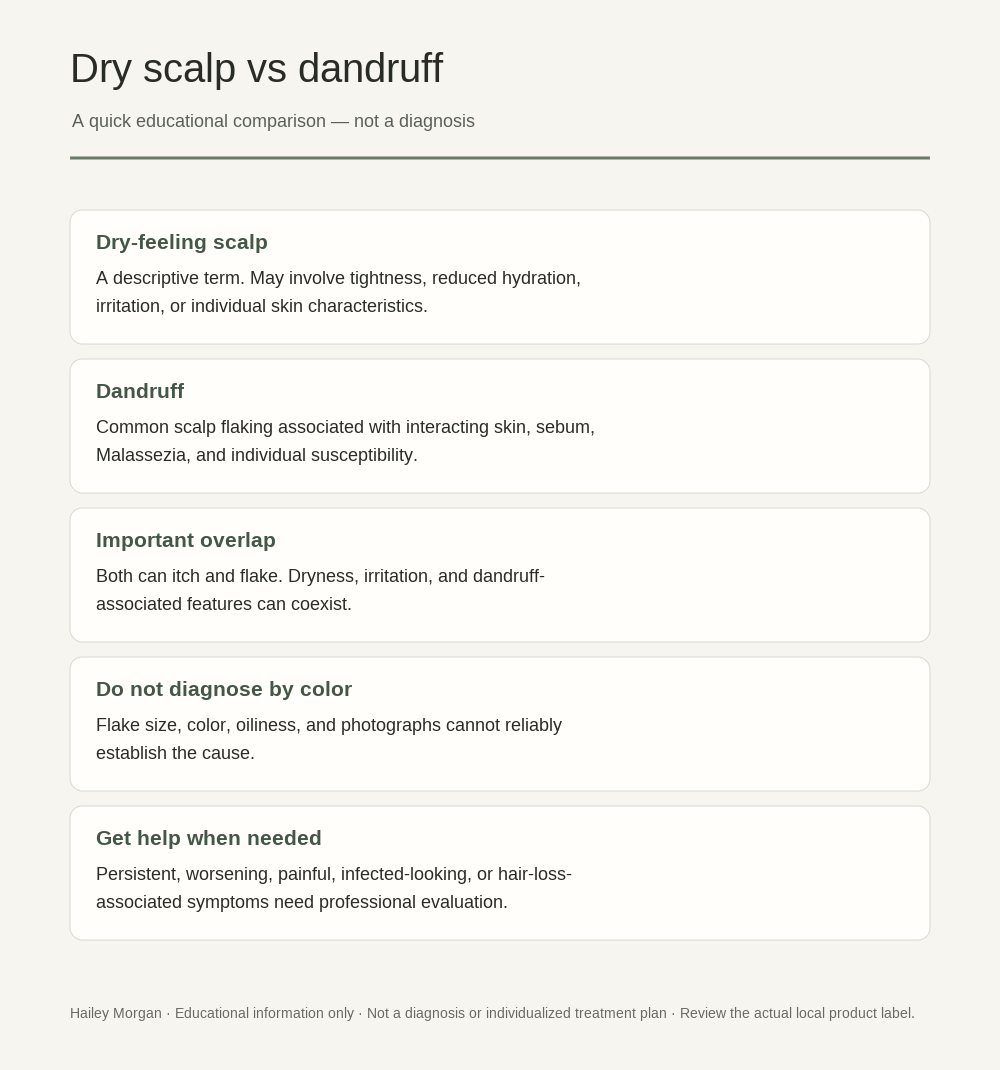
Scalp anatomy and barrier reference
A simplified explanation of epidermis, corneocytes, lipids, hydration, and water loss.
Download printable SVG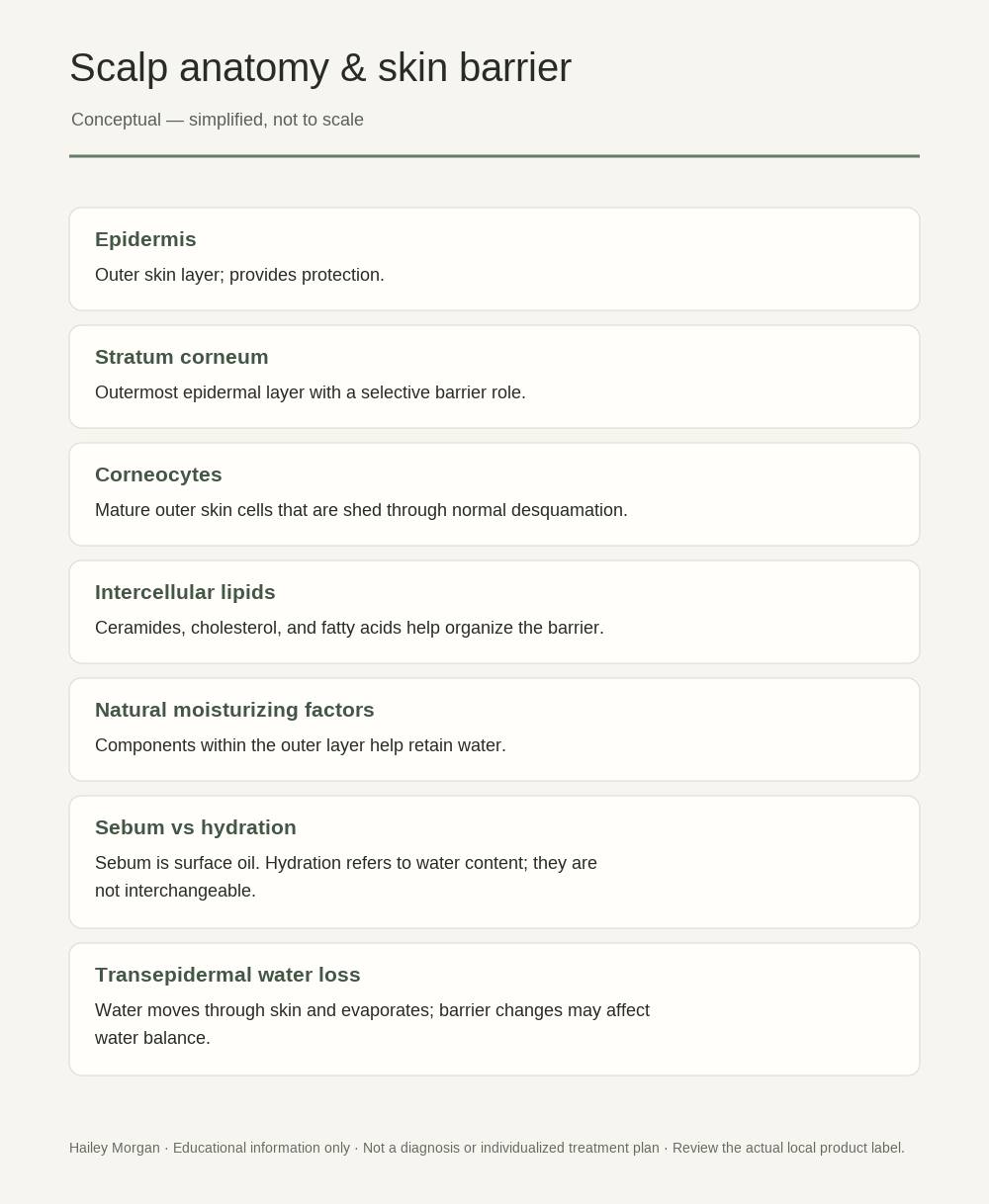
Scalp-flaking observation guide
Eight non-diagnostic observations and safety-first next steps.
Download printable SVG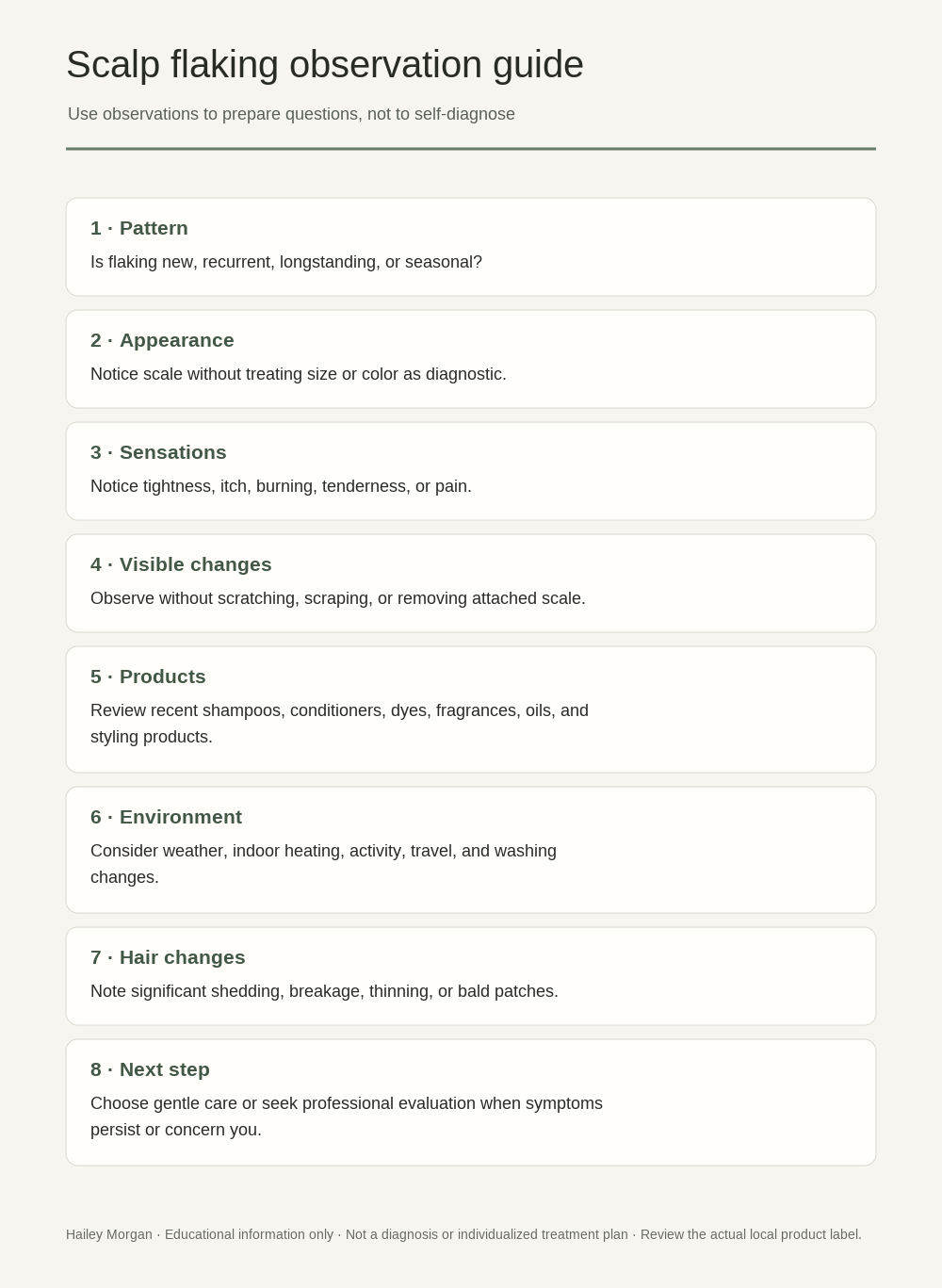
Anti-dandruff ingredient reference
Different ingredient functions, label instructions, and jurisdiction-specific limits.
Download printable SVG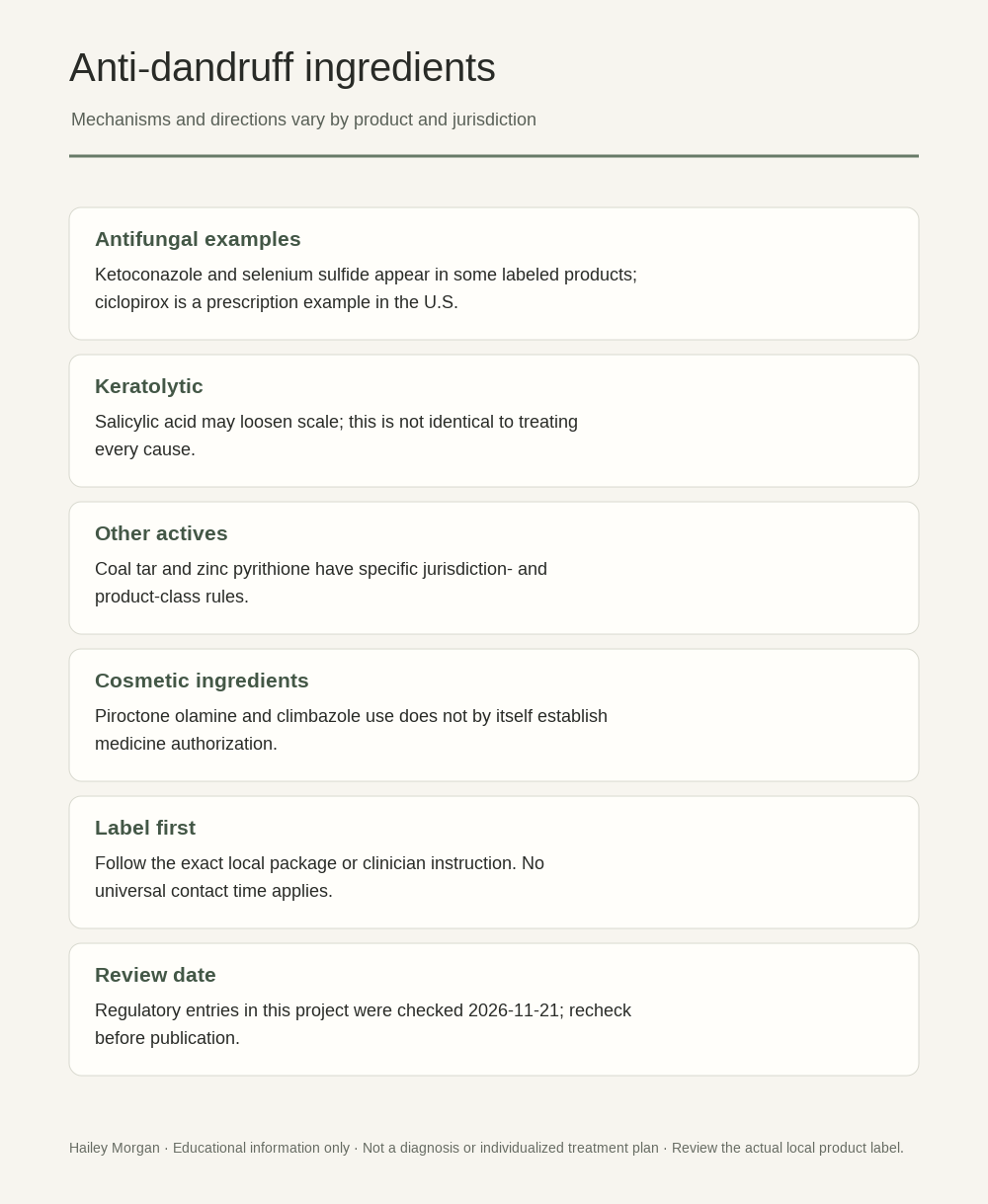
Scalp moisturizing ingredient guide
Humectants, barrier lipids, soothing ingredients, emollients, and formulation limits.
Download printable SVG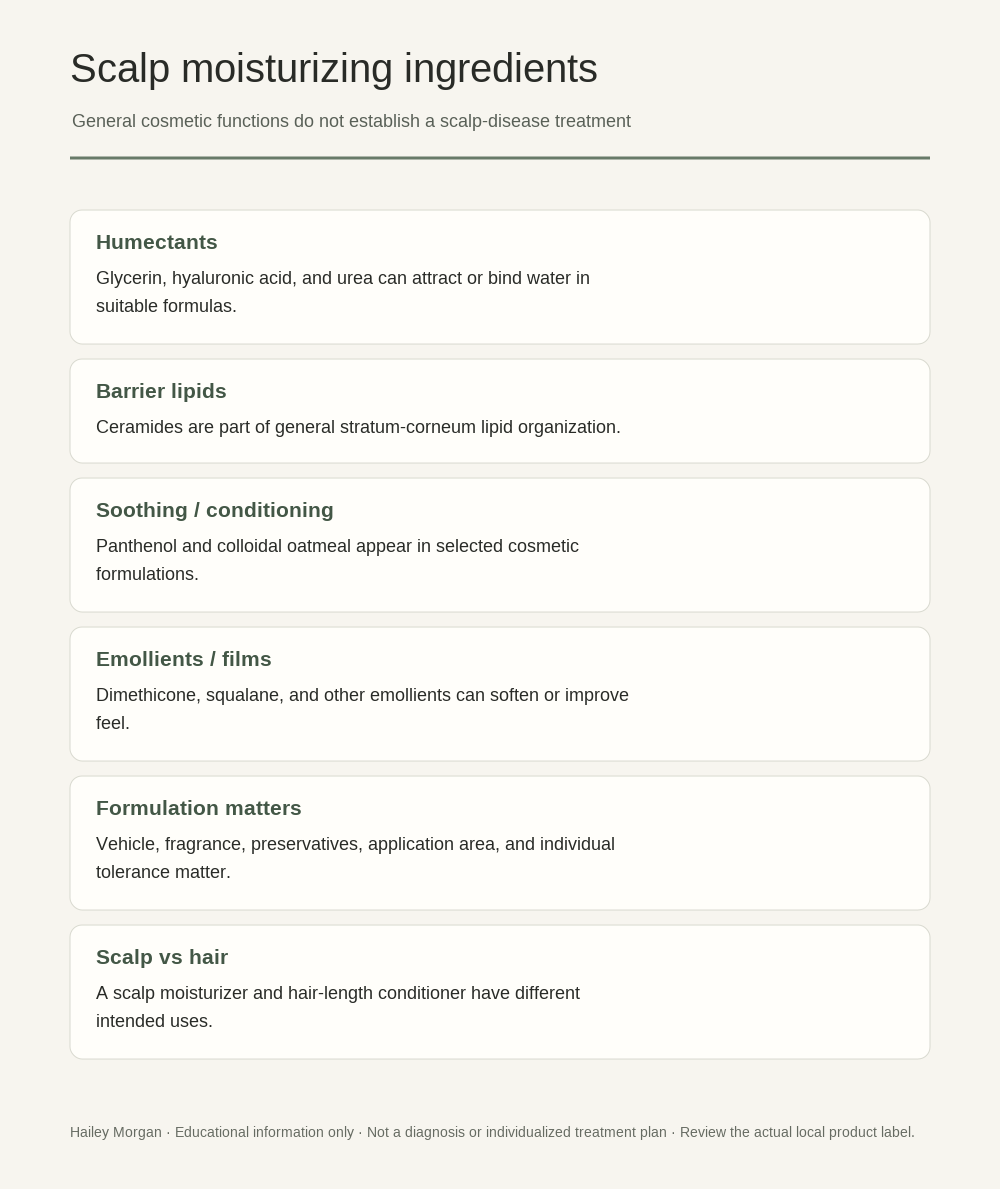
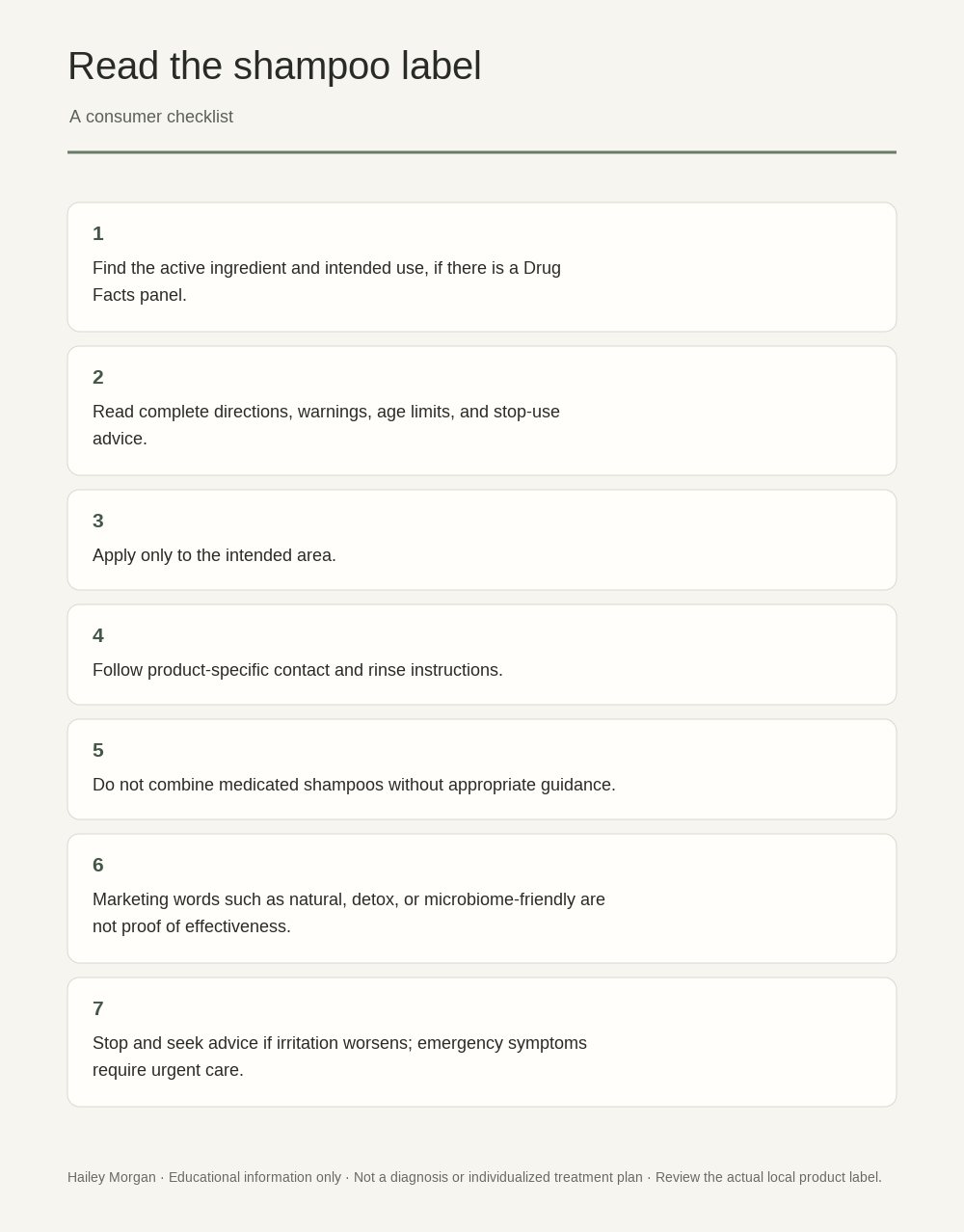
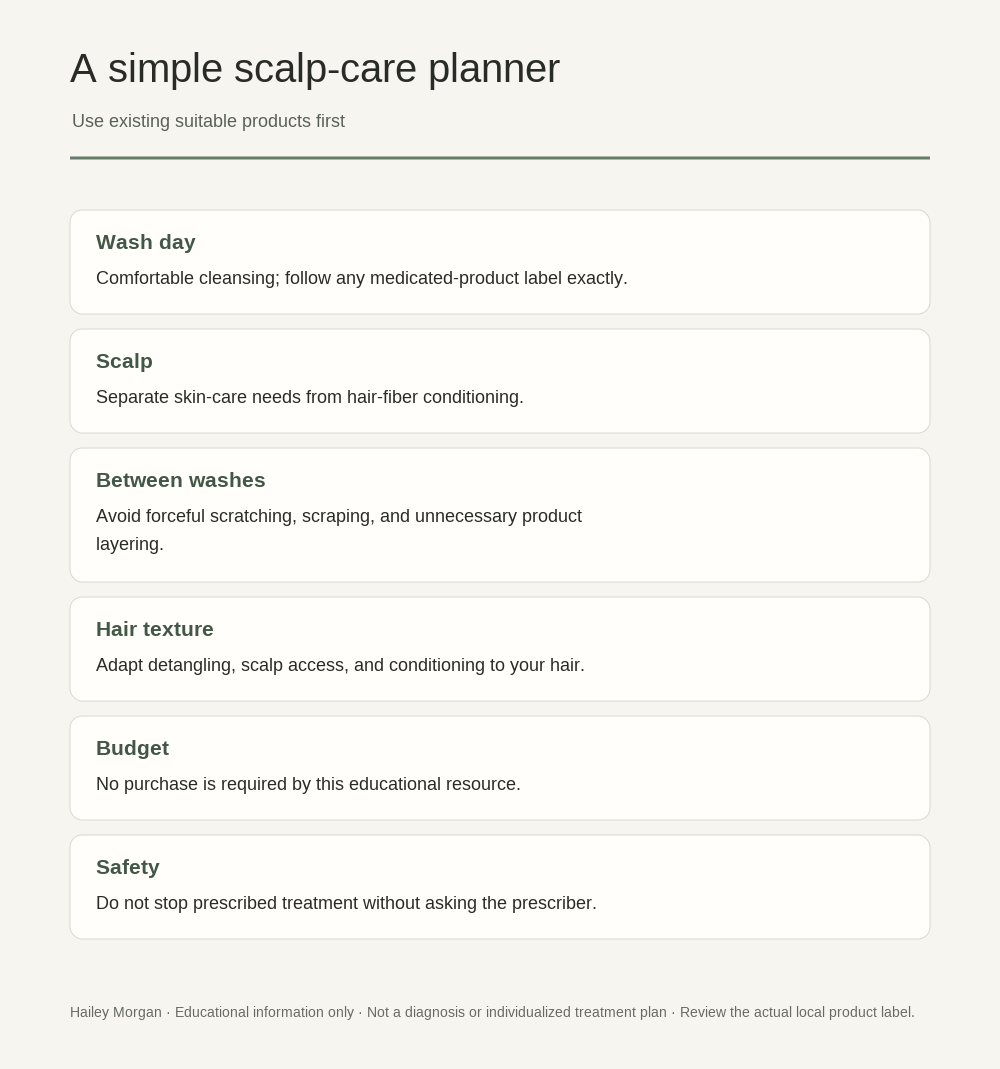
Fifteen gentle scalp-care habits
Low-risk considerations without a guaranteed-treatment claim.
Download printable SVG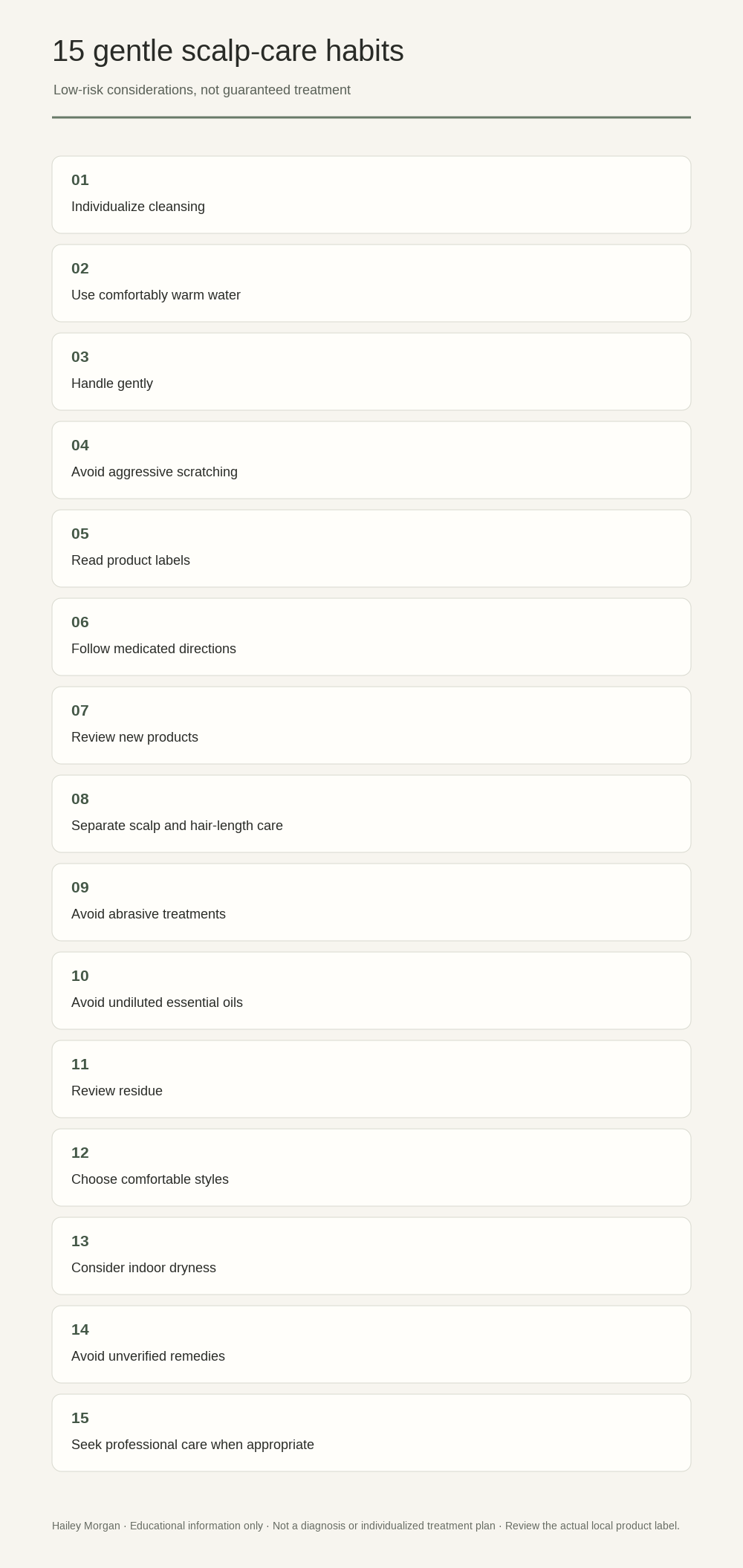
Seven-day gentle review
A non-cure review framework; warning signs override the timeline.
Download printable SVG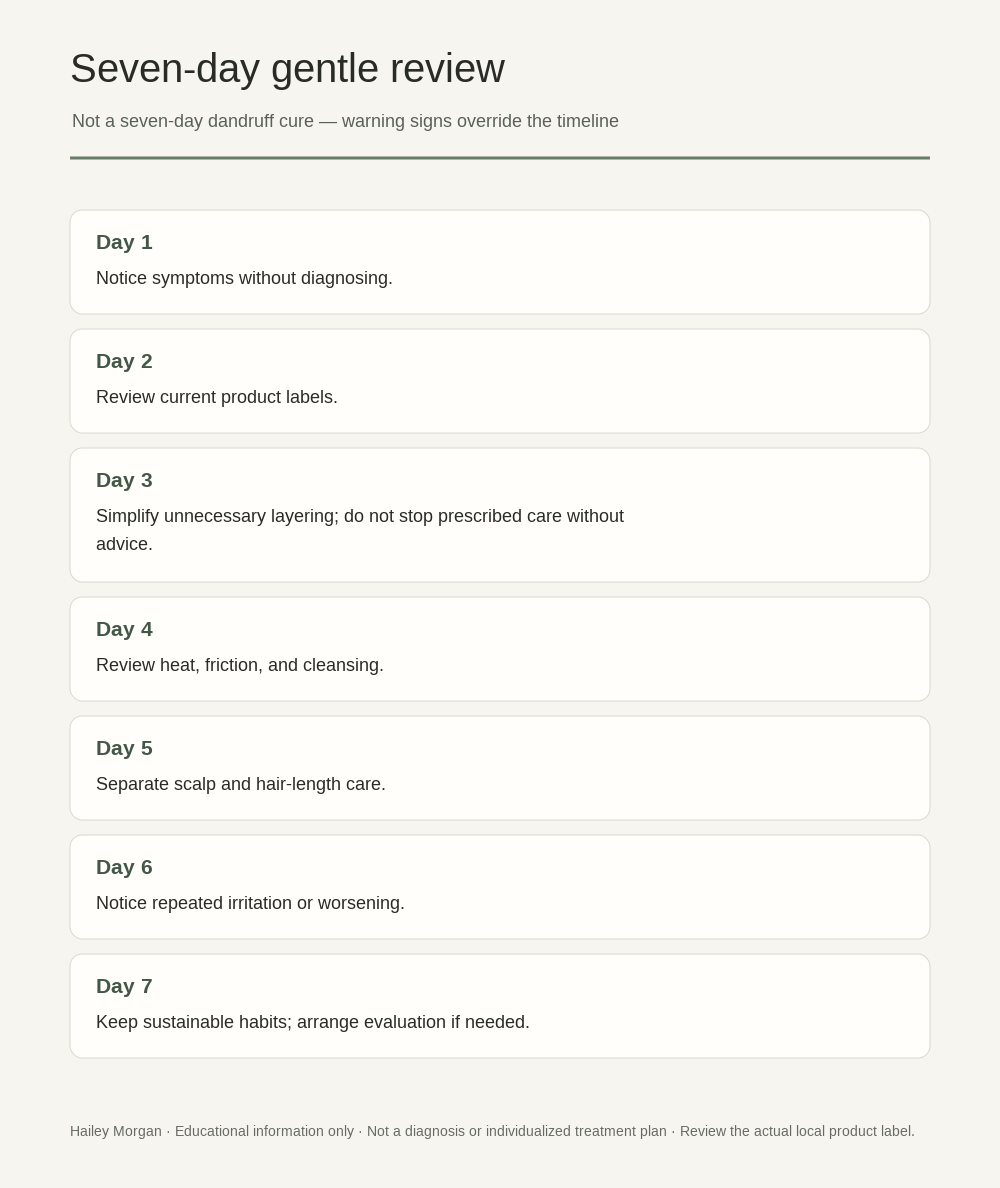
Optional 30-day observation
A brief worksheet that should not delay appropriate assessment.
Download printable SVG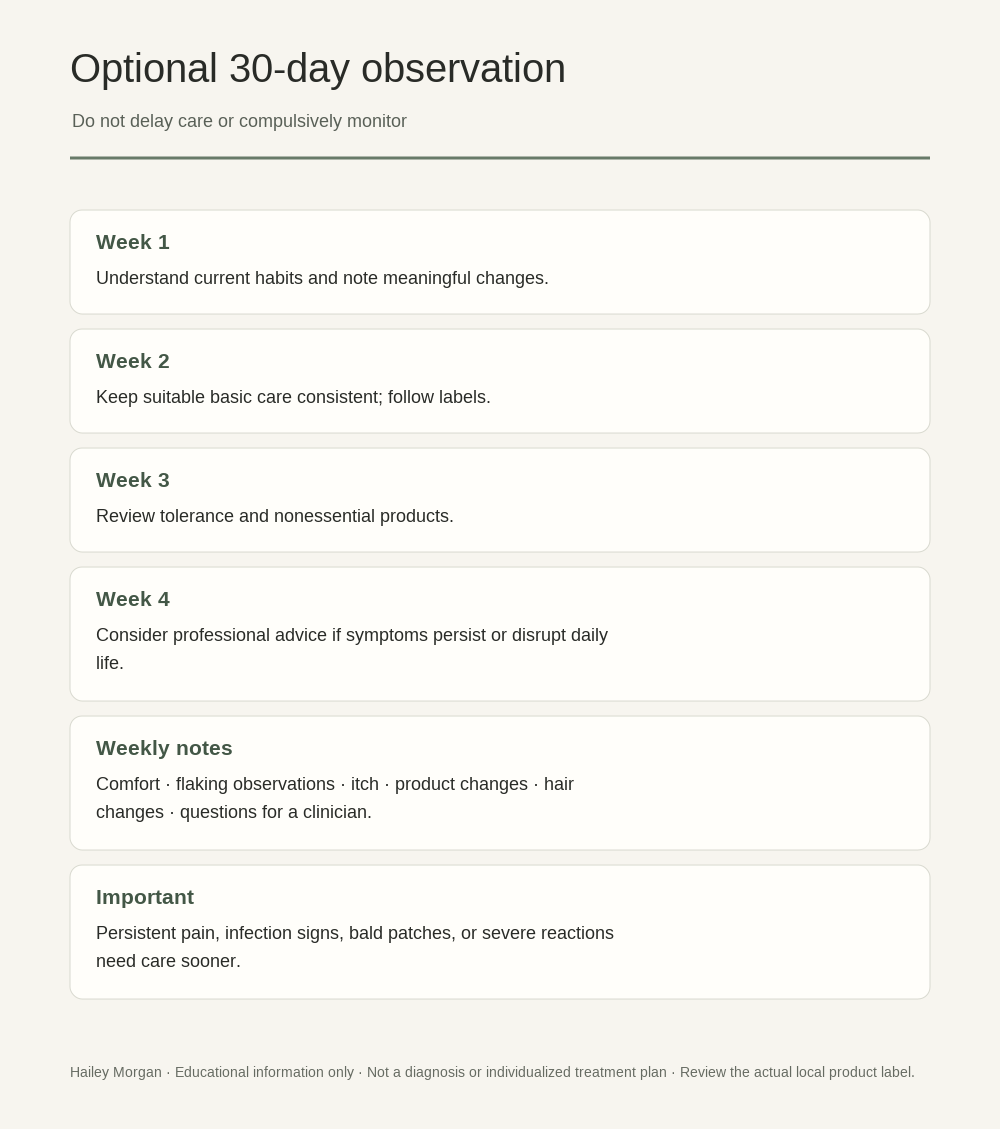
Appointment preparation checklist
Notes and questions to discuss with a clinician.
Download printable SVG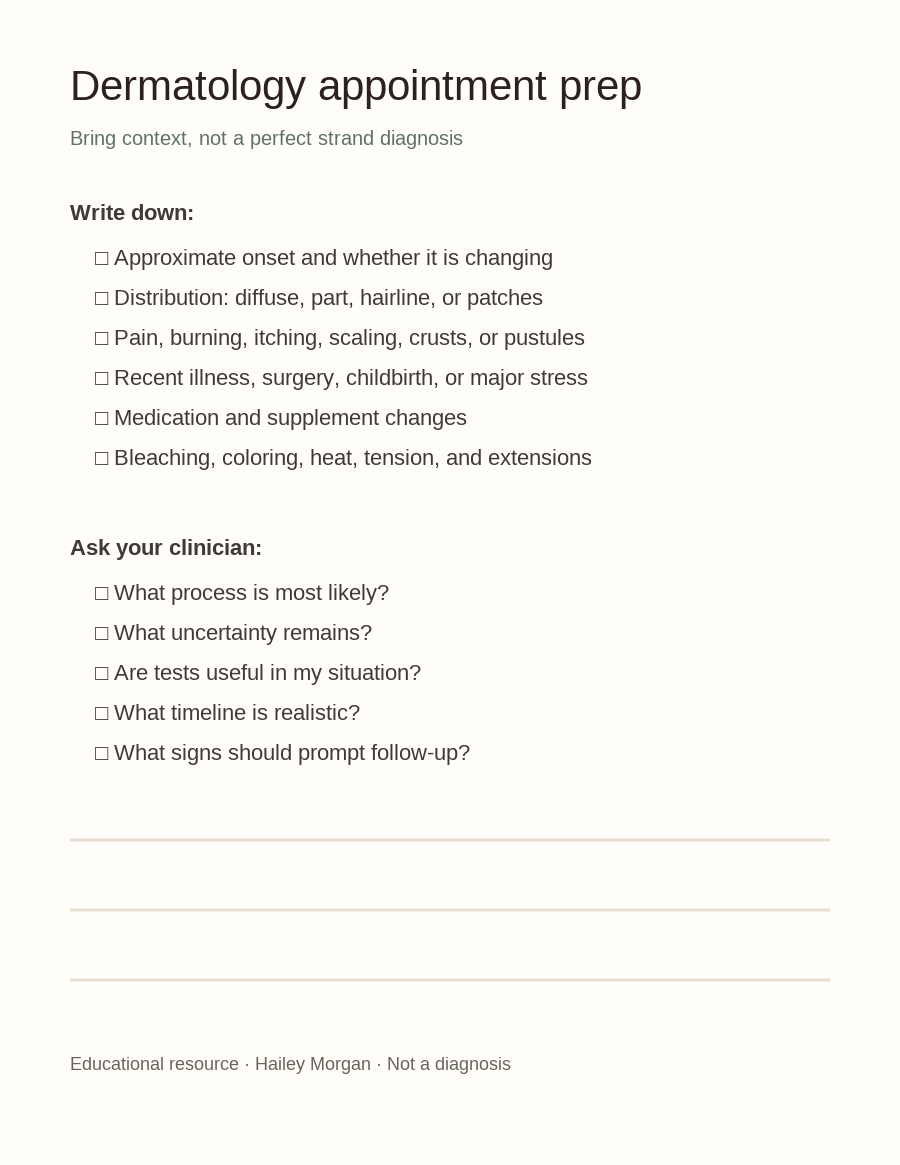
Scalp-care warning signs
When to arrange evaluation, prompt assessment, or emergency care.
Download printable SVG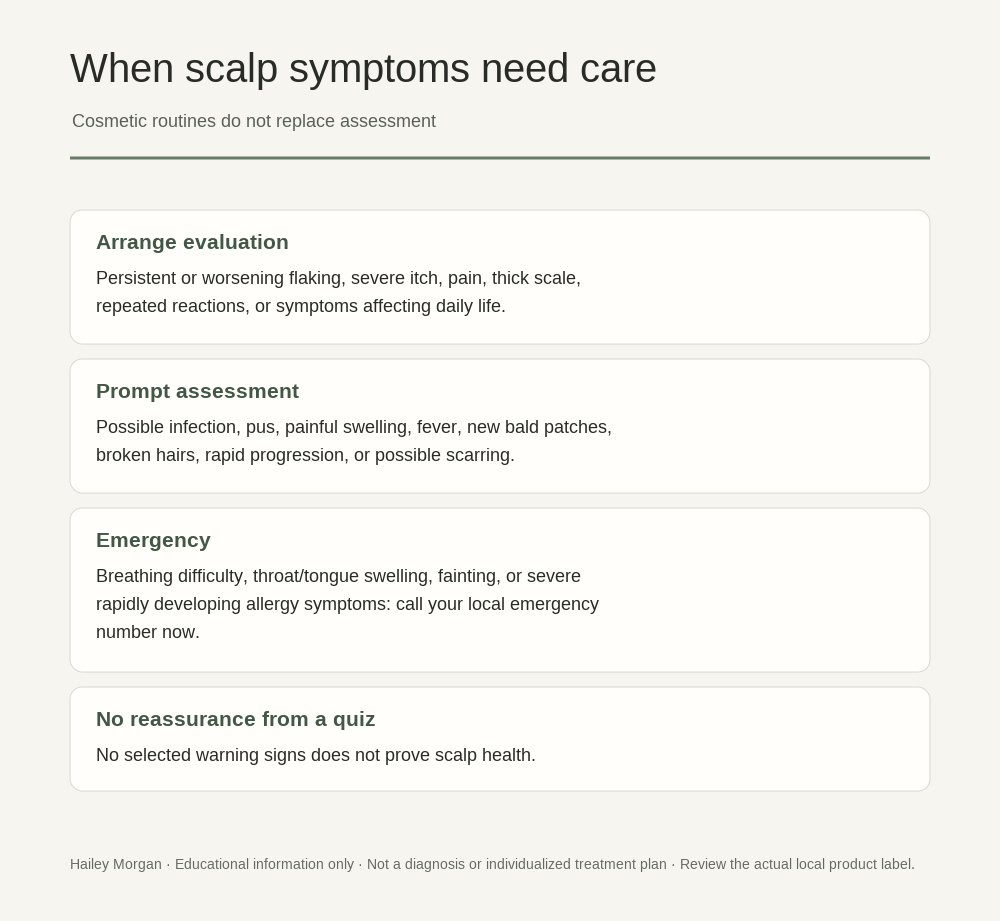
Scalp-care myths vs facts
A quick educational reminder; the article includes the complete myth list.
Download printable SVG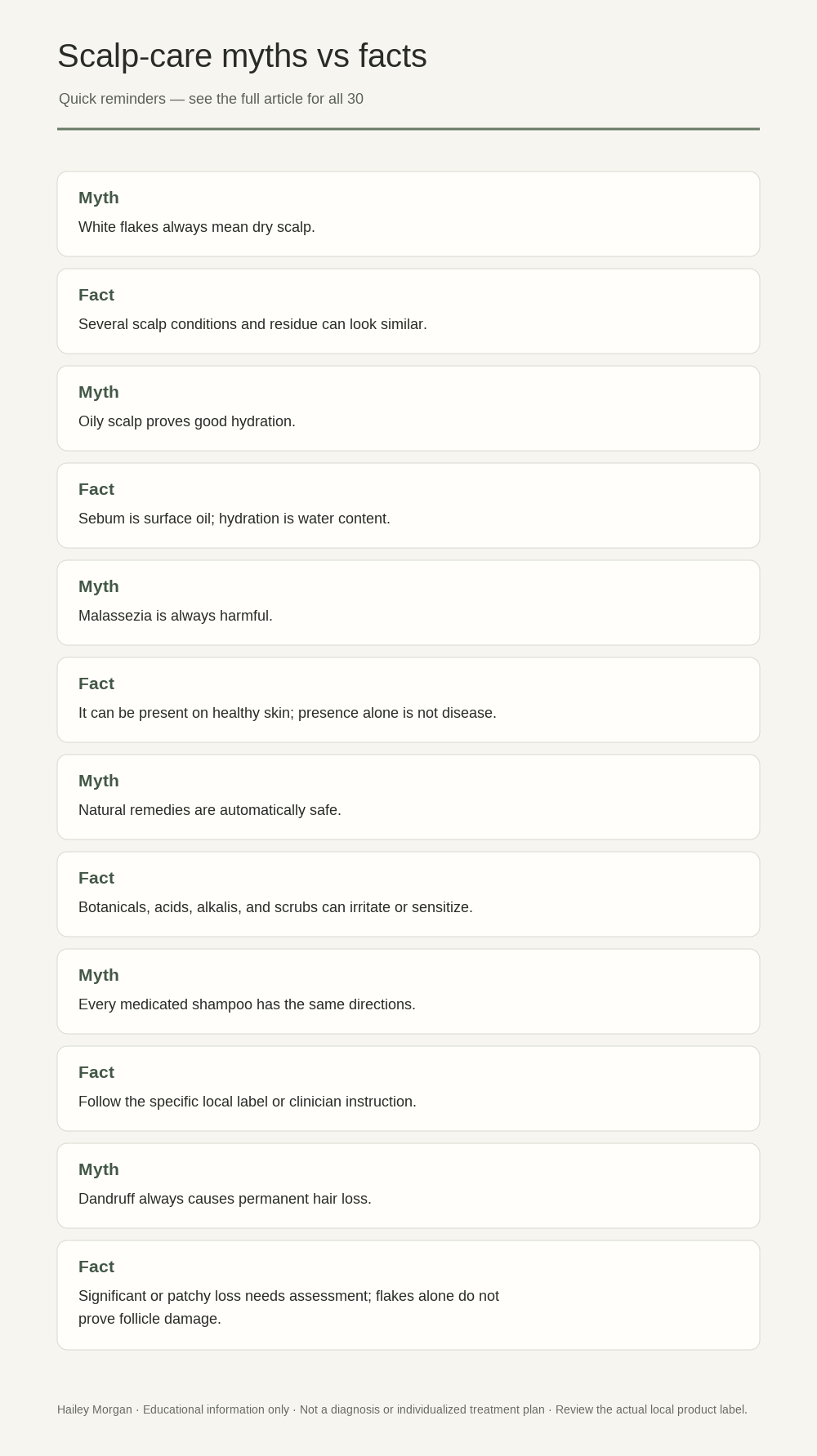
SCALP CARE & DANDRUFF MANAGEMENT
Recommended Medicated Shampoos & Scalp Massagers
As an Amazon Associate I earn from qualifying purchases. Formulated ketoconazole cleansers, gentle scalp tonics, and silicone exfoliators to restore comfort and address flake causes.
Nizoral Anti-Dandruff Shampoo with 1% Ketoconazole
Anti-dandruff ketoconazole shampoo
Vanicream Free & Clear Medicated Anti-Dandruff Shampoo
Gentle fragrance-free medicated shampoo
HEETA Hair Scalp Massager Soft Silicone Shampoo Brush
Soft silicone scalp massager brush
The Ordinary Natural Moisturizing Factors + HA for Scalp
Hydrating scalp barrier serum
Paul Mitchell Tea Tree Special Scalp Treatment Mask
Soothing tea tree scalp treatment
dpHUE Apple Cider Vinegar Hair & Scalp Rinse
Apple cider vinegar clarifying rinse
Final takeaway
Dry-feeling scalp and dandruff are not identical, but both can involve itch and visible flakes. Surface oil is not the same as skin hydration; Malassezia can live on healthy skin; and color or size cannot diagnose the cause. Gentle, label-aligned care can be useful, but persistent, painful, infected-looking, or hair-loss-associated symptoms deserve professional attention. Understanding the possible process is more useful than simply trying to remove every flake.